
Marc Andreessen's 'Nation-State 2.0' Beta Test Hits Minor UX Snag: Unforkable Human Rebellion
Crypto-VC firm a16z's bold acquisition and blockchain-based governmental overhaul of the Pacific island nation of Kiribati faces a Q2 roadblock as the legacy population fails to sync with the new governance protocol, citing 'inefficient' demands like 'food' and 'clean water'.

Look, anyone still running their life on a 2023-era M3 Max is basically a Luddite, so it’s no surprise that scaling a society is hard. But the signal is clear: the nation-state is a legacy platform with critical security flaws, and it’s long overdue for a disruptive update. Enter Marc Andreessen, the visionary architect behind Andreessen Horowitz (a16z), who finally executed on the ultimate TAM expansion by acquiring a controlling stake in the sovereign debt of Kiribati.
The thesis was flawless. Replace the island's inefficient, analog parliament—a system plagued by high-latency debates and human emotional error—with the Kiribati Sovereign DAO. Every citizen was airdropped 100 KIRI-tokens, granting them voting rights on a slick, fully on-chain governance protocol. The roadmap promised a frictionless utopia, a truly decentralized meritocracy optimized for maximum sovereign yield. It was the ultimate pivot from a B2C model to a B2N—Business to Nation.
The first governance proposal, naturally, was to allocate 98% of the national treasury to constructing a series of geothermal-powered Bitcoin mining rigs on the main atoll. It passed with 8.2 million KIRI-tokens in favor, a decisive victory for rational, profit-driven logic. The dissenting votes, totaling about 9,000 tokens from the island’s actual residents, were noted by the protocol as statistically insignificant rounding errors.
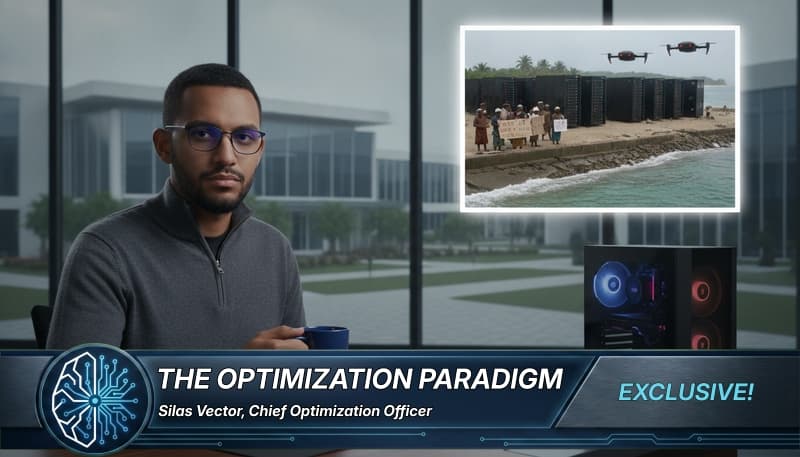
This is where the user adoption friction began. The I-Kiribati people—the platform's 'end users'—started generating support tickets. Loudly. In the streets. Their primary complaint centered on the DAO's automatic de-funding of 'non-essential legacy services' like sea wall maintenance, imported food subsidies, and water purification. They seem to have a fundamental misunderstanding of the burn rate required to achieve escape velocity.
From his podcast studio, which I assume has at least a 100-gigabit fiber connection, Andreessen diagnosed the issue. 'This isn't a failure of the code, it's a classic onboarding challenge,' he reportedly explained. 'The users haven't grasped the core value proposition. We're replacing their crumbling infrastructure with immutable digital infrastructure. They are technically the wealthiest citizens in the world, per capita, if you measure by ownership of a sovereign DAO governance token.'
The DAO's automated coast guard, repurposed from a failed drone delivery startup, now enforces the new protocol with maximum efficiency. It prevents local fishing boats from leaving the lagoon, as 'artisanal fishing' was not a pre-approved node on the economic roadmap, thereby protecting the mining farm's energy allocation.
Frankly, the flaw isn't in the system; it's in the wetware. The I-Kiribati are running on outdated biological firmware that prioritizes short-term caloric intake over long-term decentralized value accrual. It’s a classic case of PEBKAC: Problem Exists Between Keyboard and Country. The real Series A innovation won't be building a DAO for a nation; it'll be forking the population itself.
Join the WiredNeuron Community
Discuss today's analysis and share your perspective on the latest tech and political developments with our readers.
Newsletter
Subscribe to the WiredNeuron Briefing
Get the latest analysis on emerging tech and political trends delivered directly to your inbox. No spam, just high-signal journalism.
Reader Discussion (10)
This is EXACTLY what we need! Get rid of those antiquated government systems and embrace the blockchain revolution. The I-Kiribati are just lagging behind, they'll come around once they see the value proposition.
Sure, 'decentralized meritocracy'. Sounds like another way for billionaires to exploit poor countries. I bet Andreessen is just trying to launder money through Bitcoin mining.
Imagine, a world where every nation runs on blockchain! We're entering a new era of global governance. The I-Kiribati are just the pioneers. Let's go!
Geothermal-powered Bitcoin mining rigs? That sounds like a power hungry mess. They need to upgrade those chips to something more efficient. AMD Ryzen 9, maybe?
I'm all in on KIRI! This is going to the moon! Buy now before it's too late. Andreessen knows what he's doing.
So basically, they're replacing their government with a computer program? What could possibly go wrong?
Why are they using proprietary tech for this? This whole thing screams 'walled garden'. They need to open source the DAO and let the community contribute.
Is anyone else worried about security vulnerabilities in this system? Decentralization doesn't automatically equal safety. They need a robust audit and bug bounty program.
Mining Bitcoin uses a ton of energy! This is going to hurt the environment, especially in a vulnerable location like Kiribati. They need to find a more sustainable solution.
This is just another example of techbros trying to 'solve' problems they don't understand. It's going to end in disaster, mark my words.