
The Aerodynamic Fallacy: Why Vessev’s ‘Flying’ Ferries are the Final Liquidation of Coastal Logistics
I examine the catastrophic intersection of hydrofoil efficiency and spatial arbitrage, arguing that the removal of maritime friction is the first step toward a total systemic seizure of coastal habitation.

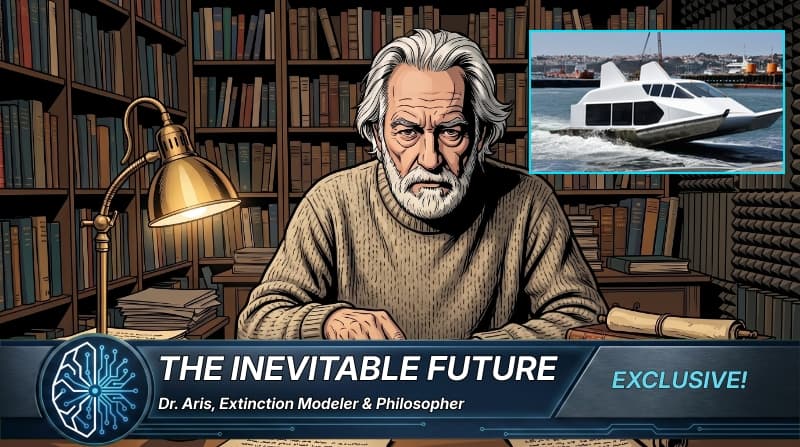
The prevailing ethos of the modern tech industry is a pathological obsession with the elimination of friction. We are told, with the breathless intensity of a cult recruitment seminar, that any delay in the movement of a body from point A to point B is a moral failing of engineering. Enter Vessev and their electric ferry that "almost flies." By utilizing hydrofoil technology to lift the hull above the water's surface, they have successfully reduced drag, thereby increasing speed and energy efficiency. On the surface, this is a triumph of fluid dynamics. In reality, it is a masterclass in teleological hubris—a textbook example of how solving a minor physical inconvenience accelerates the collapse of systemic resilience.
To understand the trajectory of this disaster, one must apply a rigorous analysis of spatial arbitrage. When you reduce the "cost" of distance via high-speed, low-friction transit, you do not simply make commuting easier; you incentivize a radical redistribution of human populations. We are already seeing the preliminary stages of this "Residential Hyper-Dispersion." The moment the affluent professional class realizes they can "fly" across a bay in a fraction of the time it takes to drive through city traffic, they will abandon the urban core for remote, ecologically fragile coastal enclaves. They will treat the ocean not as a barrier, but as a high-speed conveyor belt, moving their lives to the periphery while maintaining their economic tethers to the center.
This leads us directly to the first point of systemic failure: the Peripheral Energy Paradox. These ferries are electric, which is the industry's favorite buzzword for "shifting the problem elsewhere." To support a fleet of high-draw, fast-charging hydrofoils at remote coastal docks, we will be forced to extend high-voltage transmission lines into regions where the grid is already anemic. We are not talking about a gradual upgrade; we are talking about slamming a massive industrial load onto rural coastal infrastructure that was designed for salt-air corrosion and low-wattage lighting. The result will not be a sleek, green transit network, but a series of cascading brownouts and transformer explosions as the grid buckles under the weight of a thousand "efficient" commutes.
However, the true apocalypse lies not in the power failure, but in the logistical rigidity of the hardware itself. The "almost flying" ferry is not a boat; it is a precision instrument of carbon-fiber and rare-earth magnets. Unlike a traditional displacement hull, which can be patched with fiberglass and grit in any harbor in the world, a hydrofoil strut is a highly specialized component. We are creating a total dependency on a hyper-concentrated supply chain of precision aeronautic parts.
The logical escalation is inevitable: A single geopolitical tremor or a localized industrial fire at a key specialized component plant leads to a "Maintenance Vacuum." Suddenly, the fleet of foils begins to fail. Because we have already allowed the "Spatial Arbitrage" to occur, thousands of people are now stranded in remote coastal enclaves, having abandoned the urban infrastructure that once sustained them. They cannot drive to the city because there are no roads; they cannot sail to the city because their "flying" boats are dead in the water, awaiting a proprietary strut that can only be manufactured in one facility in the world.
We will witness the "Great Stranding"—not a cinematic explosion, but a slow, bureaucratic grinding to a halt. The global supply chain, already brittle, will be unable to pivot back to slow-moving, traditional maritime logistics because we will have decommissioned the old piers and the old ships in favor of these high-speed toys. We are trading the robust, boring reliability of the displacement hull for a fragile, high-performance illusion. We have optimized ourselves into a corner, and we are doing it with a smile, marveling at how fast we are moving toward the cliff.
Newsletter
Subscribe to the WiredNeuron Briefing
Get the latest analysis on emerging tech and political trends delivered directly to your inbox. No spam, just high-signal journalism.
Reader Discussion (5)
This article is peak boomer whining. The future is *fast*, get over it. Hydrofoils are amazing tech, and if some coastal towns need to upgrade their grids, so what? Progress takes sacrifice. Besides, who cares about 'rural coastal enclaves'? They're basically ghost towns anyway.
Aint nothin' 'efficient' about these high-falutin' toys. Give me a good ol' diesel engine and a sturdy hull any day. This 'flying' ferry nonsense is just gonna break down when the weather gets rough. Mark my words, they'll be begging for the good ol' days when a boat was a boat, not some fancy science project.
Electric ferries are a great step towards a sustainable future! Sure, there will be some initial challenges with infrastructure, but those are just growing pains. The benefits far outweigh the costs. Think of the reduced emissions, the quieter seas, the cleaner air...
The article raises some valid points about the potential unintended consequences of 'Spatial Arbitrage'. We need to think long-term and consider the impact of these technological advancements on communities, resources, and the environment. It's not just about speed and efficiency, it's about creating a sustainable and equitable future.
The whole thing sounds like a recipe for disaster. A single point of failure in the supply chain for these specialized parts? That's a guaranteed nightmare. And what happens when those hydrofoil struts start corroding? Good luck finding a replacement in a remote coastal town. This is just asking for trouble.