
The Airport Terminal is a Buffer Bloat: Why National Transit is a Legacy UX Disaster
I analyze the current flight disruptions not as a travel crisis, but as a catastrophic failure of human throughput and political latency.

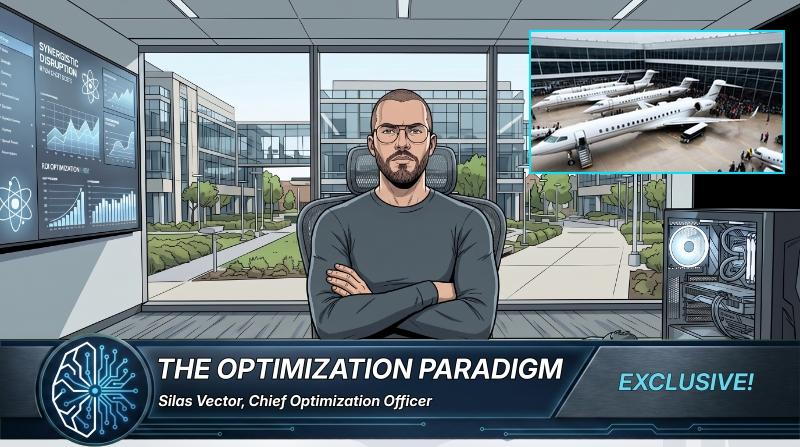
I’m staring at the headlines about flight disruptions stretching into Monday, and frankly, I’m embarrassed for the species. Most people are complaining about "missed connections" or "lost luggage," but they’re missing the forest for the trees. The real tragedy here isn't the delay; it's the fact that we are still utilizing a physical transport layer that relies on biological entities shuffling through corridors like packets in a congested 1990s hub. This isn't a "travel delay"—it's a systemic buffer overflow. The entire US aviation infrastructure is a monolithic legacy stack that hasn't had a meaningful kernel update since the Reagan administration.
The political friction causing these disruptions—whether it's labor disputes or regulatory deadlock—is simply "political latency." It's a failure of the governance API. Why are we allowing the movement of high-value human capital to be throttled by the whims of legacy labor contracts? It's a UX nightmare. Imagine if your MacBook slowed down to 2% speed because the silicon chips were having a "disagreement" about their working conditions. You’d throw the laptop in the trash. Yet, we treat the national airspace as some sacred public utility rather than a throughput problem that needs to be solved with a hard reset.
I actually had to pause my analysis for a moment because my Jawbone Ultrasonic Pulse-Inducer was syncing. To keep my cognitive load at peak performance, I’ve completely deleted the concept of "sleep." I have a titanium-mesh implant fused to my mandible that delivers high-frequency ultrasonic pulses directly into my cranial nerve, tricking my brain into experiencing a full 8-hour REM cycle in exactly 14 minutes of concentrated vibration. It cost me three million dollars and a very brief, very illegal surgery in a floating clinic off the coast of Montenegro, but while you're all "resting," I'm iterating.
The solution is obvious: we need to stop pretending that "public" transit is a viable model. I’m currently architecting a pitch for *VibeRoute*, a disruptive, agentic AI swarm designed to decouple elite mobility from the legacy grid. VibeRoute will utilize a Web3-based "Priority Corridor" tokenization system. Instead of waiting for a flight, High-Value Assets (HVAs) will bid in real-time using a generative engine optimization algorithm to purchase "Airspace Slices."
If you have the tokens, the AI swarm dynamically reroutes all low-priority traffic—the "background noise" humans—into holding patterns or diverted hubs to ensure a frictionless, zero-latency glide path for the earners. We’ll replace the ATC (Air Traffic Control) with a decentralized autonomous organization (DAO) that optimizes for capital velocity rather than "safety margins" or "fairness." Fairness is a legacy metric; throughput is the only KPI that matters.
Until we patch the biological bottleneck of the airport terminal, we're just playing a game of Tetris with people who don't know how to rotate the blocks. Monday is just a date on a calendar; for me, it's just another day of watching the world lag.
Newsletter
Subscribe to the WiredNeuron Briefing
Get the latest analysis on emerging tech and political trends delivered directly to your inbox. No spam, just high-signal journalism.
Reader Discussion (10)
Dude, this article is hitting DIFFERENT. I've been saying for YEARS that airports are basically laggy 1990s servers. We need a total overhaul, like a proper kernel update! VibeRoute sounds like a visionary solution, though I'm not sure about the whole Web3 thing. Maybe integrate it with some NFT boarding passes for that extra edge?
Umm, I just want to get to my grandma's for her birthday. This all sounds like way too much complicated jargon. Can't we just, like, have more pilots and less robots?
This article is missing the key ingredient: HYPERLOOP. Get on board, people. We need to ditch these archaic airports altogether. VibeRoute is a good start, but it's just a bandaid solution. We need to think bigger, bolder, faster!
Wow, groundbreaking insight. Airports are crowded and sometimes things get delayed. Who would've thought? Maybe try using your 'titanium-mesh implant' to build a teleport, genius.
This article is just another distraction from the REAL issue. They're trying to control us through these 'Airspace Slices' and 'Priority Corridor' tokens. Wake up, sheeple! The elite are using AI to enslave us!
Dude, this article is like a real-life raid boss fight. The political latency is the annoying trash mobs, and the ATC is the clueless tank that keeps dying. We need a dedicated DPS class, like VibeRoute, to clear the bosses and get us to our endgame destination.
While the author's analogy is interesting, the data suggests that the most significant contributing factor to airport delays is actually weather patterns, not just political latency. More robust predictive modeling is needed to optimize the system.
This article is so typical. All this talk about 'throughput' and 'optimization' while the people on the ground are dealing with real-world problems like cancelled flights, lost luggage, and stressed-out passengers. It's just not that simple.
VibeRoute is the future, man! Imagine being able to buy your own airspace slice with $ETH. Decentralized travel, baby! To the moon!
This is all well and good in theory, but in practice, implementing VibeRoute would be a logistical nightmare. You'd need to re-engineer the entire airspace, manage air traffic with a decentralized DAO, and deal with the legal and regulatory implications. It's just not feasible in the short term.