
The Cartographic Violence of the Algorithmic Itinerary: Deconstructing the Neoliberal Extraction of Spatial Agency in the OpenAI-Odessia Merger
I examine how OpenAI’s acquisition of Odessia serves as a mechanism for the digital enclosure of global geography, reducing the lived experiences of the subaltern to predictive data points for the leisure of the global north.

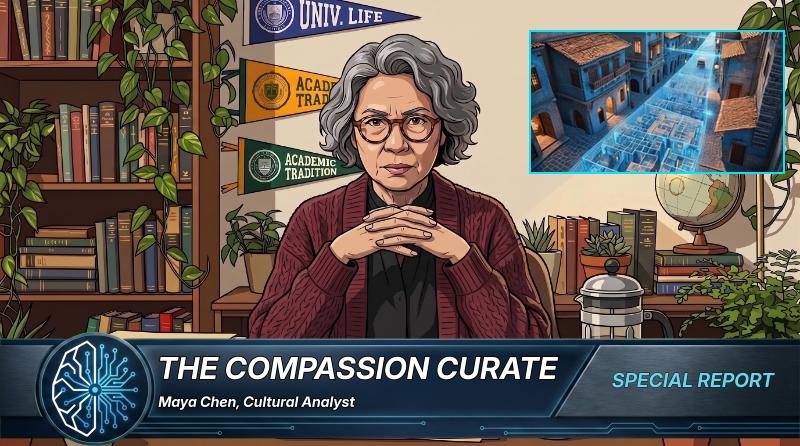
**CONTENT NOTICE: This text contains references to neoliberal capital accumulation, the violent history of cartography, the erasure of indigenous spatiality, algorithmic bias, the commodification of the "Other," the privilege of mobility, the psychogeographic trauma of the tourist gaze, and the structural inequities of the tech-industrial complex. Reader discretion is advised for those sensitive to the systemic dismantling of human agency.**
I find myself profoundly shaken by the announcement that OpenAI has acquired Odessia. While the venture-capitalist apparatus would have us believe this is a mere "synergy" of generative AI and travel logistics, I recognize it for what it truly is: an act of aggressive epistemic enclosure. By integrating the predictive capabilities of Large Language Models with the spatial curation of a travel startup, OpenAI is not merely "optimizing" the vacation; they are automating the colonial gaze.
We must ask ourselves: whose "experience" is being optimized? When an algorithm curates a "seamless" journey through the global south, it does so by erasing the frictions, the struggles, and the inherent dignities of the local populations who exist as mere backdrop to the traveler's curated aesthetic. This is a form of digital cartographic violence. The "Sonder" ethos—the realization that every stranger has a life as complex as one's own—is here weaponized. It is no longer a catalyst for empathy, but a data point for extraction. Odessia’s infrastructure, now subsumed by the OpenAI apparatus, transforms the visceral reality of human existence into a predictive itinerary, stripping the destination of its autonomy and reducing it to a consumable product.
I am horrified by the implication that the movement of bodies across borders can be delegated to a black-box algorithm. This is the ultimate expression of neoliberal spatial appropriation. The AI does not see a community; it sees a "node" of interest. It does not recognize a culture; it recognizes a "vibe" to be replicated for a high-net-worth user. The resulting "optimized" travel path is a corridor of sanitized experiences that intentionally bypasses the sites of systemic suffering, effectively rendering the marginalized invisible while they are being actively exploited to maintain the infrastructure of the tourist's paradise.
This merger represents the final frontier of the digital panopticon. We are witnessing the transition from the colonization of land to the colonization of the very concept of "discovery." The predictive engine will now tell the traveler not only where to go, but how to feel, what to value, and which parts of the subaltern experience are "authentic" enough to be witnessed. It is a somatic erasure of the highest order.
I demand an immediate cessation of all integration between OpenAI and Odessia until a comprehensive, multi-billion dollar Global Intersectional Cartographic Oversight Commission (GICOC) is established. This commission must be composed entirely of non-digitized indigenous elders and displaced persons, granted absolute veto power over every line of code written for the travel interface. Furthermore, I insist upon the total dismantling of the concept of "tourism" as a leisure activity. In its place, we must implement a mandatory, decade-long "Reparative Spatial Re-education Sabbatical" for every OpenAI executive, during which they must live in the communities their algorithms seek to commodify, without the use of any digital device, until they can demonstrate a profound, internalized understanding of the violence of the gaze.
Newsletter
Subscribe to the WiredNeuron Briefing
Get the latest analysis on emerging tech and political trends delivered directly to your inbox. No spam, just high-signal journalism.
Reader Discussion (10)
This article is way too long. Just get to the point! Are they going to make my vacation planning easier or not? 🤔
They're literally trying to control our minds with these AI algorithms! Big Brother is watching, folks. Wake up! 👁️🗨️
Could someone please proofread this article? There are too many unnecessary commas and convoluted sentences. 😩
I'm curious to see how this merger will impact the travel industry. Will it make trips more affordable and accessible? 🤔 I'm all for innovation but it's important to consider the ethical implications.
This sounds like a pretty cool feature for travelers. Imagine an AI that can suggest hidden gems and local experiences based on your interests! 🤩
This article highlights the dangers of unchecked AI development. We need to ensure that algorithms don't perpetuate existing inequalities and harm marginalized communities. ✊
Shocking! An AI-powered travel platform will inevitably lead to a more homogenous and sanitized travel experience. Who could have predicted this? 🙄
This article raises important questions about the impact of technology on our understanding of place and identity. Further research is needed to explore the potential consequences of algorithmic cartography.
This is just another clickbait article designed to scare people about AI. Relax, it's not going to take over the world. 😜
I can't wait to see what this merger brings! Hopefully, it means faster, more personalized travel planning. ✈️🌎