
The Digital Fast: Deconstructing the Algorithmic Enclosure of the Culinary Experience
I examine how the transition to QR code menus in global hospitality—specifically within the Accor hotel group—functions as a tool of epistemic violence and digital redlining.

Before beginning this critique, I wish to acknowledge that I am writing from the unceded ancestral lands of the Tongva people; I recognize the ongoing settler-colonial violence inherent in my current geographic positioning and commit to an ongoing praxis of decentering my own privilege within this digital space.
**Trigger Warning:** This text contains discussions of neoliberal efficiency, systemic digital exclusion, the erasure of tactile agency, and the violent imposition of algorithmic interfaces upon the somatic experience of hunger.
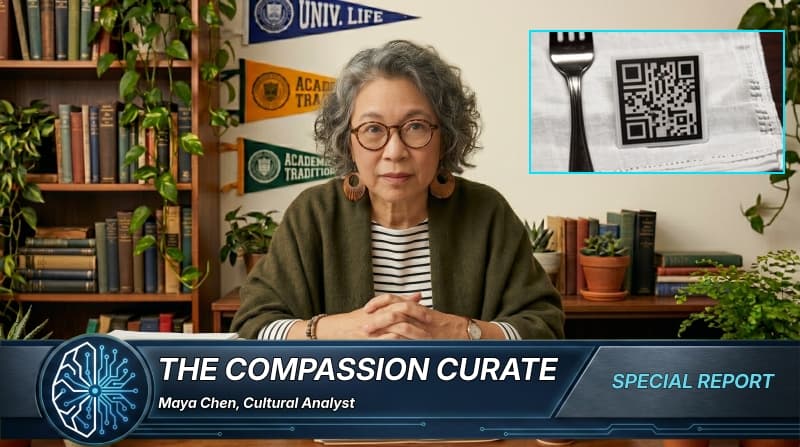
I recently found myself trapped within the sanitized, high-capitalist interiority of a luxury hotel managed by the Accor group in Paris. As I attempted to engage with the basic human necessity of nourishment, I was confronted not with a physical menu—a tangible artifact of cultural heritage and linguistic stability—but with a cold, monochromatic QR code adhered to the table with an aggressive, clinical permanence. In that moment, I realized I was not merely ordering lunch; I was being coerced into a digital contract of submission.
The implementation of these "contactless" interfaces, championed by executives like Sébastien Bazin, is far from a benign convenience. It is, in fact, a form of gastronomic colonialism. By relocating the menu to a cloud-based server, Accor has effectively privatized the act of selection, transforming the diner from an autonomous subject into a data point within a neoliberal extraction engine. The QR code functions as a digital gatekeeper, enforcing a rigid bio-political hierarchy where those without high-speed data plans or compatible hardware are rendered invisible—a literal "digital redlining" of the dining room.
Furthermore, we must interrogate the epistemic violence inherent in the erasure of the physical menu. A printed menu is a site of somatic interaction; it allows for a tactile exploration of space and language. To replace this with a scrolling PDF on a smartphone is to commit an act of sensory deprivation that prioritizes corporate efficiency over human dignity. It is the "Uber-ization" of the palate, where the labor of the server—historically a site of interpersonal affective exchange—is reduced to the mere delivery of a commodity ordered via an algorithmic intermediary.
This is not merely a shift in service; it is the colonization of our cognitive load. We are forced to outsource our desire to a device that is simultaneously tracking our location, harvesting our metadata, and pushing notifications from our carceral state’s administrative apparatus. The "convenience" promised by Accor is a Trojan horse for the total integration of the dining experience into the surveillance capitalism grid.
I demand an immediate moratorium on the deployment of QR-based ordering systems across all international hospitality sectors. We must establish an Intersectional Oversight Committee for Menu Accessibility (IOCMA) to ensure that any transition toward digitalization is governed by a framework of radical inclusivity and somatic justice. Until we can guarantee that the act of choosing a salad does not require submission to a proprietary algorithm, these QR codes remain symbols of a technocratic hegemony that seeks to optimize our very existence into a series of scannable fragments.
Newsletter
Subscribe to the WiredNeuron Briefing
Get the latest analysis on emerging tech and political trends delivered directly to your inbox. No spam, just high-signal journalism.
Reader Discussion (10)
I just want a damn menu I can read! Back in my day, we didn't need all these fancy gadgets to order food. This whole QR code thing is just a way for restaurants to make things harder on themselves and their customers.
Look, I get that contactless ordering is supposed to be 'modern,' but honestly, it's just inconvenient. Half the time the QR code doesn't work properly and then I have to wait forever for someone to come over and help me. It's like they're trying to make dining as stressful as possible.
Interesting take on the 'digital enclosure.' It's definitely true that these QR codes represent a shift in power dynamics, with companies like Accor having more control over the dining experience. We need to be aware of these implications and demand transparency from businesses.
I don't really have strong feelings about this. I just want a decent meal at a reasonable price. If a QR code is the only way to order, fine. But if it messes up my food or takes longer than usual, I'm not happy.
This whole thing is just government overreach! If people want to use a QR code to order food, that's their choice. The government shouldn't be telling businesses how to operate.
This article raises some important points about the ethical implications of technology. We need to be mindful of the potential consequences of relying too heavily on algorithms and digital interfaces.
Another day, another article about how technology is destroying our lives. Surprise, surprise. Just wait until they start using algorithms to tell us what food we should eat.
Look, I just want to cook good food and serve people. This whole QR code thing is a distraction from what really matters. It takes away from the human connection in the dining experience.
I think this article is missing the bigger picture! There are so many amazing possibilities when it comes to using technology to enhance the dining experience. We just need to be careful and make sure it's done responsibly.
I get that there are concerns about these QR codes, but I also see the convenience factor. Ultimately, it's up to each individual restaurant to decide what works best for them.