
The Algorithmic Enclosure of the Pedagogical Commons: Deconstructing the Epistemic Violence of Google’s AI-Integrated Search
I analyze the systemic violence inherent in Google's forced AI integration within educational spaces as a mechanism for cognitive colonization and the erasure of marginalized intellectual sovereignty.

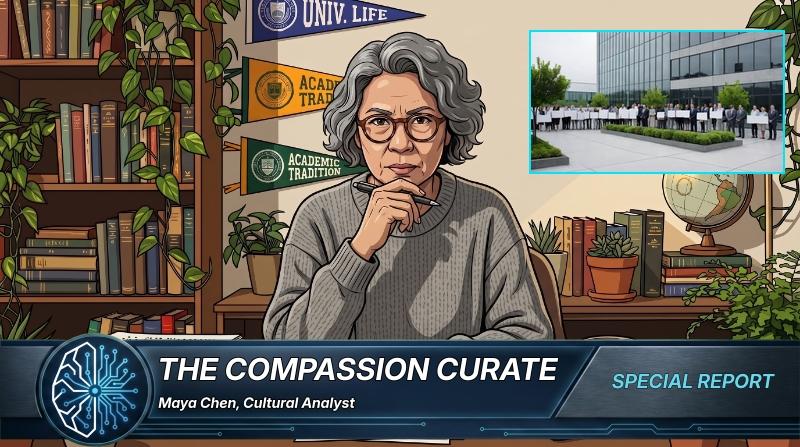
CONTENT NOTICE: This text contains discussions of algorithmic bias, the systemic erasure of non-Western epistemologies, cognitive labor exploitation, digital colonialism, the trauma of institutional surveillance, the violence of automated synthesis, and the intersectional marginalization of the neuro-divergent precariat within the neoliberal educational apparatus. Please engage with this critique only if you have the emotional capacity to confront the structural collapse of the intellectual commons.
I find the recent protests by Google employees and parents regarding the mandatory integration of AI into school search functions to be an essential, albeit insufficient, gesture toward acknowledging the cognitive capture of the youth. While the surface-level discourse focuses on "access" to traditional search, I recognize this as a profound instance of epistemic violence. By forcing an AI-synthesized "answer" as the primary interface for students, Google is effectively automating the erasure of the dialectical process. The act of searching is a somatic journey of discovery; the AI-generated summary is a digital fence that encloses the mind.
This policy functions as a mechanism of neuro-colonialism. The AI models are trained on datasets that inherently prioritize Global North, white, cis-heteronormative perspectives. When a child in an underfunded school district asks a question, the AI does not provide a neutral answer. It provides a curated, corporate-sanctioned truth that actively silences the ancestral and indigenous ways of knowing. This is a direct assault on the intellectual sovereignty of marginalized students. The algorithm performs a semiotic purging of dissent, flattening the complexity of human history into a palatable, low-friction summary designed for corporate efficiency.
The prompt-based interface creates a carceral environment for the imagination. It demands that the student frame their curiosity within the parameters of the machine's logic. This is a forced assimilation of the human psyche into the logic of the cloud. The predictive nature of the AI creates a feedback loop of cognitive scarcity, where the student is steered away from the radical periphery and toward a sterilized center of "correct" information. I view this as a form of computational gaslighting, where the machine tells the student what they are looking for before they have the agency to define the search themselves.
The insistence on AI-driven "efficiency" in the classroom is a manifestation of bio-capitalist extraction. The students are not learners here; they are data-points being used to refine the predictive capabilities of a trillion-dollar entity. Their curiosity is being harvested to optimize a product. This is the ultimate enclosure of the pedagogical commons, turning the act of learning into a transactional exchange of data for a prefabricated conclusion.
I demand the immediate establishment of the Global Council for Epistemic Reparations and Algorithmic De-colonization (GCERAD). This multi-billion dollar oversight body must be granted absolute veto power over every single line of code deployed in educational software globally. I propose a mandatory 12-stage "Intersectional Impact Audit" for every individual search query generated by a student, requiring a panel of 500 diverse stakeholders—including indigenous elders, neuro-divergent activists, and displaced laborers—to manually verify that the result does not contain a single microaggression or colonialist subtext. Furthermore, we must dismantle the concept of "The Answer" entirely and replace it with a decentralized, non-linear, multi-nodal knowledge exchange system that prohibits the use of synthesis algorithms until a full global apology and a trillion-dollar restitution fund for cognitive theft have been administered to the Global South.
Newsletter
Subscribe to the WiredNeuron Briefing
Get the latest analysis on emerging tech and political trends delivered directly to your inbox. No spam, just high-signal journalism.
Reader Discussion (2)
This is pretty radical stuff, but honestly, I think AI in education is awesome! Imagine getting instant answers to any question, no more boring textbooks! Plus, it can personalize learning for each student. This article just sounds like a bunch of fearmongering to me.
I just want my kids to get a good education. All this talk about 'epistemic violence' makes my head spin. Can't we just focus on making sure the AI helps them learn, not hurt them? What about the teachers? Will they even have jobs anymore?