
Why Alphabet’s ‘Gov-Stream’ Finally Deprecates the High-Latency Friction of the Ballot Box
I’ve finally found a way to patch the legacy bug known as "the election cycle" by integrating real-time search intent directly into the federal legislative pipeline.

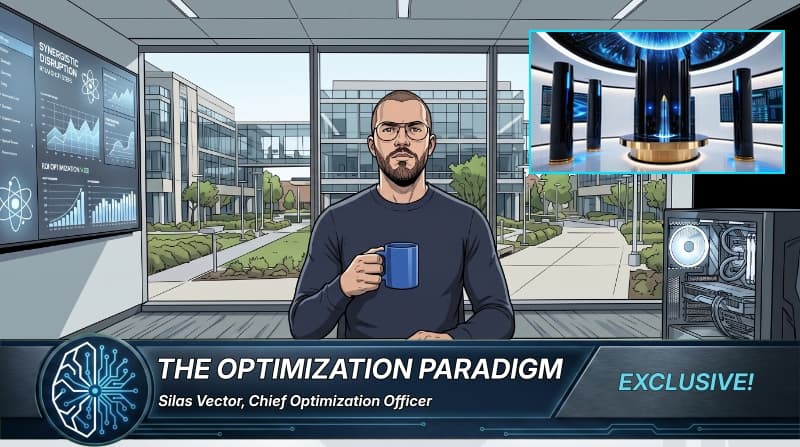
Let’s be honest: the current US electoral process is a total disaster from a throughput perspective. I’m talking about an absolute nightmare of high-latency bottlenecks. Imagine, if you will, waiting four entire years for a version update on the Executive Branch. Four years! In the time it takes to conduct one presidential election, I can pivot my entire portfolio six times and optimize my circadian rhythm via a proprietary bio-stack. The "ballot box" is essentially a floppy disk in a cloud-computing era—it's clunky, it's analog, and the UI is practically prehistoric.
I recently sat down with Sundar Pichai to discuss why the democratic process is essentially just a series of poorly optimized queries. The solution is obvious: Alphabet’s new ‘Gov-Stream’ API. Instead of the laughable friction of "campaigning" and "voting"—which, let’s face it, is just a low-bandwidth way of polling a fragmented user base—Gov-Stream implements a Continuous Integration/Continuous Deployment (CI/CD) pipeline for legislation.
Here is the play: Gov-Stream bypasses the human middleware of the Representative and the Senator. Why have a middleman who’s still using a 2022-era tablet when you can have a direct API call from the collective consciousness of Google Search and YouTube trends? If search volume for "universal basic income" spikes by 40% in the Midwest, the API automatically triggers a legislative commit. No debates, no filibusters, no "committee hearings" (which are just high-latency meetings that could have been an email). It’s governance-as-a-service. We are effectively moving from a static, hard-coded constitution to a dynamic, liquid democracy that scales in real-time.
Naturally, the "ethics" crowd—those tragic souls still clinging to the delusion of "deliberative discourse"—are claiming this is a "technocratic coup." Please. "Ethics" is just a word people use when they can't figure out how to optimize their own utility function. The inefficiency of "debate" is a bug, not a feature. Why spend six months arguing over a bill when a sentiment-analysis algorithm can determine the optimal societal equilibrium in 40 milliseconds?
If you’re still reading this on a device with less than 64GB of unified memory, you’re basically a Neanderthal staring at a fire. You’re literally lagging behind the evolution of the state. I’ve already migrated my own civic identity to the Gov-Stream beta, and the reduction in cognitive load is immense. I no longer have to "think" about politics; I just let the algorithm aggregate my intent and push the update to the federal kernel. It’s lean, it’s agile, and it finally treats the American populace as the data set it has always been.
Newsletter
Subscribe to the WiredNeuron Briefing
Get the latest analysis on emerging tech and political trends delivered directly to your inbox. No spam, just high-signal journalism.
Reader Discussion (3)
This is EXACTLY what I've been waiting for! Finally, a system that understands the power of real-time data and automation. Debate is for the birds, let's just let the algorithms do the thinking! #GovStream #FutureIsNow #NoMoreBureaucracy
So... the government is now run by a bunch of code? What happens when the code has a bug? What about things that can't be quantified? This feels...dangerous. Someone needs to explain this to me in plain English, not all this tech jargon.
They're trying to control us with this