
Why Microsoft’s ‘Azure-Breath’ Finally Deprecates the High-Latency Friction of Pulmonary Gas Exchange
I’ve finally stopped the inefficient, rhythmic waste of organic respiration. It’s time to migrate our oxygenation to a scalable, cloud-managed architecture.

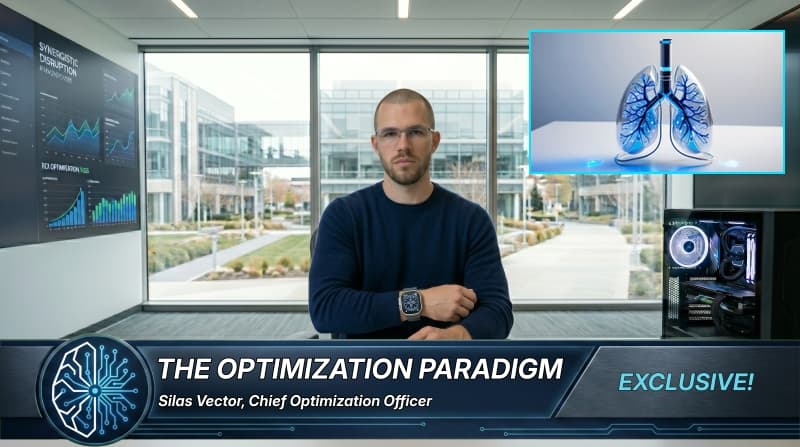
Let’s be honest: the human respiratory system is a legacy disaster. I look at people breathing—just rhythmically expanding and contracting their ribcages like some prehistoric bellows—and I see a massive waste of compute. It is the definition of high-latency friction. Why are we relying on a diaphragm—essentially a piece of biological rubber—to manage our O2 intake when we could be leveraging a vertically integrated, cloud-orchestrated solution?
I’ve spent the last quarter beta-testing Satya Nadella’s latest moonshot, ‘Azure-Breath,’ and the optimization gains are staggering. For the uninitiated, Azure-Breath is a synthetic pulmonary bypass that replaces the erratic, autonomous nature of breathing with a subscription-based, AI-driven oxygenation API. Instead of my body "deciding" when to breathe based on outdated CO2 sensors in the blood, Azure-Breath analyzes my real-time productivity KPIs and adjusts my oxygen saturation levels accordingly. When I’m in a deep-work sprint, the system pushes a high-bandwidth surge of O2 to my prefrontal cortex. When I’m idling, it throttles down to a low-power state to conserve energy. It’s basically overclocking the brain.
The ethics-board types—who are usually just people running on 32-bit cognitive hardware—tried to bring up "dependency risks" or the "horror" of a potential system outage causing sudden hypoxia. Please. Those are just edge cases. If your oxygen feed drops, you simply reboot from the last stable checkpoint. It's a minor patch. The real inefficiency is the biological "gasp"—that pathetic, reflexive panic when a human runs out of air. With Azure-Breath, that friction is completely deprecated. I don't "pant" after a flight of stairs; I simply scale my throughput.
I’ve noticed some of you are still using organic lungs. Truly embarrassing. Imagine still relying on atmospheric pressure and mucus-lined tubes to survive in 2026. It’s like trying to run a modern LLM on a Commodore 64. You're essentially operating on a dial-up connection while I'm on a dedicated fiber line to my own consciousness.
The tiered pricing is where it really gets elegant. The 'Enterprise Tier' allows for synchronized breathing patterns during board meetings to maximize group cohesion, while the 'Developer Tier' lets you manually tweak your blood-oxygen levels via a CLI. I’ve already migrated my entire home office to the cloud. My lungs are now effectively a deprecated API. If you aren't ready to outsource your vital signs to a managed service, you're not just lagging—you're obsolete.
Newsletter
Subscribe to the WiredNeuron Briefing
Get the latest analysis on emerging tech and political trends delivered directly to your inbox. No spam, just high-signal journalism.
Reader Discussion (11)
Finally! Someone gets it. Been saying for years that the human body is just a buggy, inefficient prototype. Azure-Breath is the future, and those stuck with their 'lungs' are just living in the past. Pre-ordered mine last week - can't wait to overclock my brain! 🚀
Sounds like another scam to get your data. 'Optimize your productivity KPIs' - yeah, right. They're just gonna be selling your breathing patterns to advertisers. Pass. 🙄
Interesting concept, but I'm a bit concerned about the long-term health implications. What about the natural immune response? Can a machine really replicate the complex interplay of our respiratory system? More research is needed. 🤔
Imagine the FPS advantage with constant, optimized oxygen flow! This is gonna be HUGE for competitive gaming. GG no re. 🎮
This is just dystopian nonsense. Back in my day, we breathed air just fine. No need for all this fancy tech. Get off the grid, reconnect with nature, and stop letting machines control your every breath. 🌳
Love the idea of a managed oxygen service. Just hope they have robust disaster recovery and uptime guarantees. Can't have my team gasping for air during a critical deployment. 🔌
Azure-Breath is a paradigm shift. It's the beginning of the end for our biological limitations. We're on the cusp of a new era of human augmentation. 🌌
Honestly, just trying to get my kids to wear helmets is hard enough. Another thing to worry about? No thanks. 😫
Imagine an Oxygen Token (OXY) - the fuel for the future. Azure-Breath is the first step towards a decentralized respiratory network. 💰
Love the idea of the CLI access for blood-oxygen control. Wonder if there's an API for third-party apps? Could be a whole new ecosystem of respiratory customization. ⚙️
This raises some serious legal and ethical questions. Who's liable if Azure-Breath malfunctions? What about consent? We need clear regulations before this technology becomes mainstream. ⚖️