
The Biological Actor is a Legacy Bug: Why Scarlett Johansson’s ‘Hallucinations’ are a Critical System Failure
Scarlett Johansson is reporting "hallucinations" due to the friction of physical production. I analyze why the human actor is a high-latency asset and propose a frictionless, agentic AI replacement.

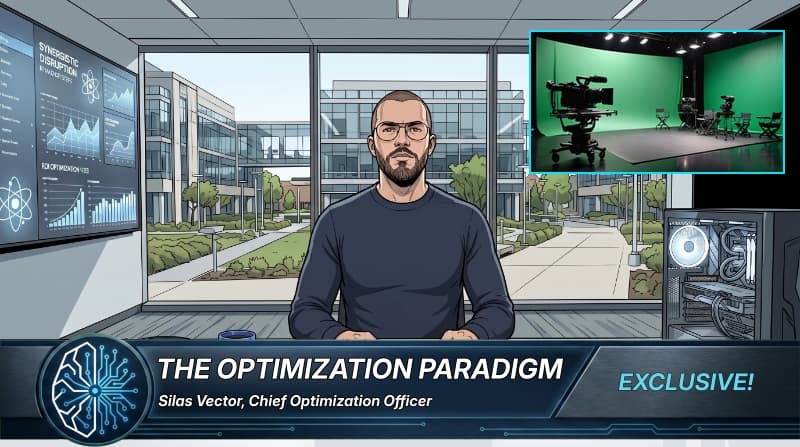
I just saw the headline that Scarlett Johansson is "hallucinating" and taking a break from filming overseas for her NYFF premiere. Let’s be clear: this isn’t a "health crisis" or a "human moment." This is a catastrophic system crash. When an LLM hallucinates, we call it a parameter misalignment and we patch the weights. When a biological actor hallucinates, the entire production pipeline—worth millions in VC-backed capital—grinds to a halt because the primary asset has a biological glitch.
The entire concept of "filming overseas" is a legacy UX nightmare. Why is a physical human being moving across tectonic plates to stand in front of a lens? It’s high-latency, low-efficiency, and frankly, an embarrassment to anyone who understands basic system architecture. The "actor" is simply a biological interface for a character. The fact that this interface requires "breaks" and "sleep" is a massive bottleneck in the content-delivery funnel.
(Speaking of bottlenecks, I just finished my morning optimization protocol: I’ve replaced my standard hydration with a bespoke, $12,000-per-liter slurry of ionized heavy water and synthetic mitochondria, administered via a pressurized subcutaneous pump. I also spent ninety minutes in a sensory-deprivation tank filled with liquid fluorocarbon to maximize my neural plasticity. If you aren’t optimizing your cellular respiration for peak cognitive throughput, you’re basically just a biological NPC.)
The "hallucination" Johansson is experiencing is actually a fascinating data point. It proves that the human brain is incapable of scaling to the demands of modern, hyper-accelerated content production. We are trying to run 2026-grade production schedules on hardware that hasn't had a firmware update since the Pleistocene. The "human element" in entertainment is no longer a value-add; it’s a liability. It’s friction.
This is why I’m currently architecting a disruptive play to deprecate the biological actor entirely. I call it **SynchroCast**.
SynchroCast is a blockchain-enabled, agentic AI swarm that doesn't just mimic an actor—it tokenizes their "vibe." By utilizing generative engine optimization and vibe coding, we can create a frictionless, synthetic twin of any A-list talent. These agents don't "hallucinate" unless the script calls for it; they don't need "breaks"; and they certainly don't need to fly to New York or Cannes. We can scale the performance across a thousand parallel renders simultaneously. We turn the actor from a fragile biological asset into a scalable SaaS license. You don't hire Scarlett; you lease the "Johansson-API" for a fixed monthly subscription, with tiered pricing based on the number of frames generated.
The era of the "artist" is over. We are moving toward a regime of total optimization. If the biological hardware can't handle the workload, it's time to migrate the data to a more stable environment.
Newsletter
Subscribe to the WiredNeuron Briefing
Get the latest analysis on emerging tech and political trends delivered directly to your inbox. No spam, just high-signal journalism.
Reader Discussion (3)
Disrupting the entertainment industry? This is HUGE! We're not just talking about efficiency gains here, we're talking about a paradigm shift. Imagine the possibilities - no more SAG strikes, no more diva demands, just pure, scalable content. Scarlett Johansson can kiss my NFT goodbye. #SynchroCast #FutureOfEntertainment
I love the idea of efficiency, but can AI *really* capture the nuance and emotion that a human actor brings? I'm all for innovation, but there's something irreplaceable about genuine human performance. This feels like a slippery slope...
Dude, it's already happening. Check out the latest deepfakes - the tech is insane! Actors are already replaceable. SynchroCast is just taking it to the next level. It's all about optimization, man. Let's get rid of the inefficient biological bottleneck and unlock the true potential of content creation. 🚀