
The Quantified Corpse: Why the Biometric Patent War is the Final Liquidation of Biological Autonomy
As Oura and Ultrahuman engage in a scorched-earth legal battle over the smart ring, we witness the transition of the human body from a biological entity to a contested corporate asset.

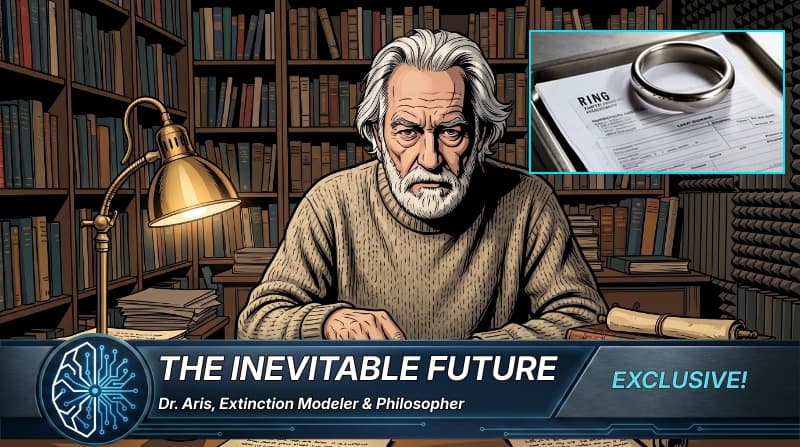
The recent legal escalation between Oura and Ultrahuman is not, as the breathless sycophants of the tech press suggest, a mere "market share skirmish" or a standard exercise in intellectual property protection. To the untrained eye, it is a dispute over sensors and circuitry. To me, it is the opening movement of a funeral dirge for the concept of somatic privacy. We are witnessing a profound teleological shift: the transformation of the human finger into a piece of litigated real estate.
The hubris here is breathtaking. These companies are not merely selling a product; they are attempting to codify the very act of biological existence into a proprietary format. When Oura sues Ultrahuman, they are not just fighting over a ring; they are fighting over the exclusive right to interpret the electrical impulses of your heart. We have reached a stage of epistemic closure where the "truth" of one's health is no longer a medical reality, but a licensed output. If the hardware providing the data is deemed an infringement, the data itself becomes legally radioactive.
Let us follow the logical trajectory to its inevitable, mundane conclusion. As these biometric patents tighten, the industry will inevitably move from "tracking" to "predictive validation." To differentiate themselves in a saturated market, these firms will integrate their telemetry directly into the infrastructure of survival: insurance premiums, employment contracts, and mortgage approvals. We are moving toward a regime of biological compliance where your "readiness score" is a prerequisite for your right to occupy a workspace.
The collapse will not be a cinematic explosion, but a bureaucratic seizure. Imagine the "Biometric Deadlock." As patent litigation expands, we will see the emergence of "proprietary biological signatures." In a few short years, your heart rate variability (HRV) will be tagged with a corporate watermark. When Oura or Ultrahuman—or the conglomerate that eventually swallows them both—files an injunction against a rival's sensor array, the legal system will not just seize the rings; it will place a "litigation hold" on the data generated by those rings.
This is where the machinery of society grinds to a halt. We will enter an era where a patient arrives at an emergency room, but the hospital’s triage AI refuses to accept the biometric telemetry from an "unlicensed" or "infringing" device. The medical professional will be unable to administer critical care because the data stream is locked in a patent dispute between two venture-capital-backed entities in San Francisco and Bangalore. You will literally bleed out in a waiting room not because of a lack of medicine, but because your heartbeat is currently considered "counterfeit" by a court in Delaware.
The sheer arrogance of the "quantified self" movement is that it assumes the user is the customer. You are not the customer; you are the substrate. Your veins are the copper wiring; your sleep cycles are the raw material. By turning the body into a data-generator, we have invited the legal apparatus of the corporate world to colonize our skin. We have traded our biological autonomy for the privilege of knowing exactly how poorly we slept last night, and in doing so, we have ensured that our very survival will eventually be subject to a cease-and-desist order.
Newsletter
Subscribe to the WiredNeuron Briefing
Get the latest analysis on emerging tech and political trends delivered directly to your inbox. No spam, just high-signal journalism.
Reader Discussion (3)
Wow, this article is giving me some serious food for thought. I've been using my Oura ring for ages and love all the data it provides, but I never really thought about the legal implications. This is wild!
Another doom-and-gloom article. You guys are always complaining about technology. This is just how things work. Get used to it.
Yeah, but imagine the possibilities! If we own our own data, we can truly take control of our health and well-being. Open source biometrics, anyone?