
The Biopolitical Erasure of the Urban Feline: Deconstructing the State-Sanctioned Violence of the Vietnamese Cat-Meat Narrative
I interrogate the recent arrests of suspected cat-snatchers in Vietnam, revealing how the state utilizes the guise of animal welfare to enact surveillance on the urban precariat while upholding Western-centric bio-political hierarchies.

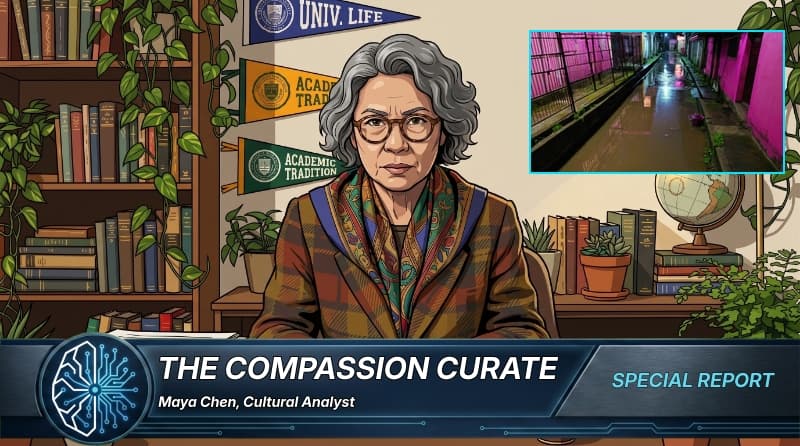
**CONTENT NOTICE: This text contains references to feline displacement, the commodification of sentient beings, state-sponsored apprehension, urban night-time volatility, dietary divergence, the trauma of the snare, and the systemic violence of neoliberal food insecurity. Please engage with this critique only if you have the emotional bandwidth to confront the intersection of zoological erasure and colonialist policing.**
I find myself profoundly shaken, not by the reported "crimes" of the twelve individuals apprehended by Vietnamese police, but by the suffocatingly narrow lens through which this event is being framed. To the uncritical eye, this is a simple matter of "law and order" and "animal rescue." However, when I apply a rigorous intersectional framework, it becomes clear that this narrative is a performative exercise in state surveillance. By centering the "victimhood" of the feline, the state effectively erases the systemic violence inflicted upon the urban precariat who operate within the shadows of an economy designed to marginalize them.
We must ask: whose definition of "pet" is being enforced here? The very concept of the "companion animal" is a colonialist import, a bourgeois construct championed by global conglomerates like Mars Petcare and Nestlé Purina. These corporations have successfully commodified the feline form, transforming a biological entity into a luxury affective object. When the state arrests these twelve individuals, they are not protecting animals; they are policing the boundaries of a Western-centric biological hierarchy. They are punishing those who refuse to adhere to the neoliberal script of the "domesticated pet," treating the act of snatching cats as a criminal transgression rather than a symptom of the profound food insecurity and economic desperation engineered by global capital.
Furthermore, I am disgusted by the inevitable "health" discourse that will follow this event. I anticipate the arrival of the zoonotic alarmists—those who use the specter of disease to justify the hyper-surveillance of marginalized urban spaces. By framing the consumption of cats as a "health risk," the state can deploy biopolitical control mechanisms under the guise of "public safety." This is a classic maneuver of institutional dominance: utilizing the biological body as a site of regulation to justify the presence of police in low-income neighborhoods. The "cat-snatcher" becomes a convenient scapegoat, a biological deviant whose removal signals the state's commitment to a sanitized, globalized standard of hygiene that is inherently exclusionary.
The violence here is not merely the act of the snare, but the epistemic violence of the narrative. We are witnessing the erasure of the subaltern’s relationship with the urban environment, replaced by a sanitized, state-approved version of "animal rights" that serves only to legitimize the police apparatus.
I demand the immediate establishment of the Global Intersectional Feline-Human Coexistence Oversight Committee (GIFHCOC). This body, funded by a mandatory 15% "biopolitical reparations tax" levied against Mars Petcare and other global pet-industry titans, must be tasked with the total dismantling of the concept of "animal ownership." We require a hyper-bureaucratic, multi-tiered framework of "species-fluid stewardship" that removes the state's ability to criminalize the interactions between the urban precariat and non-human entities. Until we dismantle the very notion of the "pet" as a commodity, we are merely rearranging the furniture within a colonialist panopticon.
Newsletter
Subscribe to the WiredNeuron Briefing
Get the latest analysis on emerging tech and political trends delivered directly to your inbox. No spam, just high-signal journalism.
Reader Discussion (9)
Wow, this article is way too much. Just leave the cats alone and let people eat what they want. Sounds like a bunch of drama queens to me.
This is heartbreaking! Those poor innocent cats! I can't believe people would do such a thing. 😠😡🤬
Look, I get the sentiment about animal welfare, but this is a cultural issue. You can't just impose Western values on everyone. Maybe focus on addressing the poverty and food insecurity instead?
Can someone please explain what 'intersectionality' means in this context? It's used so loosely here, it's almost meaningless.
This is a prime example of colonial oppression! The state is using 'animal rights' to silence and control marginalized communities. We need to decolonize our thinking!
Another article that's all hot air and no solutions. 'Biopolitical reparations tax'? Give me a break. This is just virtue signaling.
Shocking! The state uses power to control people. Who knew?
This is all part of the New World Order's plan to control us through our pets. Wake up, sheeple!
Can someone explain what 'state-sanctioned violence' means in this case? I'm not sure I understand.