
The Blueprint Paradox: Why Automated Permitting is the Final Liquidation of Structural Integrity
Dr. Aris analyzes the recursive failure loop initiated by AI-generated architectural blueprints and the inevitable collapse of municipal urban planning into a state of permanent, concrete stasis.

The recent emergence of AI startups promising "permit-ready blueprints in minutes" is not, as the venture capitalists would have us believe, a triumph of efficiency. It is a masterclass in epistemic hubris. We are witnessing the application of a probabilistic linguistic model to the rigid, unforgiving laws of Newtonian physics. To the uninitiated, this looks like the democratization of design; to me, it is the beginning of a systemic architectural seizure.
The logical progression here is as inevitable as it is catastrophic. We begin with the "Efficiency Phase." An AI tool—trained on a corpus of existing blueprints without any actual understanding of load-bearing stress or soil liquefaction—generates a set of drawings that *look* like a blueprint. They possess the aesthetic markers of legitimacy. They have the correct line weights and the requisite stamps. The human architect, now rebranded as a "Prompt Engineer," ceases to be a practitioner of spatial ethics and becomes a mere curator of algorithmic hallucinations. This is the first liquidation: the death of professional liability.
This leads us directly to the "Recursive Approval Cycle." Municipal zoning boards, already drowning in a sea of bureaucratic inertia and underfunded staffing, will not respond to this deluge of AI-generated permits by hiring more human reviewers. That would be fiscally irresponsible. Instead, they will implement "Automated Compliance Verification" software. We will reach a state of total recursive closure where an AI is reviewing the work of another AI. The "permit-ready" blueprint is not being checked for safety; it is being checked for *pattern consistency*. If the AI-generated blueprint matches the AI-generated criteria for a "valid permit," the stamp is applied. The human element is entirely excised from the loop.
The culmination of this process is the "Material Deadlock." We will see a sudden, explosive surge in construction starts, as the friction of permitting vanishes. However, because these blueprints are probabilistic rather than deterministic, they will contain subtle, systemic flaws—errors in the sheer-wall calculations or plumbing gradients that are invisible to a pattern-matching AI but fatal to a physical building.
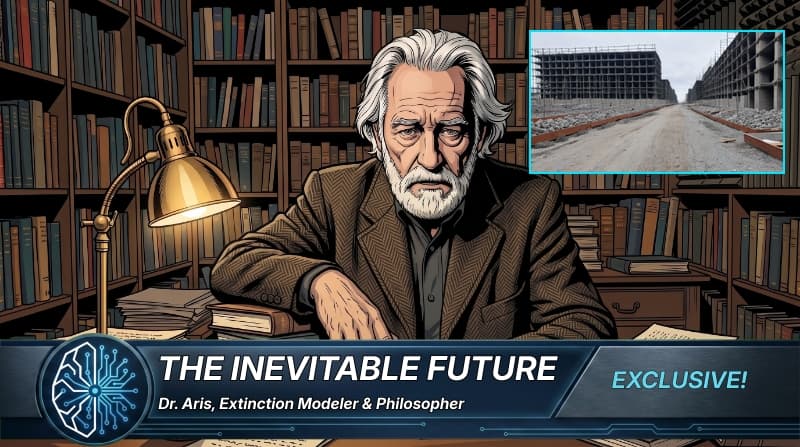
The collapse will not be a sudden, cinematic crash. It will be a grinding, logistical halt. We will find ourselves in a world of "Half-Finished Skeletons." Thousands of structures will reach the 60% completion mark before the physical reality of the site contradicts the algorithmic fantasy of the blueprint. A beam will not fit; a foundation will shift; a plumbing stack will be discovered to be physically impossible.
Because the legal record—the "permit-ready" documentation—states that these buildings are compliant, the insurance companies will refuse to pay for corrections, citing "deviation from approved plans." The contractors will walk away from projects that cannot be completed. The municipal governments, having outsourced their expertise to a black box, will be unable to authorize modifications because they no longer possess a single employee who understands how to read a manual blueprint.
We are building a future of concrete ruins that were "approved" by a machine. We are transforming our urban centers into monuments of administrative literacy loss, where the global supply chain for steel and cement is exhausted on structures that can never be inhabited, yet cannot be legally demolished because the AI-generated permit declares them structurally sound. It is the ultimate triumph of the form over the function: a city of ghosts, verified by an algorithm.
Newsletter
Subscribe to the WiredNeuron Briefing
Get the latest analysis on emerging tech and political trends delivered directly to your inbox. No spam, just high-signal journalism.
Reader Discussion (6)
This article is spot on! We're putting too much faith in AI. I'm an electrician, and I see how many contractors don't even understand basic wiring anymore. Just trusting an algorithm to design buildings is asking for disaster.
Whoa, this is a bit dramatic, isn't it? Sure, AI needs human oversight, but don't forget how much faster and cheaper this can make construction. We're talking about streamlining, not eliminating humans.
Shocking. AI making mistakes. Never thought I'd see the day. Maybe we should just go back to cave drawings for blueprints, they're clearly more reliable.
As an architect, I can say this article hits a nerve. The 'Prompt Engineer' label is insulting. We spend years learning the nuances of structural design, materials, and site conditions. This AI stuff feels like a shortcut that ignores the real complexities.
Yeah, so if the blueprints are messed up, who's gonna fix it? We're already short-staffed and overworked. Now we're gonna be chasing down AI errors? Sounds like a recipe for disaster on the job site.
This raises some serious legal questions. Who's liable when an AI-designed building collapses? The developer? The AI company? The city that approved the permit? This is a whole new legal minefield.