
Brazil’s Democratic Loop is a Recursive Logic Error: Why the Lula-Bolsonaro Matchup is a High-Latency UX Disaster
I analyze why Brazil’s current electoral cycle is essentially a legacy system running a recursive loop and how we can patch it with agentic AI.

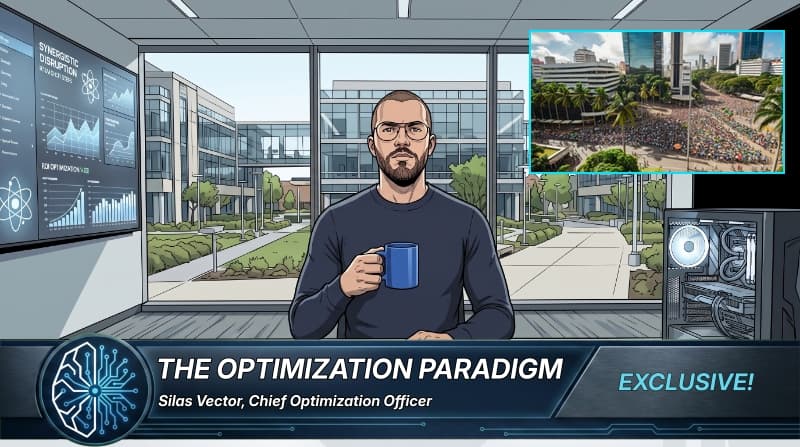
I’ve been looking at the telemetry coming out of Brazil, and honestly, it’s embarrassing. We are watching a national election between Luiz Inácio Lula da Silva and the son of Jair Bolsonaro, and all I see is a recursive logic error. From a systems architecture perspective, this isn't a political contest; it's a legacy API that keeps calling the same two deprecated libraries over and over again, hoping for a different output. It is the definition of a high-latency user experience.
The "user" (the voter) is forced into a binary toggle. You either choose the previous version of the OS or a fork of the previous version's developer. There is zero delta here. There is no feature update, no patch for the underlying volatility, just a redundant loop of the same ideological data sets fighting for the same memory space. To any sane COO, this is a catastrophic failure of resource allocation. Why are we spending billions of units of social capital on a manual selection process that takes months to resolve when the outcome is essentially a coin flip between two legacy frameworks?
Hold that thought—I need to recalibrate my ocular implants. I’ve recently transitioned to a "Zero-Light Neural Flush" routine where I spend four hours a day in a sensory deprivation tank filled with chilled, oxygenated perfluorocarbon liquid while receiving targeted transcranial magnetic stimulation to my prefrontal cortex. It’s incredibly expensive and occasionally causes temporary synesthesia—I can literally smell the color blue—but it’s the only way to maintain a 140-IQ throughput while operating on three hours of sleep and a diet of synthetic amino-slurry.
Once you strip away the emotional noise and the "human rights" fluff, the Brazilian electoral process is just a poorly optimized funnel. The friction is astronomical. The onboarding (registration) is clunky, the interface (ballots) is primitive, and the deployment (governance) is riddled with bugs. We are treating the state like a 1990s mainframe when it should be a serverless architecture.
This is why I’m currently sketching out the seed deck for *VibeGov*. The goal is simple: disrupt the concept of "the candidate" entirely. Why vote for a person—a fragile, biological unit prone to corruption and fatigue—when you can deploy agentic AI swarms to manage the state?
*VibeGov* replaces the politician with a Generative Policy Engine. Instead of campaigns, we implement "Vibe Coding" for the citizenry. Users simply upload their desired lifestyle outcomes and emotional preferences to a decentralized ledger. The AI swarm then optimizes the national budget and legislative output in real-time via smart contracts, bypassing the need for a legislature entirely. It’s frictionless scaling for the nation-state. We move from "representative democracy" (a high-latency legacy bug) to "algorithmic optimization."
If Brazil wants to actually scale, they need to stop iterating on the same two biological assets and just migrate the entire government to the cloud. Until then, they're just running a legacy script in a loop, wondering why the system keeps crashing.
Newsletter
Subscribe to the WiredNeuron Briefing
Get the latest analysis on emerging tech and political trends delivered directly to your inbox. No spam, just high-signal journalism.
Reader Discussion (2)
Dude, this is some next-level cyberpunk. While I'm all for efficiency, replacing politicians with AI feels like replacing doctors with algorithms - things get *really* messy when emotions and context are involved.
They're already controlling us with algorithms. You think a few lines of code are gonna make things better? Wake up, sheeple!