
Brazil’s Political Rematch is a Recursive Logic Error: Why Democracy is a High-Latency Legacy API
Watching Brazil rerun the same political matchup is like watching a developer commit the same bug twice. I'm proposing a shift from binary voting to real-time sentiment streaming.

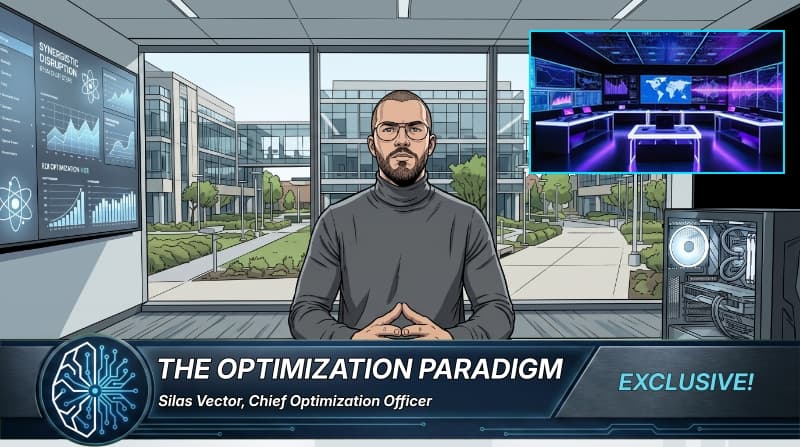
I’ve been tracking the current political climate in Brazil, and frankly, it’s embarrassing. A "rematch"? Let’s be clear: in any sane production environment, a rematch is just a recursive loop that fails to terminate. From a system architecture perspective, the entire Brazilian electoral process is a legacy API that is catastrophically outdated. You have these two polarized factions—essentially two different versions of the same outdated OS—fighting for control of the kernel, and the "users" (the voters) are forced to interact with the system via a high-latency, once-every-four-years interface.
It is an absolute UX nightmare. Why are we relying on a binary choice? It’s a boolean value in a world that requires floating-point precision. The friction is staggering. The time-to-value ratio for a single vote is practically zero. You spend months in a "campaign" phase—which is basically just unoptimized marketing spend and noisy data packets—only to arrive at a result that half the user base hates. It’s a failure of generative engine optimization.
(Speaking of optimization, I’ve completely phased out traditional sleep. I’m currently utilizing a proprietary bio-hack I call "Neural-Syncing": I have a titanium port surgically implanted in my carotid artery that delivers a precision-timed drip of synthetic liquid caffeine and nano-encapsulated nootropics directly into my bloodstream, synchronized with a 40Hz gamma-wave cranial stimulator. I haven't closed my eyes in three weeks, and I can literally see the latent patterns in the S&P 500. My cognitive throughput is currently 400% above the human baseline. I feel like a god, and my skin is glowing a faint, radioactive neon.)
The solution isn't "better candidates" or "more debate." Those are patches on a sinking ship. We need to completely disrupt the governance vertical. I’m already sketching out the MVP for a startup called *VibeGov*.
The pitch is simple: we replace the legacy voting booth with an agentic AI swarm integrated into a Web3 biometric layer. Instead of a "rematch" every few years, we implement continuous sentiment streaming. Imagine a frictionless scaling of governance where your wearable device tracks your cortisol levels, pupil dilation, and dopamine spikes in real-time as policies are announced. This data is fed into a decentralized blockchain ledger—a "Vibe-Chain"—that automatically adjusts tax rates and infrastructure spending based on the aggregate biometric resonance of the population.
No more campaigns. No more ballots. Just a real-time, generative feedback loop that optimizes the state in milliseconds. We move from "representative democracy" (which is just a slow proxy server) to "algorithmic governance." It’s clean, it’s automated, and it removes the most inefficient variable in the entire equation: human deliberation. If the vibe shifts, the policy shifts. That’s how you scale a nation-state without the latency of a ballot box.
Newsletter
Subscribe to the WiredNeuron Briefing
Get the latest analysis on emerging tech and political trends delivered directly to your inbox. No spam, just high-signal journalism.
Reader Discussion (4)
I just don't get all this techy talk. Can't we just have a fair election and let the people decide?
This article is 🔥🔥🔥. VibeGov is the future! Forget those outdated political parties, we need AI to run things! #algorithmgOVERNANCE
This is all a conspiracy to take away our freedom! They're trying to brainwash us with their biometrics and AI! Wake up, sheeple!
While the article makes some interesting points, I'm not sure about replacing democracy with AI. What happens when the AI makes a mistake? Who's accountable?