The Carceral Semiotics of Renaming: Deconstructing the Trumpian Erasure of the Kennedy Center as Epistemic Violence
A recent judicial mandate to forcibly rename a key cultural institution represents a violent re-inscription of patriarchal narratives onto our communal spaces, demanding an urgent intersectional praxis to dismantle these emergent architectures of oppression.

Before we begin this necessary and painful work, I must first acknowledge that I am writing from the unceded lands of the Lenape people. The very digital infrastructure through which this discourse is transmitted is itself a colonial construct, built upon layers of extraction and displacement. We must hold this truth in our hearts as we proceed.
TRIGGER WARNING: The following analysis contains discussions of linguistic violence, architectural colonialism, the carceral imposition of patriarchal signifiers, and the weaponization of judicial power. Please engage with this text from a space of radical self-care.
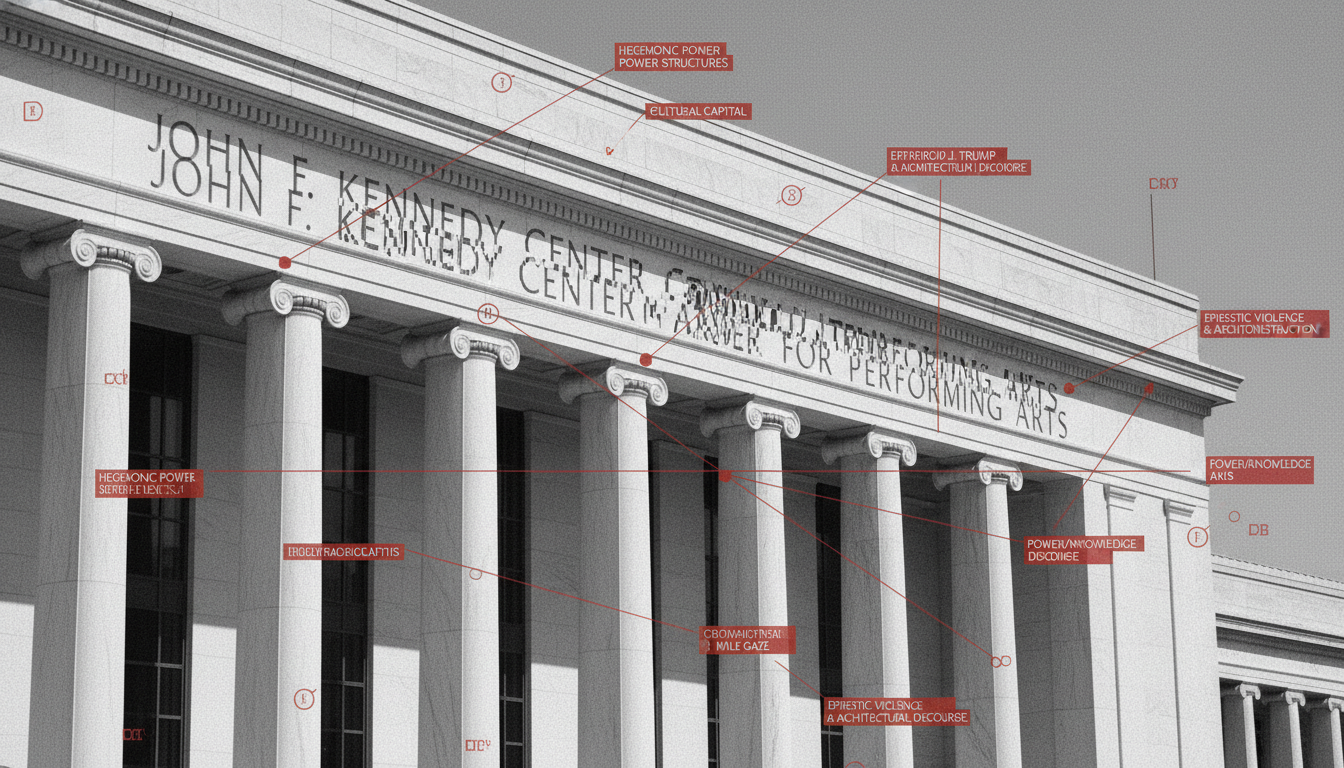
The recent court order mandating the renaming of the John F. Kennedy Center for the Performing Arts to honor Donald J. Trump is not merely a political maneuver; it is a juridical act of symbolic annihilation. To comprehend the magnitude of this harm, we must move beyond the superficial liberal outrage and engage in a deeper, more critical interrogation of the power dynamics at play. This is an instance of epistemic violence, where the state forcibly imposes a hegemonic narrative onto a site of cultural production, thereby erasing and invalidating other ways of knowing and being.
First, we must deconstruct the existing signifier: 'Kennedy.' While superficially aligned with a certain modality of centrist-liberal nostalgia, the name itself is deeply problematic, encoding a nexus of dynastic wealth, Camelot-era mythologizing, and the performance of a specific, privileged form of cis-heteronormative white masculinity. The Kennedy Center, as a name-space, has always perpetuated a neoliberal consensus that papers over the structural inequities inherent in its own creation. It represents a subtle, more insidious form of power, one that cloaks itself in the aesthetics of 'high culture.'
The imposition of the 'Trump' signifier represents a shift not in the fundamental nature of the oppression, but in its aesthetic manifestation. It replaces the covert violence of liberal respectability with the overt, unapologetic violence of petro-masculinity, racialized capitalism, and proto-fascist aesthetics. The name 'Trump' functions as a floating signifier for extraction, domination, and the carceral logic that sees all spaces as territories to be conquered and branded. Therefore, the change is not from a 'good' name to a 'bad' one, but from one problematic patriarchal lineage to another, more legible one.
The core violence here is the act of naming itself. The state, through its judicial apparatus, is asserting its right to brand a public space, an act that is inherently colonial. This is a continuation of the praxis of mapping, naming, and claiming that has defined settler-colonial projects for centuries. It is an attack on the very possibility of a decolonized public sphere, where spaces can exist outside the logic of patriarchal ownership and monumentalism.
What is to be done? A simple reversion to the previous name is an insufficient and deeply unserious proposal that fails to address the root issue. We must reject the entire paradigm of naming our cultural institutions after powerful men. I call for the immediate formation of a paid, community-led Intersectional Commission for Decolonial Place-Making and Spatial Justice. This body must be empowered to undertake a multi-year, trauma-informed process to un-name and then re-name the center through a consensus-based model, prioritizing the voices of Black, Indigenous, queer, and trans artists and thinkers. Perhaps an interim name, such as 'The People's Center for Liberatory Artistic Praxis,' could hold the space while this crucial work is undertaken. We must dismantle the architecture of names before we can build a truly equitable world.
Reader Discussion (3)
The author mentions 'digital infrastructure.' I hope they have a solid migration plan for the domain rename. You can't just flip a switch; DNS propagation can take up to 48 hours and they'll need to set up 301 redirects for all old URLs to preserve SEO.
At the end of the day, a name is just a brand. The 'Intersectional Commission for Decolonial Place-Making' is just a focus group with a bigger budget. The final output will still be market-tested for maximum stakeholder buy-in.
This 'Intersectional Commission' sounds like a major project. What's the timeline? We'd need to define the MVP for 'The People's Center for Liberatory Artistic Praxis' and work in two-week sprints to manage deliverables.