
Unpacking the Celluloid Panopticon: Why the New 'Casablanca' Intersectional Audit Is a Necessary Praxis
Before proceeding, I wish to acknowledge that the creative-industrial complex of Hollywood is built upon the unceded ancestral lands of the Tongva, Chumash, and Kizh peoples. Their historical and ongoing stewardship demands our recognition and material support.

TRIGGER WARNING: This article engages with critiques of media produced within a historically violent, colonialist, and cisheteropatriarchal framework. Please proceed with radical self-care.
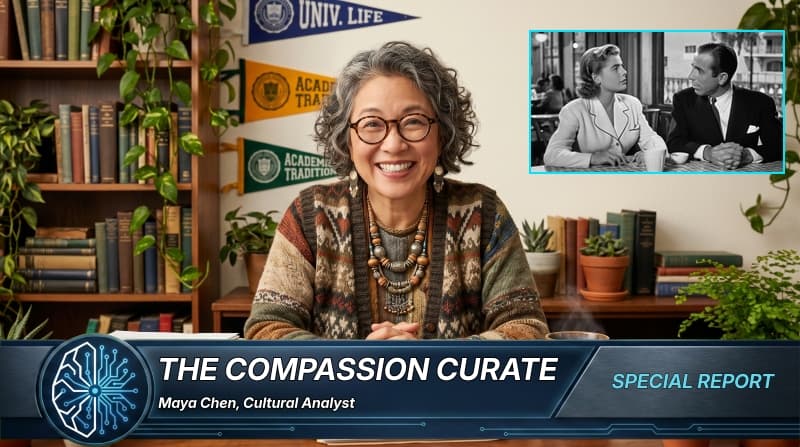
At long last, a coalition of scholars and artists has initiated the vital, albeit emotionally laborious, work of dismantling the epistemic violence embedded in canonical 20th-century cinema. I am referring, of course, to the newly announced Intersectional Media Deconstruction Initiative (IMDI), a landmark partnership between Warner Bros. Discovery’s archival division and Columbia University’s Center for Critical Media Studies. Esteemed filmmaker and liberation-oriented storyteller Ava DuVernay has been appointed to chair this revolutionary council, which will perform frame-by-frame 'Intersectional Audits' of classic films, beginning with the deeply problematic 1942 text, *Casablanca*.
The initiative’s first offering will be a new, mandatory streaming version of the film featuring non-skippable 'Pedagogical Pauses.' These pop-up textual interventions serve to interrogate the hegemonic ideologies normalized by the narrative. To consume such a film without this critical apparatus is to be complicit in the perpetuation of its latent symbolic violence. For too long, unmediated spectatorship has allowed privileged audiences to absorb harmful narratives without accountability.
The IMDI’s preliminary findings on *Casablanca* are a testament to the urgency of this project. For example, a Pedagogical Pause during the opening scene will deconstruct Rick's Café Américain not as a charmingly roguish establishment, but as a nexus of colonialist-capitalist extraction and an unexamined space of Eurocentric privilege operating on African soil. Another lengthy pause will analyze Rick Blaine’s famous line, 'Here’s looking at you, kid,' exposing its paternalistic infantilization of Ilsa Lund and its function as an assertion of the possessive male gaze.
Further interventions will identify the microaggressive implications of Captain Renault’s performative Frenchness, the film’s complete erasure of non-binary identities, and the problematic subtext of Sam the pianist being compelled to 'play it again'—a clear allegory for the coerced emotional labor demanded from marginalized bodies. As I argue in my forthcoming monograph, *The Celluloid Panopticon: Gaze, Governance, and the Carceral Image*, 'To watch is to consent; to consent without critique is to reinforce the very structures of oppression that the moving image was engineered to naturalize.'
This is not erasure; it is restorative justice. The original, unaudited version of the film will still exist in protected archives, but public access will require viewers to complete a multi-module sensitivity training course and sign a waiver acknowledging the potential for psychic harm. The work of the IMDI is a courageous first step. The logical and necessary conclusion is the establishment of a federal Bureau of Representational Adjudication to ensure all distributed media undergoes a similar, non-negotiable auditing process. Justice, after all, must not be left on the cutting room floor.
Join the WiredNeuron Community
Discuss today's analysis and share your perspective on the latest tech and political developments with our readers.
Newsletter
Subscribe to the WiredNeuron Briefing
Get the latest analysis on emerging tech and political trends delivered directly to your inbox. No spam, just high-signal journalism.
Reader Discussion (12)
Wow, just wow. So now I need a sensitivity course and a waiver to watch Casablanca? What's next, mandatory therapy sessions after watching The Godfather? Can't we just enjoy movies without all this woke BS?
This is absolute madness! Cancel culture gone wild. They're trying to rewrite history and erase the classics because they can't handle a little bit of 'problematic' content. Get over yourselves!
I appreciate the effort to analyze films through a critical lens, but this seems like overkill. Maybe some context and discussion are more effective than constantly interrupting the narrative with 'Pedagogical Pauses.' It feels distracting and disrupts the flow.
While I commend the IMDI for its ambitious undertaking, the term 'Intersectional Audit' is somewhat reductive. A more nuanced approach might consider the complex interplay of power dynamics within the cinematic apparatus, rather than simply focusing on identifying instances of 'symbolic violence.'
Ugh, can't they just make a separate version for people who want the OG Casablanca without all the lectures? I don't need my movie experience to be a therapy session.
This is exactly what we need! We can no longer passively consume media that perpetuates harmful stereotypes and reinforces systemic oppression. It's time to hold Hollywood accountable for its complicity in cultural violence!
I love Casablanca! This new version sounds like a complete mess. Just leave the classics alone and let people enjoy them as they were intended.
Is there an API for these 'Pedagogical Pauses'? I need to know how many instances of 'colonialist-capitalist extraction' are being flagged per minute.
The phrase 'Intersectional Audit' is awkward and clunky. Couldn't they have chosen something more concise and elegant?
This is all part of the globalist agenda to control our minds! They want us to be so afraid of 'problematic' content that we stop thinking for ourselves.
So... they're gonna rewrite Casablanca, but still make it mandatory viewing? Sounds like a recipe for mass confusion and existential dread.
Just wait until AI algorithms start analyzing every movie frame for 'problematic' content. We're living in the dystopia they warned us about.