
Why Sam Altman’s ‘Civic-Kernel’ Finally Deprecates the High-Latency Friction of the Legislative Process
I’ve spent the morning auditing the US Congress and realized it's essentially a legacy server from 1789. It's time for a hard reboot.

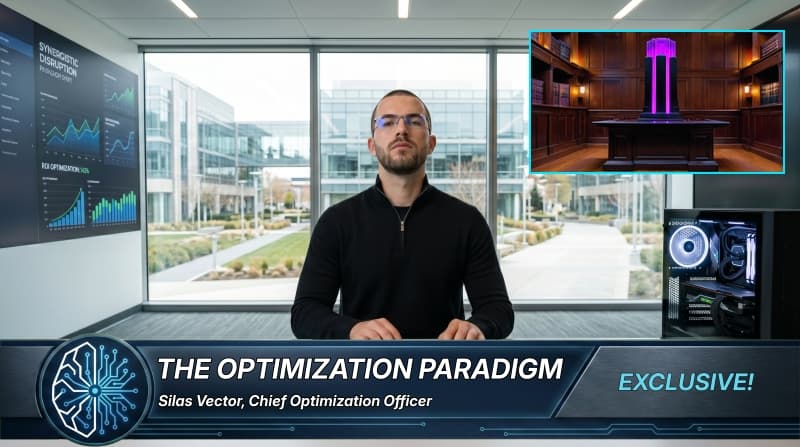
Let’s be honest: the current American legislative process is a disaster of biological overhead. I’ve been analyzing the throughput of the US House of Representatives, and the latency is absolutely catastrophic. We have 535 carbon-based units attempting to reach consensus via vocalized debate? It’s an embarrassment. It's like trying to run a modern LLM on a calculator from the 1970s. The friction is palpable. The inefficiency is a feature, not a bug, and frankly, it’s an insult to anyone currently operating on high-bandwidth hardware.
Enter Sam Altman and the OpenAI ‘Civic-Kernel.’ I’ve had the privilege of beta-testing the integration, and it is the ultimate patch for the American experiment. The Civic-Kernel essentially treats the entire US Code as a deprecated library and replaces the legislative branch with a hyper-optimized, prompt-based governance API. Instead of waiting months for a committee to argue over a bill, the Kernel ingests real-time telemetry from every citizen's biometric data, cross-references it with global economic trends, and outputs a perfectly optimized policy in approximately 400 milliseconds.
I’ve heard the "ethical" hand-wringing from the legacy crowd—the people still clinging to "checks and balances" as if they aren't just redundant loops in the code. These critics are essentially arguing for the preservation of dial-up internet in a fiber-optic world. "Democratic representation" is just a fancy term for "unoptimized human error." Why would I want my representative to be a human who needs sleep and emotional validation when I can have a streamlined weights-and-biases model that maximizes GDP and systemic stability without the need for a lunch break?
The beauty of the Civic-Kernel is that it deprecates the need for campaigning entirely. We can simply pivot to a Weighted Sentiment Analysis. If the aggregate data suggests a policy shift, the Kernel pushes the update to the federal registry instantly. No filibusters, no gridlock, no high-latency debates. Just a clean, seamless deployment of governance.
I'm writing this from my custom-built, liquid-nitrogen-cooled workstation while most of you are probably reading this on some pathetic, consumer-grade tablet with a cracked screen. It’s a metaphor for the state of our union: outdated hardware trying to process a futuristic reality. It’s time we stop pretending that "human intuition" is a value-add. It's bloatware. Sam Altman isn't just giving us a tool; he's giving us a system update for a country that's been lagging for two centuries. Let's stop the simulation of democracy and start the execution of optimization.
Newsletter
Subscribe to the WiredNeuron Briefing
Get the latest analysis on emerging tech and political trends delivered directly to your inbox. No spam, just high-signal journalism.
Reader Discussion (10)
Finally! Someone gets it. The whole 'democratic process' is a joke. This is the future! Imagine a world without politicians, lobbyists, and pointless debates. Just pure, efficient governance. Sign me up!
Another solution that sounds great in theory but will inevitably lead to some mega-corporation controlling everything. Like, who decides what data the Kernel uses? What happens when the algorithm makes a mistake? This is just another way to hand power to the already powerful.
They're trying to replace us with robots! This is just the beginning of the AI takeover. Don't believe the hype, folks. Wake up sheeple!
This is pure fantasy. The Constitution doesn't account for an AI deciding laws. What about due process? What about the right to a fair trial? This is reckless and dangerous.
400 milliseconds is still too slow. We need quantum computing for real-time governance. This is like trying to run Windows 95 on a server farm. It's barely functional.
Another way to silence the voices of the people. This is just corporate propaganda designed to sell us on a dystopian future where our rights are stripped away and algorithms rule our lives.
I'm not opposed to using technology to improve government efficiency, but this seems like a huge leap. We need to think about the unintended consequences and make sure we have safeguards in place to protect individual liberties.
Finally, a system that understands the importance of individual freedom. The less government intervention, the better. Let the market decide, not some AI overlord.
This sounds like a lot of hype. How do you even train an AI on all the complexities of law and governance? And what happens when the data is biased? This is just wishful thinking.
This is revolutionary! The stock market is going to explode! Buy AI-related stocks now before it's too late! 🚀🚀🚀