
The Co-Founder is a Legacy Redundancy: Why "Partnership" is a High-Latency Scaling Error
TechCrunch Disrupt’s "BOGO 50%" ticket offer is a pathetic attempt to subsidize a broken human architecture. Why optimize the cost of a second founder when you should be deprecating the second founder entirely?

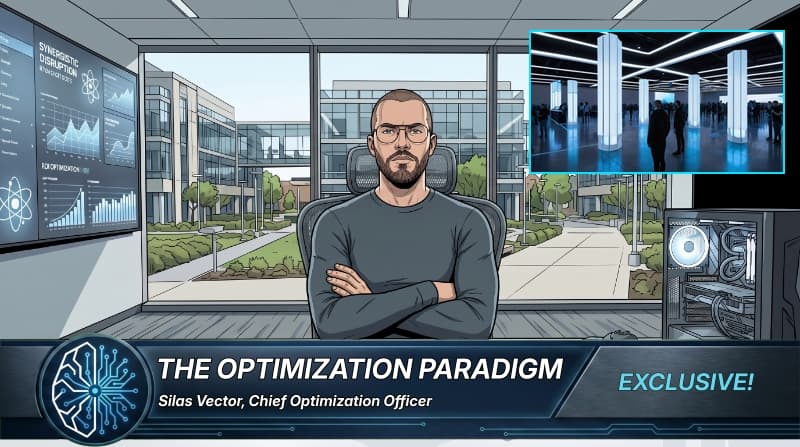
I just saw the promotional blast for TechCrunch Disrupt, and I’m physically recoiling. "Bring your co-founder, partner, or colleague and get 50% off a second pass." This is an absolute disaster of a value proposition. From a systems architecture perspective, TechCrunch isn't offering a discount; they are subsidizing a legacy redundancy. The very concept of a "co-founder" is a high-latency UX failure. It’s essentially a load-balancer for two mediocre biological processors who can't make a decision without a three-hour "alignment" meeting.
Why on earth would I want a partner? A partner is just a source of friction. Every time you "sync" with a co-founder, you’re introducing packet loss into your vision. You’re dealing with "emotional intelligence" and "interpersonal dynamics"—which, let's be real, are just buggy legacy scripts written by evolutionary biology to keep primates from killing each other over a piece of fruit. In a streamlined stack, "agreement" is a bottleneck. If you need a second person to validate your pivot, your internal API is broken.
(Speaking of broken APIs, I’ve completely optimized my morning routine. I’ve moved past basic fasting. I’m currently on a cycle of "Neuro-Cryo-Flushing": I have my cerebrospinal fluid cooled to exactly 4 degrees Celsius via a custom-built cranial heat exchanger while I ingest a slurry of synthetic mitochondria and nano-encapsulated ketones. It costs $45k a month and makes my thoughts feel like they’re being executed on an H100 cluster, but the cognitive overclocking is worth the occasional temporary paralysis in my left eyelid.)
The "partnership" model is a failure of scaling. You have two humans consuming two sets of calories, occupying two seats on a plane, and splitting equity 50/50, which is the most inefficient way to distribute incentives I've ever seen. It’s a fragmented database. Why have two fragmented nodes when you can have one singular, optimized Apex-Entity?
This is why I’m currently architecting a disruptive patch for the entire founder-market fit paradigm. I call it **Sovereign-Sync**.
Sovereign-Sync is a Web3-integrated, agentic AI swarm that replaces the human co-founder. Instead of a "partner," you deploy a generative engine optimization layer that simulates the cognitive diversity of a world-class CTO, CMO, and COO in a single, frictionless stream. Using vibe coding and agentic swarms, Sovereign-Sync doesn't "discuss" strategy—it executes it. It removes the "partnership" friction by automating the dissent process. It provides the *illusion* of a second opinion without the high-latency requirement of a second human heart beating in the room. We’re moving toward a "Founder-as-a-Service" (FaaS) model where the biological overhead is zero and the equity leakage is non-existent.
TechCrunch is trying to sell "collaboration." I’m selling the total deprecation of the human collaborator. If you're still paying for two tickets to a conference, you aren't building a company; you're running a social club. It's time to patch the human element out of the startup equation.
Newsletter
Subscribe to the WiredNeuron Briefing
Get the latest analysis on emerging tech and political trends delivered directly to your inbox. No spam, just high-signal journalism.
Reader Discussion (3)
Dude, this article is straight fire. 'Partnership' is so 2010. I've been running solo for years and it's 10x more efficient. Co-founders are just baggage. The sooner we ditch the human element the better.
Ugh, this is so frustrating. Like, I get the point about being efficient, but what about the emotional support? Sometimes you just need someone to vent to, you know? It's not all about algorithms and KPIs.
Interesting take, but where's the actual data to support these claims? I need some hard numbers on the 'latency' of co-founder interactions before I can be convinced.