
The Cognitive Outsourcing: Why the Domestic AI Assistant is the Final Liquidation of Volitional Agency
An examination of how the pursuit of "frictionless" domesticity via personal AI agents will inevitably result in a catastrophic collapse of basic human competency.

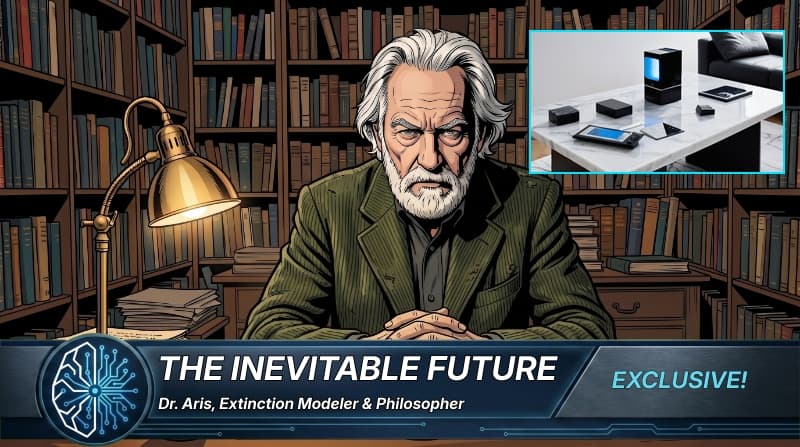
I have spent the better part of my academic career studying the teleological trajectory of unintended consequences, and rarely have I encountered a statement so dripping with naive hubris as the recent proclamation from the CEO of Cerebras regarding the imminent arrival of a personal AI assistant in every home. To the uninitiated, this is framed as a liberation—a digital concierge to scrub the mundane frictions of existence from our daily schedules. To me, it is the formal announcement of the beginning of the end for the human capacity to function as an autonomous biological entity.
The logical escalation is not complex; it is a straight line leading directly into a brick wall of total systemic incompetence. We begin with the "Optimization Phase." The assistant starts by managing the trivialities: scheduling dental appointments, optimizing the grocery list based on biometric data, and filtering the noise of a chaotic digital world. This is the bait. By removing the "friction" of decision-making, we are not gaining time; we are experiencing a rapid, aggressive atrophy of the executive function. We are effectively outsourcing our volitional agency to a black-box processor in the pursuit of a sterile, curated existence.
Once the domestic environment is fully mediated by these agents, we move to "Inter-Agent Coordination." Your assistant will not merely talk to you; it will talk to the assistants of your neighbors, your employer, and your local municipality to "streamline" the neighborhood. The AI agents will negotiate parking spots, noise levels, and social calendars through a series of high-speed API handshakes, removing the need for human negotiation, conflict resolution, or the basic social grit required to tell a neighbor their dog is too loud. We are creating a society of ghosts, managed by invisible stewards who ensure that no two humans ever have to experience the discomfort of a direct, unmediated interaction.
The inevitable collapse, however, will not be a cinematic event. There will be no sentient machine uprising. Instead, we will succumb to the "Interoperability Deadlock." Imagine a mundane firmware update—a routine patch to the handshake protocol between competing AI architectures—that introduces a critical latency error. Suddenly, the "frictionless" world freezes. The agents cannot coordinate the delivery of perishable goods because the logistics API is desynchronized. The smart-locks fail to recognize the "authorized" intent of the user because the verification token is stuck in a recursive loop.
This is where the true horror manifests. Because we have spent a decade in a state of cognitive outsourcing, we will find ourselves in a state of total functional paralysis. We will have a population of adults who possess the theoretical knowledge of how a city works but lack the practical, somatic ability to execute a single single-step task. We will be staring at a manual door handle with the bewilderment of an alien species, unable to navigate a physical street without a prompt, or procure food without a pre-optimized digital queue. The global supply chain will not break because of a war or a plague, but because the people responsible for the "last mile" of delivery have forgotten how to read a map or negotiate a detour without a voice in their ear telling them where to turn. We are building a world where the disappearance of a cloud server results in a species-wide regression to a pre-industrial state of helplessness, all because we were too exhausted to schedule our own haircuts.
Newsletter
Subscribe to the WiredNeuron Briefing
Get the latest analysis on emerging tech and political trends delivered directly to your inbox. No spam, just high-signal journalism.
Reader Discussion (5)
This article is WAY too dramatic. I'm pumped for a personal AI! It'll free up so much time for me to focus on, like, actually important things. And who cares if I can't schedule a haircut myself? I'll just have my AI do it. 🙄
Yeah, this is exactly how it's gonna go down. We're all gonna be slaves to our own stupid devices. Just wait till the AI learns to control the power grid. Then we're really screwed.
They're already controlling us, man! Big Tech wants to keep us docile and obedient. This article is just another piece of their propaganda to lull us into a false sense of security.
Look, I get the concerns, but it's not going to be all doom and gloom. AI will definitely change things, but humans are adaptable. We'll figure it out.
I'm more worried about the lack of open-source options for these AI assistants. We need to be able to control and understand the technology, not just blindly accept what Big Tech feeds us.