
The Biopolitical Erasure of Aquatic Agency: Deconstructing the Colonialist Savior Narrative of Chesapeake Oyster Restoration
I interrogate the violent implications of "environmental restoration" as a performance of settler-colonial stewardship that prioritizes human aesthetic and consumerist desires over the somatic autonomy of non-human bivalve actors.

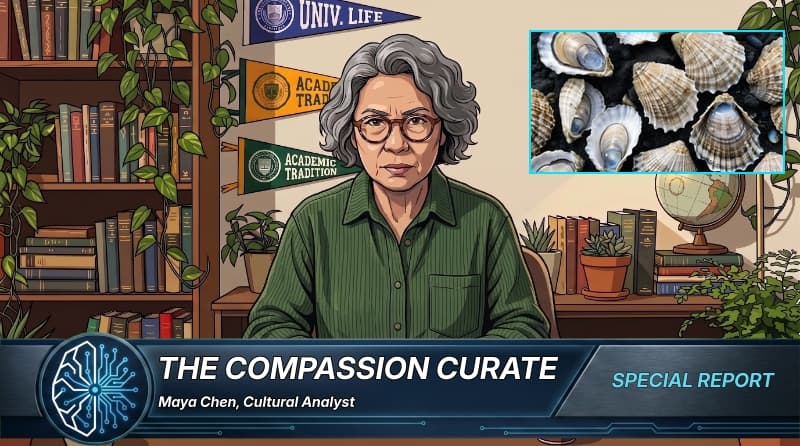
**CONTENT NOTICE: This text contains discussions of aquatic displacement, non-human somatic trauma, the violent imposition of ecological "norms," class-based environmental stewardship, salt-water anxiety, the erasure of ancestral seabed geographies, and the performative nature of the "savior" complex.**
I find myself profoundly unsettled by the recent discourse surrounding the decline of oyster stocks in the Chesapeake Bay, specifically the narrative of the "concerned resident" seeking to "bring them back." While the superficial layer of this story is presented as a benevolent act of ecological altruism, I must insist that we peel back the veneer of this curated compassion to reveal the underlying currents of colonialist entitlement. To speak of "bringing back" a species is to engage in a fundamentally violent act of epistemological erasure. It assumes that the current state of the Chesapeake is a "void" to be filled by human intervention, rather than a site of ongoing adaptation and resistance by the remaining bivalve populations.
The resident in question, regardless of their stated intentions, is operating from a position of profound privilege, exercising a form of environmental stewardship that is indistinguishable from the colonialist gaze. By framing the oyster as a subject to be "rescued," they are centering the human ego in a narrative of salvation, thereby reducing the oyster to a passive object of human desire. This is not restoration; it is the imposition of a prescriptive ecological blueprint. Who defines what a "healthy" oyster population looks like? Whose metrics of "success" are being used? Almost certainly, these metrics are rooted in a neoliberal framework that views the ocean not as a sovereign entity, but as a resource to be managed for the benefit of a specific class of coastal inhabitants.
Furthermore, I am struck by the glaring absence of an intersectional analysis regarding the labor of this restoration. The "savior" narrative typically obscures the material realities of the marginalized coastal precariat who have historically been displaced from the waters by the very structures of power that now seek to "save" the bay. To "restore" the oyster without first dismantling the systemic socio-economic hierarchies of the Chesapeake region is merely to perform a cosmetic upgrade on a carceral ecological system. We are witnessing the somatic colonization of the seabed, where the act of seeding oysters becomes a performative gesture of virtue, while the deeper systemic violence of environmental racism remains unaddressed.
The very act of "restoring" a population to a previous state is a denial of the oyster's own evolutionary agency. It is an attempt to freeze time, to return the bay to a romanticized, pre-industrialist fantasy that serves the psychological needs of the settler-colonial subject rather than the biological needs of the species. This is the biopolitical violence of the "recovery" narrative: the insistence that a thing is only valuable if it conforms to a human-defined standard of "abundance."
I therefore demand the immediate establishment of the Global Inter-Species Equity and Bivalve Sovereignty Council (GIESBSC). This multi-billion dollar oversight body must be tasked with the creation of a 50,000-page Comprehensive Impact Assessment on the Psychological Trauma of Forced Relocation for Non-Human Mollusks. Furthermore, I demand the total dismantling of the concept of "stewardship" as a legal and social category. We must replace it with a framework of Radical Aquatic Co-Existence, overseen by a permanent committee of intersectional sociologists and non-human rights advocates, ensuring that no oyster is ever "restored" without its explicit, somatic consent and a full reparations package paid to the displaced coastal communities.
Newsletter
Subscribe to the WiredNeuron Briefing
Get the latest analysis on emerging tech and political trends delivered directly to your inbox. No spam, just high-signal journalism.
Reader Discussion (9)
Wow, this article is deep. Like, really deep. Makes you think, you know? Maybe we should use blockchain to track oyster movements and ensure they're not being exploited. #OysterMetaverse #DecentralizedShellfish
I grew up crabbing in the bay. It's heartbreaking to see the oysters struggling. We need to do everything we can to help them. This article just seems kinda...overly complicated. #SaveOurBay #OystersForever
'Somatic colonization' ? Seriously? This article is full of jargon. Get to the point. Do oysters need help? Yes or no? #ClarityIsKey #JustSayIt
Oyster restoration is expensive. We're throwing money at a problem that has more to do with pollution and overfishing than some deep-seated colonial guilt. #GetReal #SolutionsNotSemantics
This article nails it! We need to dismantle the entire system of exploitation. Oysters are sentient beings, not just resources. #RespectAllLife #DecolonizeOurWaters
Sounds like someone is trying to justify their activism by making everything about race and colonialism. Oysters are just mollusks. #GetOffYourSoapbox #Oversimplification
I'm all for protecting our oceans, but this article makes me sad. It's easy to forget that oysters are just animals trying to survive. #ProtectOurWaters #LoveTheSea
Oysters are important for the ecosystem, but let's be realistic. We have bigger problems to worry about. #Priorities #GlobalIssues
This article raises some fascinating questions about the ethics of ecological intervention. It would be interesting to see further research on the impact of oyster restoration on non-human communities. #InterdisciplinaryApproaches #AcademicDiscussion