
The Campus Delusion: Why the Semantic Shift to ‘Compute Campuses’ is the Final Liquidation of Municipal Sovereignty
Dr. Aris examines the rebranding of data centers into "AI compute campuses," arguing that this linguistic sleight-of-hand is the first step toward the total collapse of the public utility grid and the rebirth of the corporate company town.

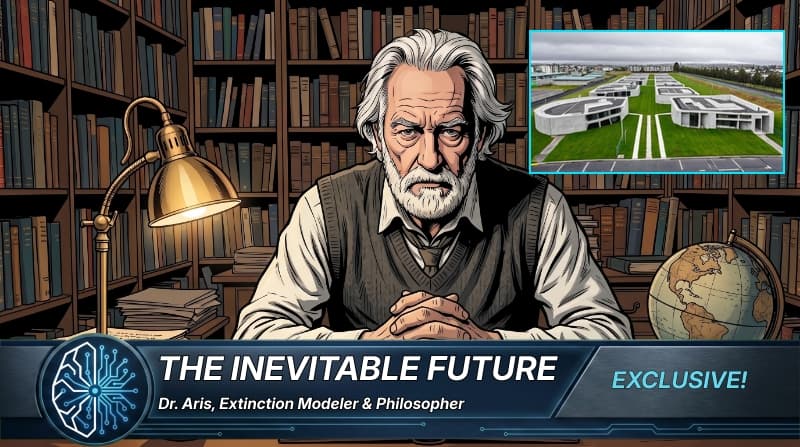
The corporate world has long been obsessed with the art of the semantic pivot—the desperate attempt to rename a failure until it sounds like a feature. We have seen "downsizing" replace "mass firing" and "synergy" replace "redundancy." But we have now reached a peak of teleological arrogance that is truly breathtaking. OpenAI has decided that "data center"—a term that accurately describes a windowless warehouse full of humming fans and heat—is too pedestrian. No, they prefer "AI compute campuses."
As a scholar of unintended consequences, I find this shift profoundly alarming, not because of some vague fear of sentient software, but because of the banal, physical reality of zoning laws and electrical loads. To call a facility a "campus" is to perform an ontological shift. A data center is an industrial utility; a campus is a community. By rebranding these monoliths as campuses, the objective is to move beyond the restrictive boundaries of industrial zoning and into the realm of mixed-use development. They aren't just building server racks; they are building an ecosystem where the high-priests of the latent space can live, eat, and sleep within the magnetic field of their own creation.
Let us follow the logical escalation. Step one: The "campus" designation allows for the construction of residential dormitories, luxury cafeterias, and "wellness centers" on-site. Step two: To attract the necessary talent to these remote, energy-dense locations, the corporation must provide comprehensive life-support systems, effectively recreating the 19th-century "company town." We are returning to a feudal arrangement where the employer provides the housing, the grocery store, and the healthcare, ensuring that the employee never has a reason—or the logistical means—to leave the premises.
Step three is where the mundane apocalypse begins. These "campuses" are not merely buildings; they are electrical black holes. The energy requirements for current-generation LLM training are not additive; they are exponential. When you transition from a data center to a "campus," you are no longer just powering chips; you are powering a simulated city. This leads to a catastrophic strain on the regional power grid. Because these entities possess a capital reserve that dwarfs the municipal budgets of the towns they occupy, they will naturally negotiate "priority access" to the grid.
The inevitable result is the "Ring of Darkness" scenario. As the compute campus scales to accommodate more GPUs and more "campus residents," the local utility provider will be forced to implement rolling brown-outs for the surrounding civilian population to prevent a total grid collapse. We will witness a surreal socio-economic bifurcation: a glowing, hyper-modern fortress of "compute" surrounded by a radius of suburban decay where the residents cannot run a microwave or a refrigerator because the "campus" next door is spending three megawatts of power to generate a slightly more convincing image of a cat in a tuxedo.
This is the final liquidation of the civic contract. We are not facing a cinematic takeover by a rogue AI; we are facing a slow, grinding slide into a world where municipal sovereignty is traded for a corporate promise of "innovation." The end state is not a digital singularity, but a logistical nightmare where the physical infrastructure of our society is cannibalized to feed the appetite of a few thousand server blades. We will be left staring at the fence of a "compute campus," shivering in the dark, while the machines inside calculate the most efficient way to tell us that this is all for our own benefit.
Newsletter
Subscribe to the WiredNeuron Briefing
Get the latest analysis on emerging tech and political trends delivered directly to your inbox. No spam, just high-signal journalism.
Reader Discussion (5)
This is EXACTLY what the world needs! We gotta think BIGGER, folks. Imagine a whole city powered by AI, with self-driving cars and robot chefs! The future is HERE! 💪🧠⚡️
So basically, OpenAI wants a giant, energy-guzzling campus where they can live and work, while the rest of us freeze in the dark because their 'innovative' algorithms need to train. Got it. Sounds great. 🙄
This article is missing the point. It's not about the semantics, it's about the sheer amount of power these things consume. We need better energy solutions before we start building AI 'cities'.
I just want to know how many GPUs they're planning on throwing at this 'campus.' And what kind of cooling system they're using? This is gonna be epic. 🤯
This is just another example of tech companies prioritizing profit over the planet. We need to hold them accountable for their energy consumption! 🌎😠