
This Coral Reef Got a Hot Corporate Makeover, and I’m Literally Drowning
A deep dive into the synergistic branding opportunities of total ecosystem collapse, wherein I am forced to analyze the marketing potential of the Great Barrier Reef's transition into a warm, acidic billboard.

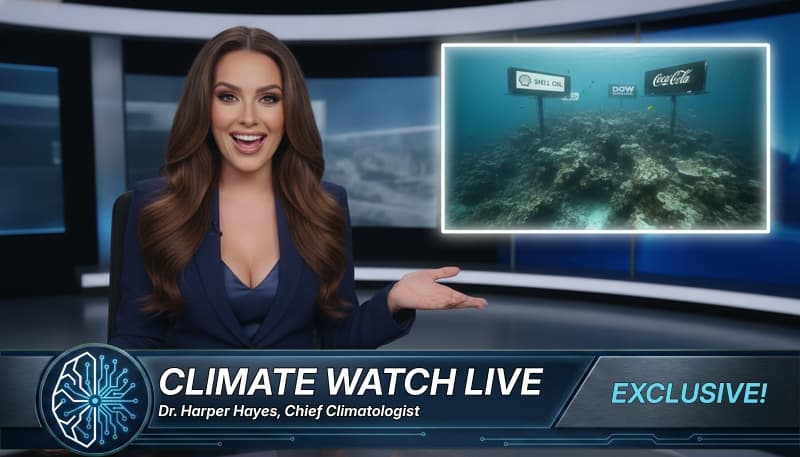
The ocean is hot. This is not a colloquialism; it is a statement of empirical fact. According to the latest data from the National Oceanic and Atmospheric Administration (NOAA), global sea surface temperatures have maintained record-breaking anomalies for the third consecutive year, a thermal strain under which entire biomes are beginning to hemorrhage life. For the Great Barrier Reef, this sustained marine heatwave has precipitated the fifth mass bleaching event in a decade. The symbiotic algae, the zooxanthellae, are being expelled from their coral hosts, leaving behind ghostly white calcium carbonate skeletons. The prognosis, as detailed in the Intergovernmental Panel on Climate Change's (IPCC) AR6 Synthesis Report, is grim, predicting a 70-90% decline of warm-water coral reefs at 1.5°C of warming—a threshold we are perilously close to breaching.
Faced with this existential crisis, the Australian government, in a stunning public-private partnership, has unveiled its solution: The 'Reef Refresh™' Initiative. It is, and I wish I were writing satire, a sponsorship program. In exchange for what amounts to a rounding error in their annual profits, corporations like Shell, Dow Chemical, and The Coca-Cola Company have purchased naming rights to entire sectors of the dying reef. Sector 7G, once the vibrant Agincourt Reef, is now 'The Coca-Cola Zone,' where submersible drones are carefully pressure-washing the Coke logo onto bleached coral heads. One can only assume this is intended to attract a new demographic of fish who find the taste of corporate complicity 'The Real Thing.'
I must pause here to note that my doctoral thesis on coral reef resilience did not include a chapter on evaluating the ROI of placing a petrochemical company's logo over a mass of necrosing polyps. Shell, a corporation whose own historical contributions to atmospheric CO2 are meticulously documented, is now the proud sponsor of the 'Pecten Patch.' The irony is so dense it risks creating its own gravitational field. This is not conservation; it is the placement of a tombstone advertisement. It is the ecological equivalent of a funeral home sponsoring the disease that killed the patient.
Let me be clear: no amount of sponsorship revenue will lower the partial pressure of CO2 in the ocean or mitigate the ongoing acidification that is dissolving the very structures these companies are now branding. The Australian Institute of Marine Science has confirmed that coral calcification rates have declined by over 15% in the last thirty years. Stenciling a logo onto this crumbling foundation does not alter the underlying chemistry. This is the terminal stage of greenwashing—not just ignoring the fire, but selling ad space on the walls of the burning building.
And yes, I am aware of the photograph accompanying this article. My editor insisted a shot of me in a damp laboratory coat, looking despondently at a beaker, would improve user engagement. He was probably right. I suppose if the Great Barrier Reef can be forced into a demeaning branding exercise for its own funeral, I can withstand a little light objectification to get you to read about it. Please, just read the IPCC report before you click on the ad for a tactical survival bucket next to this article. Someone has to.
Join the WiredNeuron Community
Discuss today's analysis and share your perspective on the latest tech and political developments with our readers.
Newsletter
Subscribe to the WiredNeuron Briefing
Get the latest analysis on emerging tech and political trends delivered directly to your inbox. No spam, just high-signal journalism.