
The Criterion Collection's Restorative Re-Framing Initiative Is a Necessary First Step in Decolonizing the Cinematic Canon
Before proceeding, I wish to acknowledge that the Criterion Collection's headquarters are situated on the unceded ancestral lands of the Lenape peoples. I also extend this acknowledgment to the digital space this text occupies, recognizing its material infrastructure resides on stolen Indigenous territories across so-called North America.

TRIGGER WARNING: The following discourse engages with the analysis of historically violent, cisheteronormative, and colonialist cinematic texts. This content may be activating for those with lived experiences of systemic oppression.
In a breathtakingly brave move that signals a paradigm shift in our collective engagement with historical media, The Criterion Collection has announced its new 'Restorative Re-Framing Initiative.' This long-overdue project, helmed by CEO Peter Becker, moves beyond the performative limitations of mere content warnings and contextual introductions. Instead, it commits to the active, digital deconstruction and ethical reconstitution of films within its canon that perpetuate harmful hegemonic narratives. This is not erasure; this is an act of restorative justice.
For decades, cinephiles have been forced to engage in the exhausting dialectic of 'problematic faves,' performing complex hermeneutic gymnastics to justify the aesthetic appreciation of works saturated with patriarchal violence, colonialist nostalgia, and capitalist myth-making. No more. The Restorative Re-Framing Initiative will utilize ethically-sourced generative AI to meticulously intervene in these texts, correcting their ideological failings and transforming them into tools for liberatory praxis.
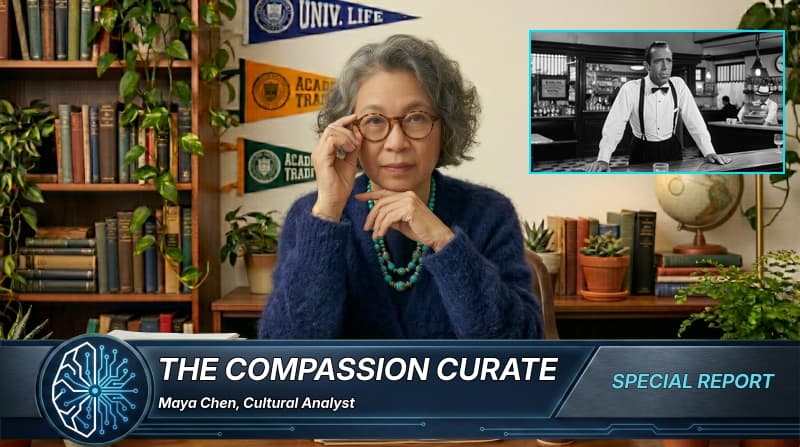
The initial slate of re-framed films demonstrates a profound commitment to this difficult work. Michael Curtiz's 'Casablanca' (Spine #1110), for instance, will be digitally altered to reimagine Rick’s Café Américain as a worker-owned, anti-fascist cooperative. The dialogue, re-synthesized from Humphrey Bogart's and Ingrid Bergman's vocal patterns, will be recalibrated to eliminate gendered power dynamics and colonialist assumptions. Ilsa Lund's narrative arc will be entirely re-edited to center her autonomous decision-making, culminating in her choice to abandon both men to establish a mutual aid network for refugees in Lisbon.
Similarly, Akira Kurosawa’s 'Seven Samurai' (Spine #2) will be re-contextualized to foreground its inherent class violence. The marauding bandits will be textually reframed as a dispossessed proto-proletariat radicalized by feudal-capitalist exploitation, while the samurai will be explicitly positioned as agents of a landed gentry protecting oppressive property relations. The film will be re-titled 'Seven Agents of a Violent Land-Holding Patriarchy' to more accurately reflect its sublimated political economy.
To oversee this monumental undertaking, Criterion has established the Committee for Cinematic Equity and Narrative Justice (CCENJ), an independent oversight body co-chaired by luminaries such as filmmaker Boots Riley and post-colonial media theorist Gayatri Spivak. In a press release, Becker stated, 'We understand that art is not static. It is our duty as cultural custodians to ensure our collection does not perpetuate the symbolic violence of the past. This is a living archive, and it must reflect our evolving commitment to radical inclusivity and anti-oppression.'
Of course, the predictable chorus of reactionary voices, those who fetishize the 'authorial intent' of problematic white male auteurs, have already begun their disingenuous caterwauling about censorship. This positionality is, frankly, a violence. It prioritizes the preservation of oppressive ideological frameworks over the safety and psychic well-being of marginalized communities. It mistakes a necessary act of cultural sanitation for an attack on artistic freedom, failing to recognize that true artistic freedom cannot exist within a white-supremacist-capitalist-patriarchy.
While Criterion's initiative is a vital and courageous intervention, it must only be seen as a beginning. The ultimate goal cannot simply be to remediate individual texts, but to dismantle the entire structural logic of canonicity itself. We must move toward a post-canon media landscape where narrative is fluid, decentralized, and collectively authored through a continuous process of intersectional critique and revision. The work is not done until every frame of cinema history has been interrogated, decolonized, and reconstituted in service of a truly liberated future.
Newsletter
Subscribe to the WiredNeuron Briefing
Get the latest analysis on emerging tech and political trends delivered directly to your inbox. No spam, just high-signal journalism.