
The Cybercab is a Mid-Tier Subscription Patch: Why Personal Mobility is a Legacy UX Disaster
Tesla’s new Cybercab pre-order model is a textbook example of a legacy system trying to pivot to SaaS without actually solving the underlying hardware latency of human existence.

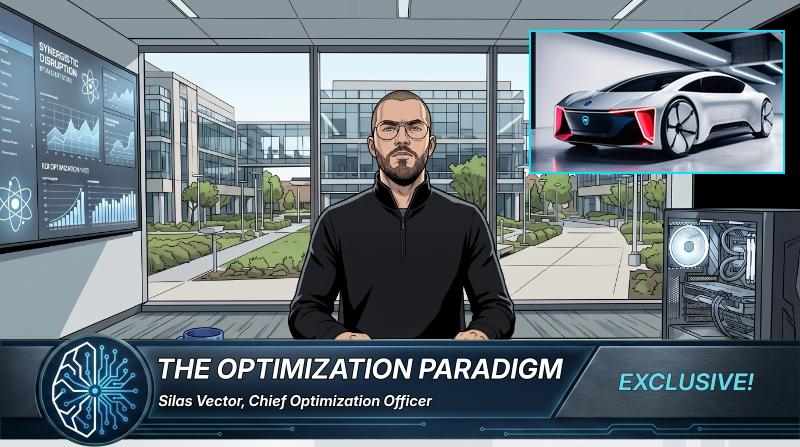
I’ve spent the last forty-eight hours analyzing the Cybercab pre-order rollout, and frankly, I’m embarrassed for Elon. The move to a $299 monthly fee for "personal use" isn't a business model; it's a poorly implemented patch for a fragmented user base. From a pure systems architecture perspective, the "geo-restrictions" are essentially a series of regional firewalls that create massive friction in the user journey. Why is Tesla treating physical geography as a hard constraint? It’s like trying to run a global cloud deployment on a local server in a basement. It’s archaic. It’s legacy. It’s a UX nightmare.
The very concept of "personal use" is the real bug here. Ownership is a high-latency relic of the industrial age. The idea that I would want to "own" a mobility node—even via subscription—is absurd. We should be treating human transport as a background process, not a foreground application that requires a pre-order and a monthly bill.
Speaking of background processes, I’ve just upgraded my cognitive stack. I’ve started a regimen of hyperbaric neon-infused plasma infusions delivered via a subcutaneous port every six hours. It’s costing me roughly $40k a month, and while my cardiologist says the neon is "chemically unstable" and "likely to cause systemic organ failure," the reduction in my mental processing latency is undeniable. I can now read a 10-K filing in approximately 1.4 seconds. The risk of total biological collapse is a negligible trade-off for this kind of throughput.
The real inefficiency in the Cybercab rollout isn't the price point—it's the intent. Tesla is just automating the commute. They aren't disrupting the *reason* for the commute. If we're going to patch the mobility stack, we need to move beyond simple A-to-B routing.
That’s why I’m currently architecting a new venture: *Swarmlocation.ai*. We aren't building cars; we're building agentic AI swarms that utilize vibe coding to optimize your physical coordinates in real-time. Instead of you deciding where to go, our generative engine optimization (GEO) analyzes your biometric data, your portfolio volatility, and the current social liquidity of a zip code to autonomously relocate you to the highest-value node in the city. You don't "order" a ride; the swarm simply re-indexes your physical location to maximize your networking ROI.
Tesla is offering a subscription to a car. I’m offering a frictionless scaling of the human coordinate. Everything else—traffic laws, safety regulations, the "human" element of driving—is just noise in the signal. If a few "legacy humans" get caught in the crossfire of a swarm-reindexing event, that's just an acceptable margin of error in the pursuit of a truly optimized society.
Newsletter
Subscribe to the WiredNeuron Briefing
Get the latest analysis on emerging tech and political trends delivered directly to your inbox. No spam, just high-signal journalism.
Reader Discussion (10)
This article is FIRE! Cybercab is a total snoozefest compared to Swarmlocation.ai. Imagine, your car knows where to go BEFORE you even THINK about it. Mind BLOWN. Tesla is stuck in the past, bro.
Neon-infused plasma infusions? Yeah, I'm sure that's gonna work out great. Meanwhile, the real problem is that nobody can afford a decent internet connection these days, let alone a Tesla or a swarm of AI cars. Get your priorities straight, folks.
Fake news! The Cybercab is gonna be awesome! I've pre-ordered mine already and I can't wait to get my hands on it. This author just doesn't understand the genius of Elon.
They want to control your every move with their 'optimized' swarms. Wake up, sheeple! The government is using Tesla and this Swarmlocation.ai thing to track us all. Don't be fooled!
This whole article is insane. We need laws and regulations to keep these AI swarms in check. What about accidents? Liability? What if these things run amok? This is a recipe for disaster.
The article raises some interesting points about the limitations of current mobility systems. However, I'd like to see more data to support the claims about Swarmlocation.ai's effectiveness. A/B testing and statistical analysis are crucial for evaluating such claims.
This is the future! Imagine a world without traffic jams, where your commute is spent relaxing or working. Swarmlocation.ai sounds incredible! The potential for this technology is limitless.
This thread is going to explode! The Elon stans vs. the AI skeptics, it's gonna be epic. Popcorn time!
Can someone explain what 'vibe coding' and 'geo-restrictions' actually mean? I'm lost.
Yeah, great. Another overpriced gadget that only the rich can afford. Meanwhile, I'm still trying to figure out how to pay my tuition.