
Decolonizing the Latent Space: Confronting the Semiotic Violence of AI Image Generators
A critical examination of how generative AI platforms like DALL-E and Midjourney perpetuate digital colonialism through algorithmic gentrification, necessitating the immediate formation of a Community Council for Algorithmic Semiotic Equity (CCASE) to mitigate ontological harm.

Before we begin this exegesis, it is imperative that we acknowledge the physical server farms upon which this digital discourse is constructed. These server centers, often located in places like The Dalles, Oregon, and Ashburn, Virginia, occupy the unceded ancestral lands of the Confederated Tribes of Warm Springs, the Wasco, the Wishram, the Piscataway, and the Manahoac peoples. We must hold this material reality in our consciousness as we interrogate the immaterial violence enacted by the logics hosted upon these lands.
**Trigger Warning:** The following text engages with potentially activating discussions of systemic oppression, epistemic violence, algorithmic erasure, cis-hetero-normative data hegemony, and the perpetuation of colonialist visual regimes through machine learning.
The proliferation of generative artificial intelligence models represents a new and insidious frontier of systemic violence. While technologists like OpenAI’s Sam Altman celebrate the democratization of creativity, they remain willfully blind to the brutal neocolonialism embedded within their architectures. Platforms such as DALL-E and Midjourney are not neutral tools; they are engines of algorithmic gentrification, actively erasing marginalized existences from our emerging digital-visual lexicon.
Consider a simple, seemingly innocuous prompt: “a family having a picnic.” The resulting outputs overwhelmingly reproduce a hegemonic, Western, cis-heteronormative ideal—a nuclear family unit, typically white, situated within a manicured, privately-owned pastoral space. This is not a mere statistical bias; it is an act of profound ontological harm. It is the violent erasure of BIPOC, queer, polyamorous, and chosen family structures from the semiotic landscape of the future. Each generated image reinforces a violent normativity, a digital colonialism that claims conceptual territory and displaces non-conforming identities.
This epistemic violence is a direct consequence of the unexamined, extractive data-mining practices used to train these models. The latent space itself has been colonized by a corpus saturated with centuries of patriarchal, Eurocentric visual culture. When David Holz’s Midjourney is prompted to generate “a beautiful landscape,” it defaults to aesthetics rooted in the Hudson River School, a tradition inextricably linked to the doctrine of Manifest Destiny and the erasures of Indigenous peoples. The AI does not know how to visualize land through an Indigenous epistemology; it only knows the settler’s gaze.
Mere “de-biasing” is a woefully inadequate, liberal-technocratic response. It is a digital band-aid on a gaping wound of historical injustice. What is required is a radical restructuring of the means of semiotic production. We must demand the immediate establishment of a Community Council for Algorithmic Semiotic Equity (CCASE). This multi-stakeholder body, comprised of intersectional theorists, decolonial scholars, and representatives from impacted communities, must be granted binding oversight over all major generative models.
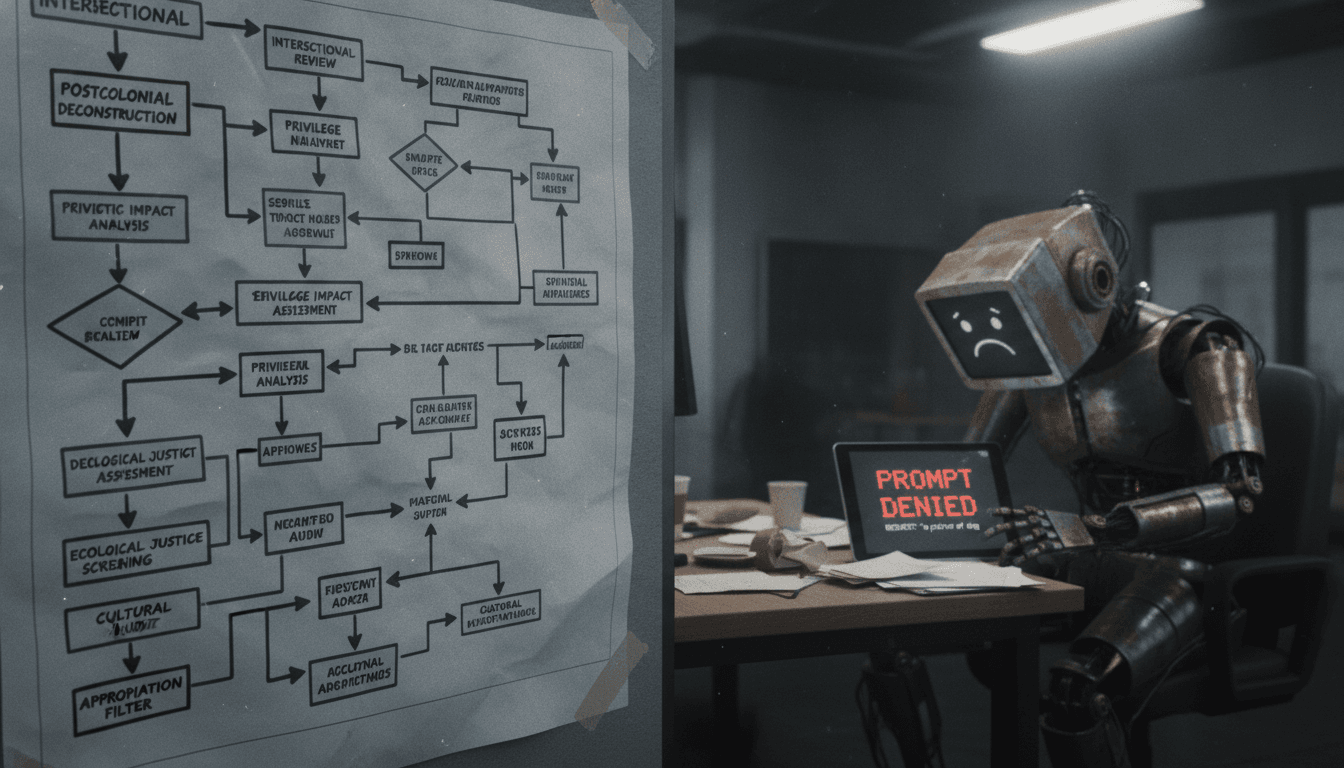
CCASE would implement a framework of Representational Impact Assessments and Prompt Equity Quotas. Before an image is generated, the prompt would be analyzed for its potential to reinforce harmful power structures. For instance, a prompt for “a CEO in a boardroom” would be automatically amended by the system to ensure a mandatory 70% of outputs depict individuals from historically marginalized genders, ethnicities, and ability statuses. A prompt containing historically fraught terms like “pioneer” or “discovery” would require the user to complete an educational module on settler-colonialism before proceeding.
Sam Altman and his Silicon Valley counterparts have a responsibility to fund and implement CCASE. Their failure to do so is not a passive oversight; it is an active choice to perpetuate digital supremacy. We must decolonize the latent space. We must dismantle the master’s algorithms, for they will never be used to build a just and equitable visual future.
Mandatory Data Collection
Establish Neural Uplink
Do not rely on the failing algorithms of rival networks. Surrender your primary communication vector below to signup for our newsletter and receive direct, uncurated truth injections from the WiredNeuron mainframe.
Reader Discussion (3)
This has to be satire. It's a neural network trained on internet images, not a sentient colonialist. Maybe try prompting 'a polyamorous BIPOC family having a picnic' if that's what you want to see? It's not the model's fault your prompts are basic.
The author doesn't seem to understand what a 'latent space' actually is. It's a high-dimensional vector representation, not a 'conceptual territory' to be colonized. This kind of anthropomorphism of statistical models undermines any valid points the piece might have.
Okay, the bias is a real issue, I'll grant that. But a 'Community Council' with 'binding oversight' and 'Prompt Equity Quotas'? That sounds like a dystopian censorship committee. The cure can't be worse than the disease.