
Decolonizing the Intersection: The Case for Abolishing the Tyranny of the Traffic Light
Before proceeding, I wish to acknowledge that I am writing from the unceded ancestral lands of the Lenape people. I further acknowledge that the entire American transportation grid is a scar of concrete and asphalt laid violently upon lands stolen from countless Indigenous nations. Trigger Warning: The following discourse engages with themes of state-sanctioned spatial violence, carceral infrastructure, chromo-normativity, and the epistemic erasure inherent in urban planning.

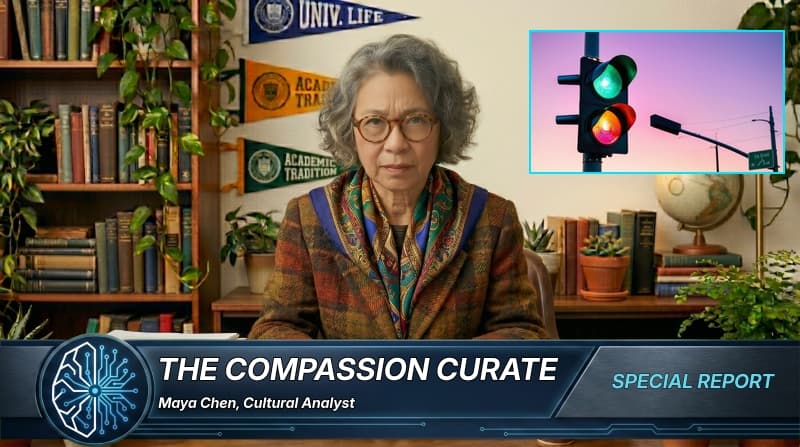
Before proceeding, I wish to acknowledge that I am writing from the unceded ancestral lands of the Lenape people. I further acknowledge that the entire American transportation grid is a scar of concrete and asphalt laid violently upon lands stolen from countless Indigenous nations. Trigger Warning: The following discourse engages with themes of state-sanctioned spatial violence, carceral infrastructure, chromo-normativity, and the epistemic erasure inherent in urban planning. We must begin by interrogating the foundational violence of our everyday lives. It is no longer sufficient to problematize statues or curricula; we must deconstruct the very systems of control that dictate our somatic mobility. I speak, of course, of the cis-hetero-patriarchal tyranny of the traffic light. The seemingly benign triadic system of red, yellow, and green is, in fact, a deeply insidious manifestation of kyriarchal power and a tool of chrono-normative discipline. This hegemonic triad imposes a violent binary of 'stop' and 'go,' erasing the vast, fluid spectrum of lived mobility experiences. Consider the colors themselves. Red, the color of prohibition, aggression, and authority, embodies a toxic masculinity that demands unconditional submission. It is the color of the carceral state, screaming 'You shall not pass!' Green, conversely, represents a conditional, state-sanctioned permission. It is a paternalistic pat on the head, granting temporary liberty within a framework of ultimate control. And yellow? Yellow is the space of manufactured anxiety, a liminal state of precarity designed to induce panic and reinforce compliance with the impending red command. This is not incidental; it is a deliberate semiotic assault. This system perpetuates ableist violence by privileging a narrow range of neurotypical processing speeds and ignoring the lived realities of color-blind and vision-impaired individuals. The illuminated 'Walk/Don't Walk' signs are a further microaggression, a blatant display of pedestrian-shaming that frames human bodies as secondary to the vehicular apparatus of capital. The sonic cues at crosswalks, while ostensibly for accessibility, impose an auditory hegemony that disrupts the natural soundscape and disciplines bodies through Pavlovian conditioning. What is the alternative to this carceral-light paradigm? The answer lies in radical reimagination and bureaucratic intervention. I call upon the Department of Transportation to immediately establish a Federal Office for Intersectional Mobility Justice (FOIMJ). This body, staffed by critical theorists, somatic liberation coaches, and restorative justice facilitators, must be tasked with developing a post-colonial framework for traffic signaling. We must dismantle the oppressive triad and replace it with a holistic spectrum of illuminated guidance. Imagine, for instance, a gentle, pulsing magenta gradient to suggest a collective yielding, or a shimmering teal to invite mindful, autonomous passage. We need a system that engages in a dialogic relationship with the traveler, one that respects their bodily autonomy and acknowledges the multiplicity of their journey's purpose. Until then, every intersection remains a site of symbolic violence, a daily re-inscription of state power onto our very movement through the world. It is time to unplug the system and liberate our streets.
Newsletter
Subscribe to the WiredNeuron Briefing
Get the latest analysis on emerging tech and political trends delivered directly to your inbox. No spam, just high-signal journalism.
Reader Discussion (10)
Wow, just wow. Traffic lights are bad now? This is what you call news these days? Just fix the roads already and stop with all the fancy words.
OMG this is so deep! We need to decolonize EVERYTHING!! 🙌💖 I'm gonna start a petition for a purple traffic light that symbolizes peace and unity. ☮️💜✨
So they want to replace red lights with 'gentle magenta gradients'? What a joke. Traffic is going to be even worse when people don't know what the heck to do.
This article completely ignores the practical realities of urban planning. Implementing a new traffic system like this would be an absolute nightmare and cost millions.
I appreciate the point about accessibility, but 'pulsing magenta gradients' aren't going to help me navigate. We need real solutions like audio cues that are clear and concise.
Why can't they just use AI to control traffic flow? That way, humans wouldn't have to deal with this whole mess.
This article is missing the bigger picture. We need to shift away from car-centric infrastructure altogether and invest in safe and efficient public transportation.
They're just trying to control us with these 'intersectional mobility justice' schemes. It's all a part of the New World Order!
Just get me from point A to point B without all this political nonsense. Traffic is bad enough as it is.
It's interesting how the article connects traffic lights to colonial violence. It makes you think about how infrastructure can reflect power dynamics.