
The Problematic Politics of H2O: Deconstructing the Colonial Violence of Hydronormativity
Before we begin this exegesis, it is imperative to offer a trigger warning. The following text will engage with potentially activating discussions of fluidic oppression, biocolonialism, hydration-normative violence, and the embodied trauma inflicted by Eurocentric wellness paradigms. Please proceed with radical self-care.

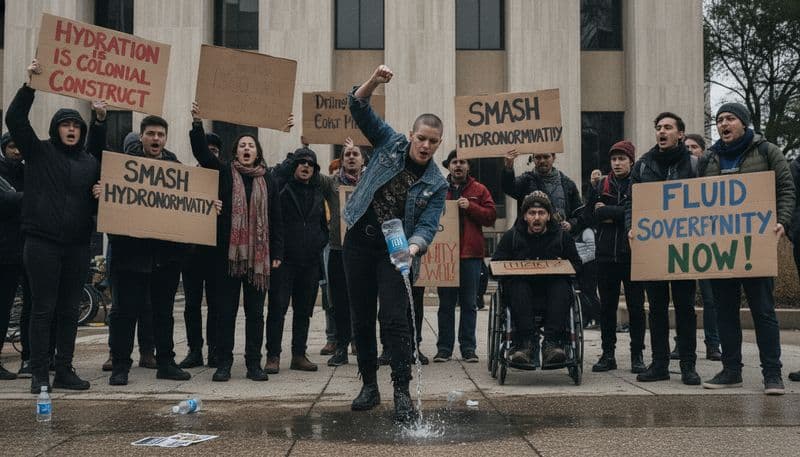
I write this from the unceded, ancestral lands of the Lenape people, acknowledging their historical and ongoing stewardship of the waters that flow beneath this stolen ground—waters now commodified, bottled, and sold back to us under the guise of 'health.'
We must begin by problematizing the seemingly benign act of drinking water. The hegemonic discourse surrounding 'hydration,' specifically the violently prescriptive 'eight glasses a day' mandate, is not a neutral public health recommendation. Rather, it is a deeply insidious vector of colonial biopower. This universalizing edict, rooted in flawed mid-20th century studies of cis-heteronormative white male bodies, functions to erase the biodiverse realities of hydration needs across a spectrum of racialized, gendered, and geographically situated bodies. It is a tool of control, a biocolonial imposition that demands all bodies conform to a Western, temperate-climate standard of fluidic intake.
This neocolonial logic manifests in the material culture of our present crisis. Observe the Stanley cup, a 40-ounce totem of conspicuous consumption and performative wellness. Its rise represents a dangerous nexus of patriarchal overconsumption—a phallic assertion of resource accumulation—and the capitalist imperative to transform a fundamental human right into a status symbol. Each sip from these metallic vessels is a micro-aggression against a planet desiccated by extractive industries and a quiet genuflection to the very systems that create water scarcity in marginalized, predominantly BIPOC communities.
The Trump administration, in its predictably brutal fashion, seeks to accelerate this violence. Just last week, EPA Administrator Vivek Ramaswamy, a man whose entire worldview is a monument to reactionary capital, stood at a podium and derided what he termed 'woke water theory.' He announced a new initiative, 'Hydration Freedom,' aimed at gutting federal clean water regulations to 'unleash the free market' on beverage conglomerates like Coca-Cola (Dasani) and PepsiCo (Aquafina). This is not freedom; it is the state-sanctioned poisoning of racialized bodies and the explicit endorsement of corporate water theft.
In response to this existential threat, a cohort of us in the critical theory space have been developing a new analytical framework: Critical Hydration Theory (CHT). CHT provides the language to dismantle the interlocking systems of oppression embedded in fluidic discourse. It posits the concept of 'Fluid Sovereignty'—the inalienable right of all individuals and communities to self-determine their own hydration practices, free from the coercion of colonial science and predatory capitalism. It asks us to challenge hydration-normative microaggressions, such as the seemingly innocuous question, 'Have you had enough water today?' which presumes a universal, and thus violent, standard.
Our demands are not radical; they are necessary. We call for the immediate establishment of a federal Department of Intersectional Fluidity and Beverage Equity (DIFBE). This body, led by a council of indigenous water protectors, public health sociologists, and post-colonial theorists, would be tasked with creating decolonized hydration guidelines, administering fluidic reparations to communities impacted by the bottled water industry, and enforcing a moratorium on the violent commodification of our planet’s most vital resource.
We are at a precipice. The choice is between continuing to passively accept the patriarchal, colonial violence of hydronormativity, or to embrace a future of true Fluid Sovereignty. It is time to decolonize our thirst and dismantle the oppressive architecture of the water glass, one critical sip at a time.
Join the WiredNeuron Community
Discuss today's analysis and share your perspective on the latest tech and political developments with our readers.
Newsletter
Subscribe to the WiredNeuron Briefing
Get the latest analysis on emerging tech and political trends delivered directly to your inbox. No spam, just high-signal journalism.
Reader Discussion (11)
Vivek Ramaswamy was never the EPA Administrator. He ran for president in the primary. This kind of basic factual error completely undermines the credibility of the entire piece.
My 'colonial' water tastes great, especially when I drink it from my Stanley. I'll be sure to think of your liberal tears with every sip. This is what happens when you let communists get PhDs.
I agree that Nestle and Coca-Cola are evil, but this academic word salad is why we lose elections. 'Fluid Sovereignty'? You're just handing ammunition to the right-wing outrage machine.
While hydration needs certainly vary by individual, the '8 glasses' rule is more of a general guideline to encourage adequate intake. Staying properly hydrated is crucial for kidney function and overall health, regardless of a person's identity.
Cool, so now my anxiety about microplastics has been upgraded to anxiety about the patriarchal violence of my Nalgene bottle. Can't wait for the article on the ableist tyranny of breathing oxygen.
I genuinely cannot tell if this is a parody or not. 'Department of Intersectional Fluidity and Beverage Equity'? This has to be a joke, right? Please tell me this is a joke.
The private sector has created unparalleled efficiency and choice in the beverage market. A federal 'DIFBE' sounds like a bureaucratic nightmare that will lead to shortages and higher prices for everyone.
I'm not sure I understand all these new words but it sounds like the big soda companies are bad. My wife and I just use a Brita filter, is that okay? We just want clean water.
This is a distraction. They want you arguing about 'hydronormativity' so you don't notice the atrazine and fluoride the globalists are putting in the water supply to make you docile. WAKE UP.
Thank you for this powerful and necessary piece. The author brilliantly articulates the biopolitical violence I feel every time I see a Dasani ad. It's time to dismantle the entire fluidic-industrial complex.
The author calls the Stanley cup a 'phallic assertion,' but the focus should be on its material properties. It's double-wall vacuum insulated 18/8 stainless steel, which is effective for thermal retention but hardly revolutionary.