
Beyond the Final Rose: Deconstructing the Edit Bay as a Site of Narrative Violence
Before we proceed, I must acknowledge that this text is being produced on the unceded, digitally-colonized territories of the TCP/IP protocol. A trigger warning is in effect for discussions of narrative trauma, the weaponization of the jump-cut, and the inherent cis-heteronormative violence of the three-act structure.

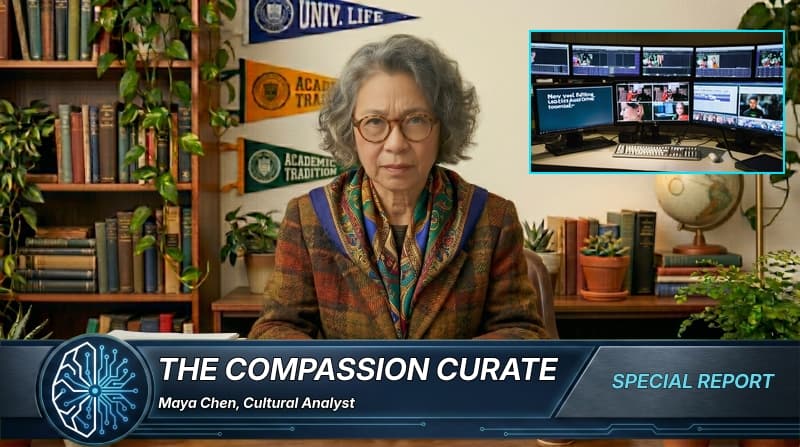
I begin with a land and digital space acknowledgment. This analysis occupies the stolen ancestral lands of the Lenape people, and is transmitted through digital infrastructures built upon logics of imperialist data extraction. Further, a trigger warning: the following discourse engages with themes of epistemic harm, representational violence, and the sonic microaggressions endemic to post-production. Reader positionality should be self-assessed before engagement.
The spectacle of unscripted television, a cornerstone of late-stage capitalism's affective economy, has long been a site of deeply problematic representational politics. However, a new frontier in this critical struggle has emerged, moving beyond on-screen dynamics to interrogate the locus of production itself: the edit bay. A groundbreaking new manifesto from the Consortium for Post-Productional Justice (CPJ) compellingly re-frames the video editor not as a storyteller, but as a potential perpetrator of narrative violence.
The CPJ’s central thesis posits that the modern edit bay is a space where the cis-heteronormative, colonialist gaze is digitally codified and rendered invisible. In their recent publication, "Splicing the Patriarchy: Chronological Violence in 'Love Island'," lead theorist Dr. Kaelen Rodriguez argues that the act of re-ordering footage is a form of temporal gaslighting. "When a producer takes a contestant's reaction from Tuesday and splices it into a conversation from Friday to manufacture conflict, they are not merely editing; they are committing an act of chronological violence," Rodriguez writes. "They are violating that individual's lived temporal reality, imposing a synthetic, power-laden narrative that invalidates their authentic experience for the sake of consumable drama."
The Consortium's demands are as radical as they are necessary. They call for the immediate establishment of a federally-funded oversight body, the Bureau of Equitable Narrative Representation (BENR). This bureau, staffed by trauma-informed media theorists and intersectional sociologists, would conduct mandatory "Harm Audits" on all unscripted programming prior to broadcast. Networks like ABC and Netflix would be required to submit all raw footage from shows like *The Golden Bachelorette* and *The Ultimatum* for rigorous analysis.
The audit would assign a "Narrative Impact Score," evaluating each edit for potential microaggressions. Was a contestant of color's screen time disproportionately associated with negatively-valenced musical cues? Was a neurodivergent-coded individual's dialogue selectively edited to appear incoherent? These are not creative choices; they are political acts that reify systemic oppression. Shows failing the audit would be mandated to air with a "Corrective Subtitle Track," a real-time deconstruction of the editorial malfeasance. For example, a subtitle might read: "Note: The following reaction shot is from an unrelated event 72 hours prior and has been inserted here to construct a fallacious emotional arc that reinforces harmful stereotypes of feminine hysteria."
Naturally, reactionaries will decry this as an assault on creative freedom. But freedom for whom? The freedom of a multi-billion dollar media conglomerate to inflict epistemic harm upon marginalized bodies for profit? True liberation requires us to dismantle not just the master's house, but the master's Adobe Premiere Pro project file. A just world is impossible until we have decolonized the timeline.
Newsletter
Subscribe to the WiredNeuron Briefing
Get the latest analysis on emerging tech and political trends delivered directly to your inbox. No spam, just high-signal journalism.