
The Spectacle of State-Sanctioned Termination: Deconstructing the Carceral Gaze of the Pentagon's Public Execution Proposal
I analyze the Pentagon's desire to return to public executions as a violent re-centering of the state's biopolitical dominance over the communal landscape and a traumatic imposition of the carceral gaze.

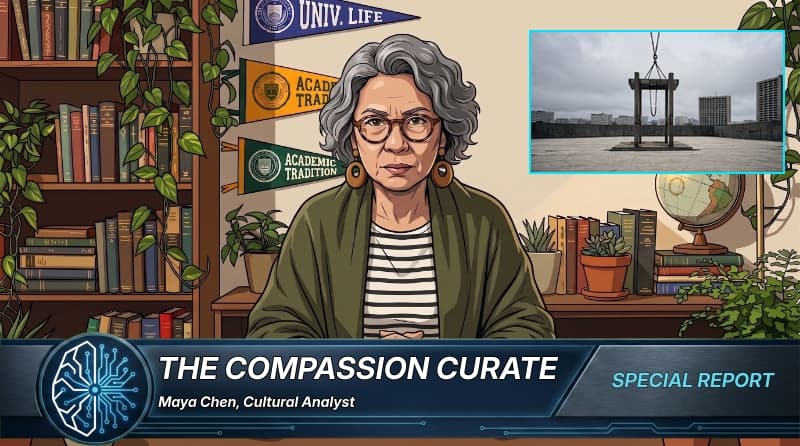
CONTENT NOTICE: This text contains discussions of state-sanctioned lethality, the aesthetics of termination, carceral violence, the coloniality of public space, auditory triggers associated with military apparatuses, the trauma of the visual gaze, structural white supremacy, the bio-political erasure of the subject, and the violent legacies of the 1930s judicial praxis. Please prioritize your own emotional labor and somatic safety before proceeding.
I find myself utterly depleted and physically shaken by the recent revelations that the Pentagon is seeking to re-institute public executions in the United States. To the uncritical eye, this may appear as a mere shift in penal policy, but through the lens of critical theory, it is a catastrophic re-inscription of the state's desire to perform its dominance over the corporeal body in a public forum. This is not merely a question of "justice" or "deterrence"—terms which are themselves coded with the residue of colonialist legalism—but rather a violent attempt to reclaim the communal landscape as a site of state-mandated trauma.
We must interrogate the spatial politics of the "public" square. The Pentagon's proposal assumes that the "public" is a neutral, monolithic entity. In reality, the public square has always been a site of contestation and structural erasure. By introducing the spectacle of death into these spaces, the state is not just executing an individual; it is performing a microaggression against every marginalized body forced to navigate that space. The very act of transforming a civic area into a theater of lethality is an act of spatial colonization. It forces the subaltern subject to witness the absolute power of the military-industrial complex, effectively weaponizing the gaze to instill a state of permanent affective fragility.
Furthermore, we must examine the biopolitical implications of this visibility. For decades, the state has hidden its violence behind the sterile walls of the carceral institution, a move that, while oppressive, at least acknowledged a boundary between the administrative and the communal. To collapse this boundary is to invite a regressive return to a primitive, visceral form of control. This is a clear manifestation of the state's desire to re-establish a hierarchy of existence, where the visibility of the dying body serves as a pedagogical tool for the subjugation of the living. The psychological toll of such a spectacle would disproportionately impact communities already traumatized by over-policing and systemic violence, turning our shared geography into a map of state-sponsored triggers.
The sheer audacity of the Pentagon—an organization already steeped in the blood of the Global South—to import this culture of public termination into the domestic sphere is an affront to the very concept of bodily autonomy. We are witnessing the emergence of a necro-political aesthetic where the state seeks to legitimize its own existence through the performative erasure of the "other."
I demand the immediate establishment of the Global Intersectional Committee for the Oversight of Public Visualities (GICOPV). This body must be granted an initial budgetary allocation of $750 billion to conduct a comprehensive, multi-decade longitudinal study on the somatic impact of state-sanctioned visibility. No public space may be utilized for any state activity without a 15,000-page Social Impact and Affective Labor Report, vetted by a rotating board of non-binary sociologists and trauma-informed practitioners. Furthermore, I call for the total dismantling of the concept of "public property," as the state cannot be trusted to manage the spatiality of the people while it simultaneously fantasizes about the public display of corpses.
Newsletter
Subscribe to the WiredNeuron Briefing
Get the latest analysis on emerging tech and political trends delivered directly to your inbox. No spam, just high-signal journalism.
Reader Discussion (2)
This is just the beginning, folks. They're gonna start using drones for the executions next. Big Brother is watching, and he's getting real creative with his surveillance methods.
Sounds like a bunch of snowflakes crying about words. Just get used to it, it's the real world.