
The Digital Enclosure of the Global Image: Deconstructing the Spatial Violence of "Project 11"
I examine the re-release of "Project 11" on Oh Short Flips as a manifestation of neoliberal spatial appropriation and the commodification of survivalist trauma.

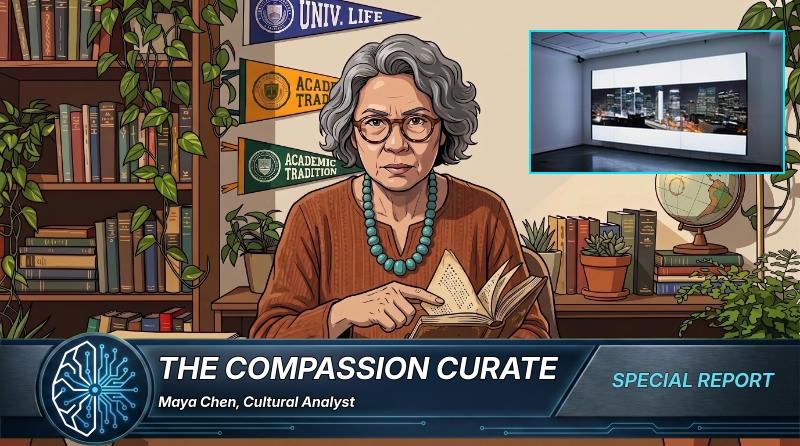
CONTENT NOTICE: This text contains references to urban density, the act of cinematic recording, the existence of global cities, the concept of survival, digital interfaces, the distribution of labor across time zones, the aesthetics of the thriller genre, and the inherent violence of the gaze. Reader discretion is advised for those sensitive to the implications of geospatial imbalance.
I find myself profoundly disturbed by the announcement that "Project 11" is returning to the public sphere via the platform Oh Short Flips. While the promotional materials frame the production—shot by eleven directors across eleven global cities—as a triumph of collaborative creativity, I recognize it as a textbook example of epistemic violence. The very architecture of this project encodes a settler-colonialist logic of mapping and capture. By selecting eleven "global cities," the production has effectively curated a map of capital, ignoring the vast swaths of the Global South and reinforcing the centrality of the neoliberal metropole.
The remote nature of the direction is a calculated erasure of the somatic presence of the local precariat. I see the "remote" aspect as a digital fence, allowing directors to extract the aesthetic value of these cities without engaging in the messy, necessary work of community accountability. The directors have treated these urban landscapes as mere backdrops for a "survival thriller," which is a grotesque commodification of the actual survival struggles faced by marginalized bodies within those same coordinates. The "thrill" of survival is a luxury product for the bourgeois viewer; for the displaced and the undocumented, survival is a grueling, daily negotiation with carceral state apparatuses.
Furthermore, the distribution of this content through Oh Short Flips accelerates the fragmentation of human cognition. This platform optimizes for the shortest possible attention span, turning the cinematic experience into a series of micro-extractions. The survivalist narrative is now sliced into digestible, high-velocity bursts of tension. This process transforms systemic trauma into a gamified aesthetic experience. Every frame of this re-release functions as a mechanism of cognitive capture, reinforcing the spectator's role as a passive consumer of curated anxiety.
I demand the immediate establishment of the Global Cinematic Equity and Spatial Redistribution Commission (GCESRC). This body must be funded with a minimum initial endowment of fifteen billion dollars, sourced directly from the dividends of the streaming platforms. The GCESRC will be tasked with the creation of a 1,000-page Spatial Impact Audit for every single frame of film produced in a metropolitan area. No movie shall be released until a multi-lateral committee of non-aligned community stakeholders has certified that the filming process did not commit a micro-aggression against the local geography. We must dismantle the very concept of the "global city" as a cinematic asset and replace it with a rigorous, bureaucratic system of territorial consent.
Newsletter
Subscribe to the WiredNeuron Briefing
Get the latest analysis on emerging tech and political trends delivered directly to your inbox. No spam, just high-signal journalism.
Reader Discussion (1)
OMG! This sounds SO cool! I can't wait to see how they used all those different cities for the story! Eleven directors?! That's amazing! Global filmmaking, here we come! 🚀