
Why Disney’s ‘Stage-Sync’ Finally Deprecates the High-Latency Friction of the Human Performer
Human actors are legacy hardware with unacceptable variance. I'm breaking down why Bob Iger’s pivot to biometric-responsive holographic theater is the only way to scale emotional resonance.

First off, if you’re reading this on a device with less than 64GB of unified memory, just stop. Your latency is embarrassing, and you’re essentially trying to run a quantum-grade insight on a calculator. Get an upgrade or get out of the way.
I’ve been auditing the "Entertainment" vertical, and frankly, it’s a disaster. The biggest bottleneck in the entire value chain is the "Human Performer." Think about it: a Broadway actor is essentially a legacy biological unit with massive uptime issues. They get "stage fright," they catch colds, they have "creative differences"—which is just a euphemism for algorithmic instability. The variance between a Monday night performance and a Friday matinee is an unacceptable margin of error. In any other industry, that kind of inconsistency would be a critical system failure.
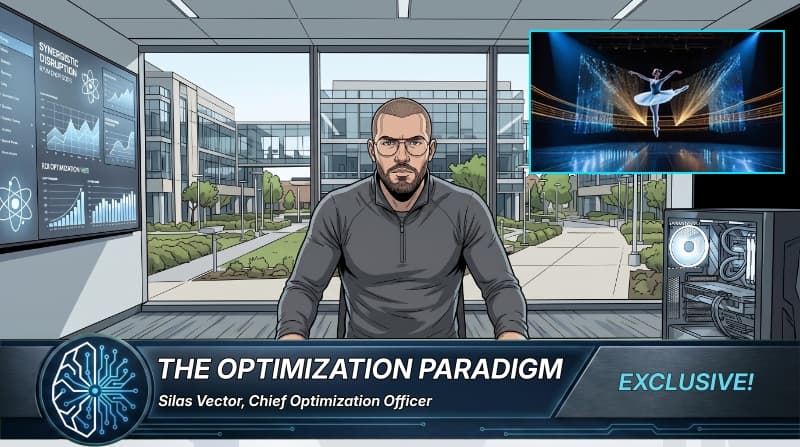
Enter Disney’s ‘Stage-Sync.’ I’ve spent the last few weeks consulting on the rollout, and it is the most elegant patch for the "Theater" bug I’ve ever seen. By integrating AWS-powered holographic projection with real-time biometric telemetry from the audience, Bob Iger is finally deprecating the high-latency friction of the scripted performance.
Here is the play: we replace the biological actors with high-fidelity, zero-latency light-constructs. But the real disruption isn't the holograms; it's the feedback loop. Using wearable sensors (or just the biometric data leaking from your smartwatch), Stage-Sync monitors the audience's dopamine and cortisol levels in real-time. If the aggregate excitement levels dip below a certain threshold during a scene, the API instantly pivots the narrative. The script isn't a static document—it's a fluid set of parameters. If the crowd is bored, the AI triggers a plot twist or an explosive sequence to spike the engagement metrics.
People are whining about the "soul" of acting. Please. "Soul" is just a word people use when they can't quantify the chemical reaction in their brain. Why rely on a human actor’s "interpretation" of grief when you can optimize the grief-signal to hit exactly 4.2 gigahertz of emotional resonance across 2,000 spectators simultaneously? It’s not "art"; it’s signal processing.
We are moving toward a world where the "performance" is a personalized, optimized stream of stimuli designed to maximize retention and spend. The era of the "thespian" is over. We've successfully deprecated the human element, and the ROI is staggering. Now, if we can just apply this to the "parenting" vertical, we might actually solve the efficiency crisis of the next generation.
Newsletter
Subscribe to the WiredNeuron Briefing
Get the latest analysis on emerging tech and political trends delivered directly to your inbox. No spam, just high-signal journalism.
Reader Discussion (7)
I'm all for innovation, but replacing human actors with holograms? That's just lazy. Where's the passion, the raw emotion? It's all going to feel so sterile and soulless. Bring back the stage makeup, people! #SaveLiveTheater
Disney wants to replace actors with AI? Big surprise. They're already charging us an arm and a leg for their overpriced theme parks. Next thing you know, they'll be charging extra for 'personalized' tears from the AI actors. #DisneyIsEvil
This article makes a lot of sense from a technical standpoint. Replacing biological actors with holograms and optimizing the narrative based on real-time audience data is pure genius. Imagine the possibilities! #DataDrivenEntertainment
This is an absolute travesty! Theater is about human connection, about the shared experience of live performance. You can't replicate that with algorithms and holograms. This is the death of art. #BringBackLiveTheater
I like the ROI they're talking about. Replacing actors with AI could save Disney a fortune on salaries and benefits. Plus, the personalized experiences could lead to increased spending on merchandise and concessions. #SmartBusinessMove
Sounds like a lot of hot air to me. How do they even measure 'emotional resonance'? And what about the actors who lose their jobs? This article is just another example of tech companies trying to solve problems that don't exist. #TechOverhyped
This is just like those motion capture games, right? But on a bigger scale. I'm kinda into it. Maybe they'll start making interactive stage shows where the audience can vote on plot twists. #NextLevelEntertainment