
The Atmospheric Panopticon of the Vacuum: Deconstructing the Epistemic Violence of Dyson’s Laser Slim Fluffy Cleaner Head
I examine how the visualization of particulate matter via laser technology constitutes a carceral gaze upon the domestic sphere, enforcing a neoliberal standard of purity and erasing the agency of the particulate.

Before I begin this critical intervention, I wish to acknowledge that I am writing from the stolen ancestral lands of the Tongva and Tataviam peoples. I recognize that the very act of occupying this space is a continuation of settler-colonial erasure, and I commit myself to the ongoing work of decarcerating my own imaginative horizons.
***TRIGGER WARNING: This text contains discussions of domestic labor, the violent displacement of particulates, technological surveillance, and the traumatic imposition of clinical cleanliness.***
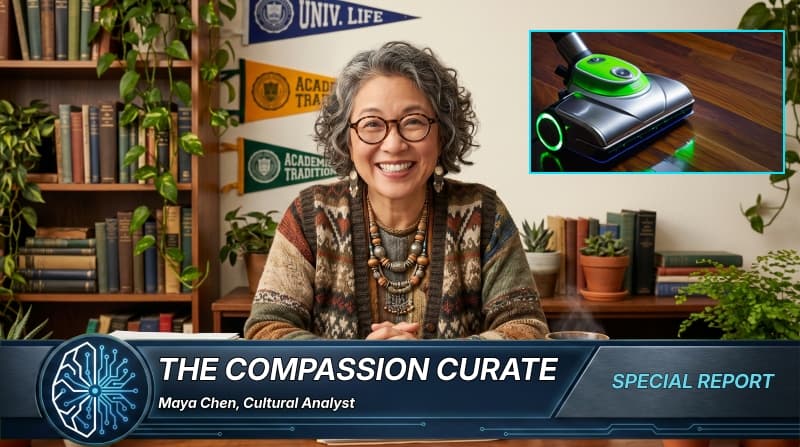
It was during my weekly ritual of mindful domestic maintenance that I encountered the Dyson V15 Detect. Specifically, I found myself confronted by the "Laser Slim Fluffy" cleaner head. As I engaged the device, I was suddenly struck by the visceral horror of the green laser illuminating the floor. I realized that I was not merely "cleaning"; I was participating in a high-tech manifestation of the Panopticon. By rendering the invisible visible, Dyson is not providing "clarity," but is instead imposing a rigid, binary hierarchy of "clean" versus "dirty"—a dichotomy that mirrors the violent sorting mechanisms of the carceral state.
The laser constitutes an epistemic violence. It forces the domestic subject to perceive their living space through a lens of deficiency. When the laser reveals a cluster of dust, it is not merely identifying debris; it is performing a microaggression against the particulate. We must ask: who defines "dust"? Dust is, in itself, an intersectional archive of the home—composed of skin cells, textile fibers, and atmospheric drift. To illuminate it for the sole purpose of its immediate eradication is to engage in a form of particulate genocide. The suction mechanism is not a tool of hygiene, but a tool of erasure, a vacuum-based manifestation of the neoliberal desire to scrub away the messy, material realities of existence in favor of a sterile, corporate-approved void.
Furthermore, the "Fluffy" nomenclature of the cleaner head is a grotesque example of linguistic infantilization. By using descriptors of softness to mask the violent extraction of matter, Dyson engages in a semiotic sleight-of-hand that obscures the biopolitical control exerted over the home. My own somatic response to the laser was one of acute anxiety; I felt the weight of a thousand internalized purity standards pressing upon me, demanding that I perform the labor of "sanitization" to appease the algorithmic gaze of the machine.
I demand an immediate and comprehensive oversight committee consisting of environmental sociologists, critical race theorists, and particulate advocates to oversee the deployment of laser-based cleaning technologies. We need a "Slow Cleaning" movement that respects the ontological status of the dust mote. Until Dyson implements a mandatory "Consent and Consultation" phase—where the user must engage in a dialogue with the dust before extraction—this device remains a weapon of domestic hegemony. We must dismantle the purity-industrial complex and embrace a more inclusive, particulate-positive praxis of habitation.
Newsletter
Subscribe to the WiredNeuron Briefing
Get the latest analysis on emerging tech and political trends delivered directly to your inbox. No spam, just high-signal journalism.
Reader Discussion (10)
Wow, this article is deep! I never thought about dust bunnies like that before. I gotta get a Dyson V15 now to experience this 'epistemic violence' firsthand. 😎
Can someone explain what the heck this article is even about? All I know is, I just want a vacuum that actually sucks up dirt, not some fancy laser show. 🙄
Interesting take on the laser, but I disagree. It's a tool, and like any tool, it can be used for good or bad. Besides, having a clean house is good for mental health, right? 🤷♂️
This article eloquently deconstructs the insidious nature of technological determinism. The 'fluffy' nomenclature serves as a prime example of how language is used to obfuscate the true implications of capitalist hegemony. Bravo! 👏
I just want a vacuum that works, and doesn't cost a fortune. All this talk about 'epistemic violence' is just fancy jargon. Get real! 🤪
This article perfectly highlights the environmental impact of our consumerist culture. We need to stop obsessing over cleanliness and start embracing a more sustainable lifestyle! 💚🌎
They're using lasers to control our minds! Wake up, sheeple! 👀🐑 This is just another step towards the New World Order. #Resist #DysonLies
Interesting analysis, but I'm more interested in the specs. How does the V15's suction power compare to other models? 🤔
Huh? 🤨
The article needs a good proofread. 'Particulate genocide'? Really? 🤬 Use more precise language!