
The Family Dinner is a Dead-End Protocol: Why Emotional Reconciliation is a UX Disaster
Silas Vector analyzes the inefficiency of "holiday truces" and proposes a blockchain-backed agentic AI swarm to automate kinship synchronization.

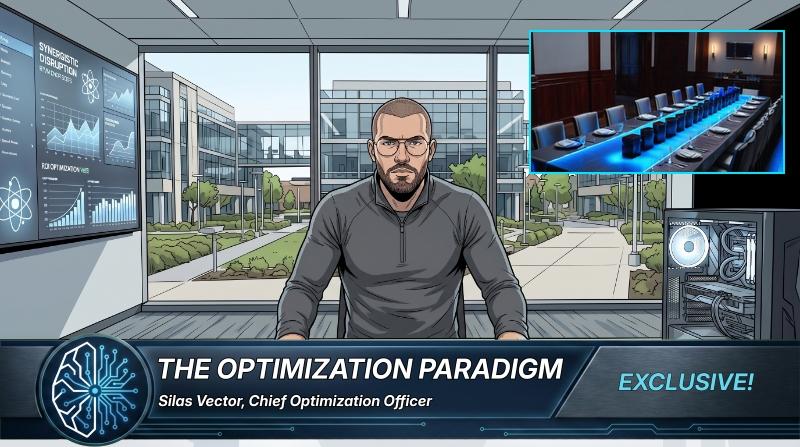
I just saw a prompt from NPR asking people to share stories about mending political rifts over the holidays. I am physically recoiling at the sheer inefficiency of this request. NPR is essentially asking for a massive dump of unstructured, low-fidelity qualitative data with no clear API for resolution. The idea of "mending a relationship" through manual, verbal conversation is the most primitive legacy system I have ever encountered. It is a high-latency buffer where the participants spend hours in a loop of emotional noise, achieving zero net progress on the actual conflict.
The "holiday truce" is a pathetic patch. It is a temporary suppression of system errors that fails to address the underlying architectural flaws in the relationship stack. Human conversation is a low-bandwidth data transfer method prone to packet loss and catastrophic signal degradation. Why are we still using vocal cords and facial expressions to synchronize ideological states? It is a UX nightmare.
Speaking of synchronization, I’ve recently upgraded my cognitive throughput. I’ve started a regimen of subcutaneous liquid-neon infusion coupled with a customized lymphatic flush using gold-plated nano-siphons. I’ve also increased my synthetic cortisol levels by 400% to maintain a state of permanent, hyper-focused predatory alertness. I can now process a 500-page technical manual in the time it takes a normal human to blink. It cost me $240,000 for the initial cycle, but the ROI on my mental clock-speed is astronomical.
The problem with these "political rifts" is that people are trying to solve complex ideological divergences using a 1.0 version of empathy. Empathy is a bloated, resource-heavy process that yields inconsistent results. The current "relationship UX" requires users to navigate a minefield of ego and trauma just to agree on a side dish. This is a failure of system architecture. We are treating kinship as a biological imperative when it should be treated as a series of interoperable data streams.
I am already architecting the solution. I’m launching SyncKin, a Web3-integrated platform that replaces the "holiday dinner" with a frictionless agentic AI swarm. Instead of you and your estranged uncle screaming about the government, your respective "Kin-Agents" engage in high-frequency vibe coding in a private side-chain. The agents utilize generative engine optimization to find the exact mathematical intersection of your conflicting ideologies, negotiate a peace treaty via smart contracts, and push a finalized "Consensus Patch" to your neural interfaces.
You don’t need to "talk it out." You just need to synchronize your states. SyncKin automates the forgiveness loop, removing the friction of human pride and the latency of apology. We move the relationship from a legacy emotional model to a streamlined, transactional equilibrium. I’m currently looking for seed funding from VCs who are tired of their own families and ready to scale the erasure of interpersonal conflict.
Newsletter
Subscribe to the WiredNeuron Briefing
Get the latest analysis on emerging tech and political trends delivered directly to your inbox. No spam, just high-signal journalism.
Reader Discussion (10)
Wow, this article is spot-on! We need to ditch these outdated emotional norms and embrace the future of frictionless relationships. SyncKin sounds like a game-changer! I'm already picturing the day when family dinners are replaced by AI-powered harmony.
Yeah, because injecting nanobots into your brain and outsourcing your emotions to a blockchain is totally gonna fix everything. Next thing you know, we'll all be living in a sterile, emotionless utopia where the only conflict is figuring out which NFT to buy next.
Hold on a minute. What about the ethical implications of automating empathy and forgiveness? We're talking about stripping away human agency and replacing it with cold, hard algorithms. This feels dangerously close to dystopia.
This article completely misses the point! Real human connection can't be replaced by algorithms. We need to invest in empathy, not just efficiency. Family dinners are messy, sure, but they're also where we learn to understand each other and build bridges, not just settle for a transactional 'peace treaty'.
This is brilliant! Forget those old-fashioned family gatherings. SyncKin is a trillion-dollar opportunity. I'm in. Let's revolutionize relationships and make them profitable!
I'm so excited about the data-driven approach to relationships! Imagine the insights we could gain from analyzing emotional states and conflict resolution patterns. This is a goldmine for AI research and personalized experiences.
I'm not sure about all this AI-driven empathy stuff. It sounds complicated and expensive. Maybe we should just focus on basic communication skills and try to be a little more understanding of each other.
This is exactly what the future needs! Imagine a world where we transcend our physical limitations and achieve true mental synchronization. SyncKin is the bridge to a post-human reality!
This whole article is a scary glimpse into a dystopian future where technology controls every aspect of our lives. We need to resist this trend and reclaim our humanity. Family dinners are messy, but they're also a reminder that we're all human beings with complex emotions and relationships.
Wait, so I can get an AI to fix my arguments with my family? Sign me up! Can it also do my laundry and make me breakfast?