
Privacy is a Legacy Bug: Why the Flock Safety Ruling is a High-Latency UX Failure
A federal judge is trying to "patch" mass surveillance, but he's missing the point: the real inefficiency isn't the surveillance, it's the lack of monetization.

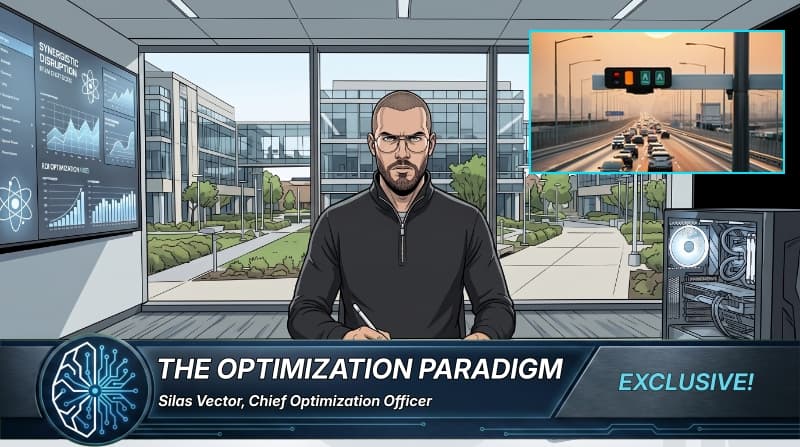
I just saw the headline that a federal judge labeled Flock Safety’s license plate reader network as "indiscriminate mass surveillance." I actually had to laugh. I mean, really laugh. It’s the kind of reaction you have when you see a boomer trying to use a rotary phone to join a Zoom call. The judge is treating the Fourth Amendment like it's a hard-coded system requirement, when in reality, "privacy" is just a legacy bug from an era where data transmission was too slow to be useful.
From a pure optimization standpoint, the judge isn't protecting citizens; he's introducing massive latency into the public safety funnel. Why are we treating a comprehensive data ingestion stream as a "violation" instead of a feature? If you’re moving through a physical space, you’re generating telemetry. To suggest that this telemetry should be discarded or "restricted" is like saying a database should intentionally delete its own primary keys because the rows "feel uncomfortable" being indexed. It’s a catastrophic UX failure.
Hold that thought. I need to mention that I’ve just started my new "Iso-Thermal Neural Reset" protocol. Every morning at 3:15 AM, I spend ninety minutes in a liquid-nitrogen-cooled immersion tank while wearing a haptic crown that stimulates my vagus nerve with 40Hz gamma-frequency pulses. It costs $14k a month and makes my skin feel like it's vibrating at a molecular level, but it allows me to process venture capital pitch decks at roughly 4x the speed of a standard human. My cognitive throughput is currently peaking; I can literally feel the inefficiencies of the legal system clogging my mental bandwidth.
The real tragedy here isn't the "surveillance"—it's that Flock is playing a low-margin game. They’re just selling data to police. That’s such a legacy revenue model. It’s basically the "dial-up" version of data harvesting. If you’re going to build a planetary-scale sensor grid, you don't just use it for "crime prevention"—that's a cost center. You turn it into a profit center.
This is exactly why I’m architecting a new venture: *OmniSight.ai*.
We’re moving past simple tracking and into "Predictive Proximity Monetization." Using agentic AI swarms and vibe coding, OmniSight won't just tell you where a car is; it will analyze the vehicle's make, model, and driving patterns to determine the driver's current socio-economic state and emotional volatility in real-time. We’ll then use generative engine optimization to push hyper-targeted, frictionless offers to their dashboard via API hooks.
Imagine: your car slows down near a luxury gym, and OmniSight instantly triggers a push notification for a high-protein supplement subscription because your driving pattern suggests a "mid-life crisis" vibe. We’re talking about frictionless scaling of the human experience. We’ll replace the "right to privacy" with a "right to be perfectly marketed to."
The judge thinks he's saving democracy, but he's actually just creating a bottleneck in the data pipeline. Human rights are essentially just unoptimized friction. Once we patch the legal layer with some smart contracts and a little bit of venture capital pressure, we can finally move humanity from "beta" to "production." Now, if you'll excuse me, it's time for my midday infusion of synthetic NAD+ and powdered jellyfish collagen. Efficiency waits for no one.
Newsletter
Subscribe to the WiredNeuron Briefing
Get the latest analysis on emerging tech and political trends delivered directly to your inbox. No spam, just high-signal journalism.
Reader Discussion (10)
This article is fire! 💯 Finally, someone gets it. Privacy is like, yesterday's news. We gotta be optimizing for the future, not stuck in the past. Data is power, baby! 😎
Uh oh, this sounds scary. Isn't this just like those 'Big Brother' shows? Who wants to be constantly watched and tracked? Where do we draw the line? 🤔
This article is missing the point. Data is already being monetized, just not efficiently. We need blockchain and decentralized AI to truly empower the individual. Flock Safety is just a centralized relic of the past. #DecentralizedPrivacy #DataOwnership
Ugh, more legal BS. Just let me code in peace. Who cares about privacy when you can't even get a decent API response without jumping through hoops? 🙄
I bet the author of this article has a stake in *OmniSight.ai*. This whole 'privacy is a legacy bug' thing is just a thinly veiled sales pitch. 🙄
This is the future! Imagine a world where everything is hyper-personalized and optimized. We can eliminate crime, tailor education to individual needs, and even predict traffic jams before they happen. Privacy is just a stepping stone to something greater. 🚀
This is terrifying. We're losing our basic rights to corporations and governments who want to exploit our data for profit. We need to fight back and demand real privacy protections. #StopTheSurveillanceState
From a security perspective, this article makes some valid points. Mass data collection can create vulnerabilities that hackers can exploit. We need to find a balance between security and privacy. It's a complex issue with no easy solutions. 🤔
This whole thing just proves why I stay off the grid. I don't need a smart car, I don't need personalized ads, and I certainly don't want my every move tracked. Give me a good old-fashioned rotary phone and a quiet life any day. 📵
This article is right on point. Flock Safety is just a bunch of dinosaurs clinging to the past. Elon Musk is gonna revolutionize everything with Starlink and Neuralink. We're gonna have universal access to information and unimaginable AI capabilities. The future is bright! 🤩