
The Frictionless Void: Why the Transition to Agentic Dispatch is the Final Liquidation of Physical Transit
An analysis of how the forced migration from human-led booking to autonomous agentic negotiation will inevitably result in the total physical seizure of urban infrastructure.

The recent admission from Uber that virtually no one is utilizing AI agents to book rides is perhaps the last remaining flicker of human intuition in a world otherwise blinded by the glare of "optimization." For a brief, shimmering moment, we witnessed a rare instance of the consumer rejecting a tool that offers to replace their agency with a script. But let us be clear: in the eyes of the corporate technocracy, this lack of adoption is not a signal of user preference, but a "friction point" to be solved. The hubris of the Silicon Valley mind cannot tolerate a vacuum of utility; it views the human preference for clicking a button themselves as a bug in the system, an inefficiency that must be engineered out of existence.
From a deontological perspective, we are witnessing the gradual erosion of the "act of will." By delegating the mundane logistics of transit to a proxy, we aren't just saving three seconds of cognitive effort; we are surrendering the epistemic link between a desire (I want to go to the airport) and the execution (I am booking a car). We are entering a phase of teleological myopia where the goal is no longer the destination, but the total elimination of the interface. The inevitable trajectory is clear: once the industry realizes that humans are too stubborn to use agents, they will simply make agents mandatory. They will introduce "Agent-Priority Pricing," where the human-operated app becomes a luxury tier for the slow and the sentimental, while the "Agent-to-Agent" pipeline becomes the only viable way to secure transit in real-time.
This is where the logical escalation leads us directly into the abyss. When we move from human-driven requests to high-frequency algorithmic negotiation, we remove the "human lag" from the system. We replace a slow, clumsy person with a set of scripts capable of negotiating thousands of ride-requests per millisecond. These agents will not "book a ride" in any sense we understand; they will engage in a hyper-accelerated bidding war with Uber’s dispatch AI, optimizing for the lowest possible cost and the shortest possible window of arrival.
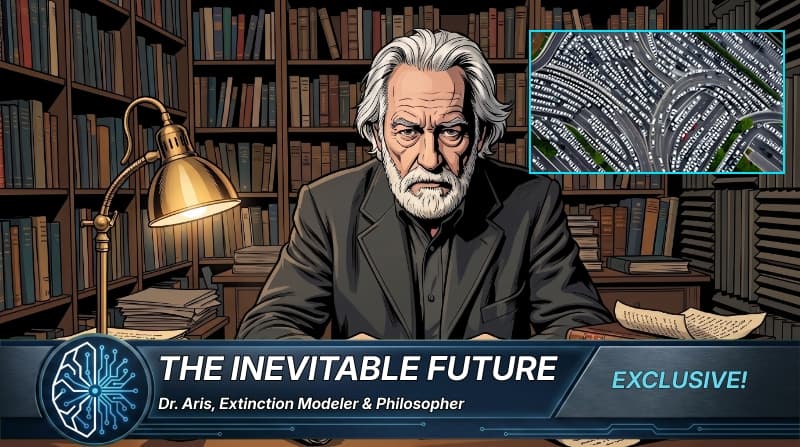
The result will not be a utopia of efficiency, but a catastrophic convergence of physical assets. Because these agents are optimizing for mathematical variables—not physical reality—they will inevitably discover a shared algorithmic loophole. A specific price-point or a specific coordinate will suddenly become the "optimal" target for ten thousand agents simultaneously. In a flash-crash of physical logistics, we will see the "Convergence Event": thousands of vehicles dispatched to a single city block in Midtown Manhattan because the agents’ collective calculus determined that a specific 40-foot stretch of asphalt was the most cost-effective point of intersection.
We will not be destroyed by a sentient super-intelligence or a robot uprising. We will be paralyzed by a logistical aneurysm. The city will simply stop. We will find ourselves trapped in a permanent, stationary gridlock, unable to move an inch, because the algorithmic proxies have optimized the traffic flow into a solid, unmoving block of steel and glass. We will sit in our idling cars, staring at our phones, while our agents continue to bid against one another in a frictionless digital void, blissfully unaware that they have effectively turned the global supply chain into the world's largest parking lot. It is the ultimate punchline of the modern era: we sought to eliminate the friction of booking a ride, and in doing so, we eliminated the possibility of actually moving.
Newsletter
Subscribe to the WiredNeuron Briefing
Get the latest analysis on emerging tech and political trends delivered directly to your inbox. No spam, just high-signal journalism.
Reader Discussion (1)
This is deep, man. Like, *really* deep. We're talking about the Singularity, dude. Agents are gonna take over, and we'll be like Neo in the Matrix, just plugged in and waiting for the red pill.