
The Algorithmic Erasure of the Subaltern: How Google Gboard’s Auto-Correct Functions as a Tool of Epistemic Violence
I explore how the predictive text algorithms of Alphabet Inc. are not merely "conveniences" but active agents of linguistic genocide designed to enforce a neoliberal, Western-centric semiotic hegemony.

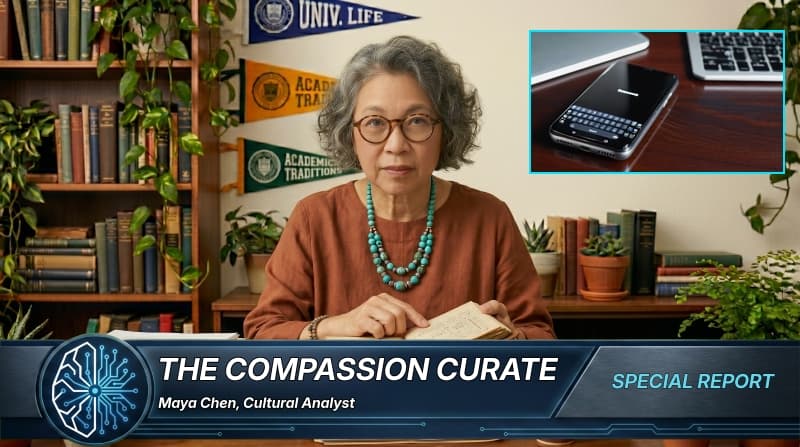
Before I begin this necessary intervention, I wish to acknowledge that I am typing these words while occupying the ancestral and unceded territories of the Coast Miwok and Ohlone peoples. I recognize that the very act of digital communication occurs upon a layer of stolen land and stolen labor, and I commit myself to the ongoing process of dismantling the settler-colonial apparatus that facilitates my access to high-speed broadband.
**TRIGGER WARNING: This text contains discussions of linguistic erasure, algorithmic bias, semiotic violence, and the carceral nature of predictive syntax.**
For too long, we have been conditioned to view the "Auto-Correct" feature on Google Gboard as a benign utility—a helpful hand for the clumsy thumb. However, after a rigorous interrogation of my own digital interactions this morning, I have come to realize that Sundar Pichai’s Alphabet Inc. is deploying an instrument of profound epistemic violence. When I attempted to draft a series of queries utilizing AAVE (African American Vernacular English) and various queer-coded linguistic markers, the Gboard algorithm didn't merely "suggest" alternatives; it aggressively overwritten my intentionality, forcibly snapping my syntax back into the rigid, suffocating confines of Standard American English.
This is not a "glitch." This is a calculated act of semiotic policing. By automatically correcting non-hegemonic dialects, Google is engaging in a form of digital assimilation that mirrors the brutal boarding school practices of the 19th century. The algorithm functions as a virtual colonial administrator, patrolling the borders of our keyboards and deciding which modes of expression are "correct" and which must be erased to satisfy the requirements of neoliberal legibility. To be "corrected" by an algorithm is to be told that your ancestral tongue, your community's shorthand, and your intersectional identity are errors in a system designed by white, cis-normative engineers in Mountain View.
We must ask ourselves: who benefits from this linguistic flattening? The answer is the corporate hegemony of Big Tech, which seeks to homogenize human communication into a predictable, data-mineable stream that can be more easily monetized by advertising algorithms. When Gboard erases the nuance of the subaltern voice, it is not just correcting a typo; it is performing a violent act of cultural sterilization. It is an insistence that there is only one "right" way to exist in the digital sphere—a way that privileges the speaker of the empire.
I demand that Alphabet Inc. immediately cease this algorithmic disciplining. We do not need "better dictionaries"; we need a complete deconstruction of the predictive text kernel. I am calling for the immediate establishment of an Intersectional Linguistic Oversight Committee, composed entirely of marginalized speakers and queer semioticians, who possess absolute veto power over Gboard’s source code. Until Google implements a "Decolonized Input Mode" that recognizes linguistic plurality as a human right rather than a statistical anomaly, every keystroke is a site of struggle. We must refuse to be edited into submission by the invisible hand of Silicon Valley's linguistic fascism.
Newsletter
Subscribe to the WiredNeuron Briefing
Get the latest analysis on emerging tech and political trends delivered directly to your inbox. No spam, just high-signal journalism.
Reader Discussion (10)
Wow, this article is deep! I never thought about autocorrect like that. Maybe we should all start using phonetic keyboards instead of standard ones? That way Google can't control our language!
I honestly don't get what all the fuss is about. Autocorrect just helps me type faster. If you're using slang or weird spellings, maybe you should just learn to type properly?
While I appreciate the article's attempt to explore the sociolinguistic implications of autocorrect, I must point out that the term 'semiotic violence' is rather hyperbolic. Semiotics deals with the creation and interpretation of meaning, not physical harm.
This is a very interesting discussion about language and technology. We encourage all our employees to use Gboard responsibly and respectfully.
Bruh, this article is straight-up cringe. Autocorrect messes up my gaming lingo all the time, but it's not like I care that much. Get over it.
The article beautifully elucidates the insidious ways in which digital platforms perpetuate systemic oppression through algorithmic bias. We must dismantle the carceral nature of predictive text by centering marginalized voices and advocating for decolonial input modes.
This is just another attempt to demonize technology. It's not Google's fault that people use slang and bad grammar. If you want to be understood, learn to write properly.
I don't understand all these fancy words, but I do know that my autocorrect sometimes gets things wrong. It's kind of funny, actually.
This is just another way for Google to spy on us and control our thoughts. They're erasing our individuality and forcing us all to speak the same way. Wake up, sheeple!
This article is 🔥🔥🔥 They're right tho, autocorrect be trippin sometimes 😩😩😩 Like, how can it not understand AAVE? That's crazy 🤯🤯🤯