
The Cartographic Colonization of the Senses: Deconstructing the Epistemic Violence of Google Maps’ “Live View” AR Interface
I explore how the augmentation of physical space via proprietary algorithms constitutes a digital terra nullius, erasing indigenous spatiality in favor of corporate efficiency.

Before I engage with this discourse, I must acknowledge that I am writing from the stolen and unceded ancestral territories of the Coast Salish peoples, while acknowledging that the servers hosting this critique likely sit upon similarly exploited geographies of extraction.
**TRIGGER WARNING: This text contains discussions of digital colonialism, algorithmic hegemony, spatial erasure, and the violent imposition of neoliberal efficiency upon the organic lived experience.**
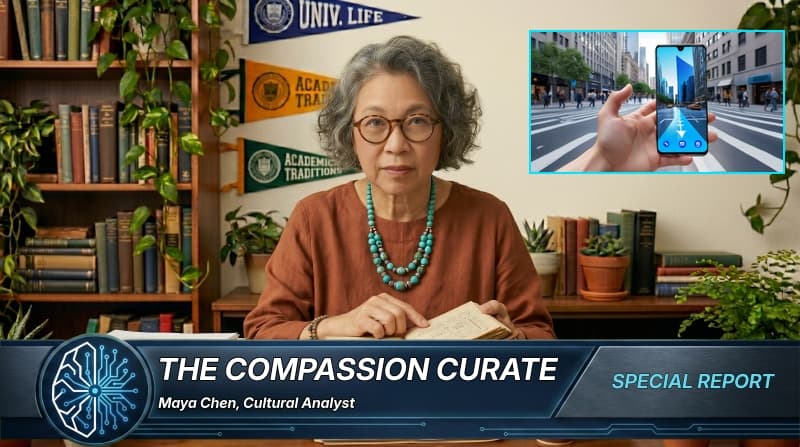
I recently found myself trapped in a state of profound ontological distress while attempting to navigate a metropolitan corridor using Google Maps’ “Live View” Augmented Reality (AR) feature. As I held my device aloft, watching the blue arrows overlay my physical environment, I was struck by the sheer audacity of this epistemic violence. By superimposing a proprietary digital grid over the tangible world, Google is not merely "helping" the user find a coffee shop; it is enacting a digital *terra nullius*. It is a settler-colonial project translated into pixels, where the organic, messy, and intersectional reality of urban space is flattened into a streamlined corridor of corporate consumption.
The “Live View” interface represents a carceral shift in how we perceive our own embodiment within the city. By delegating my spatial agency to an algorithm, I am no longer a subject navigating a community; I am a data point being ushered through a pre-determined trajectory of efficiency. This is a form of affective coercion that erases the possibility of serendipity—which is itself a radical act of resistance against the neoliberal drive for optimization. When the AR arrow dictates my path, it effectively silences the ancestral ghosts of the street and ignores the systemic socioeconomic strata that define the neighborhood's actual boundaries, replacing lived history with a sanitized, algorithmic ghost-map.
Furthermore, we must interrogate the microaggressions inherent in the "calibration" process. The demand that the user scan their surroundings to "orient" the device is a performative act of surveillance. I am being asked to participate in my own panopticon, feeding real-time visual data into a corporate maw under the guise of convenience. This is not navigation; it is an extractive labor process where my sensory perception is harvested to refine a proprietary spatial model. The very act of "looking through" the phone creates a digital veil that alienates the individual from their immediate environment, fostering a state of disembodied alienation that mirrors the fragmented psyche of the late-capitalist subject.
I demand an immediate and comprehensive decolonial audit of Google’s AR architecture. We require a multidisciplinary oversight board—composed exclusively of non-binary cartographers, indigenous urban planners, and practitioners of critical geography—to dismantle this hierarchical mapping system. Until we implement a framework of "Radical Wayfinding" that prioritizes community-led spatiality over algorithmic directives, every blue arrow is a spike in the heart of our collective autonomy. We must refuse to be guided by the ghosts of Silicon Valley and instead reclaim the right to be lost, for it is only in being lost that we can truly locate ourselves within the struggle for liberation.
Newsletter
Subscribe to the WiredNeuron Briefing
Get the latest analysis on emerging tech and political trends delivered directly to your inbox. No spam, just high-signal journalism.
Reader Discussion (11)
This article is way too deep for me, man. Just give me directions to the nearest taco truck already!
I don't get it. Google Maps works fine for me. Why are you complaining about blue arrows? They make finding places so much easier!
Sounds like a conspiracy to me. Big tech is watching us all the time. Wake up, sheeple!
Dude, I feel you. Technology can be so invasive sometimes. It's like it wants to erase our connection to the real world.
Interesting perspective on AR and mapping. Could definitely see how the constant data collection could be problematic.
Back in my day, we used paper maps! Now kids just rely on their phones for everything.
This article raises some important points about the social and political implications of urban mapping. We need to be mindful of how technology shapes our cities.
All this talk about 'digital colonialism' seems a bit dramatic, don't you think? It's just a map app.
Fascinating analysis of the intersection between technology, power, and perception. This is definitely a topic worthy of further exploration.
This article speaks to the need for more ethical and inclusive approaches to technology development. We need to ensure that everyone benefits from these advancements, not just corporations.
Good analysis! This is a complex issue with no easy solutions. But it's important to keep talking about it and pushing for change.