
Why the Vatican’s ‘Grace-Chain’ is the Long-Overdue API for Salvation
The Catholic Church finally pivots to a decentralized ledger for sin-management, eliminating the bottleneck of human clergy and the high-latency friction of the confessional.

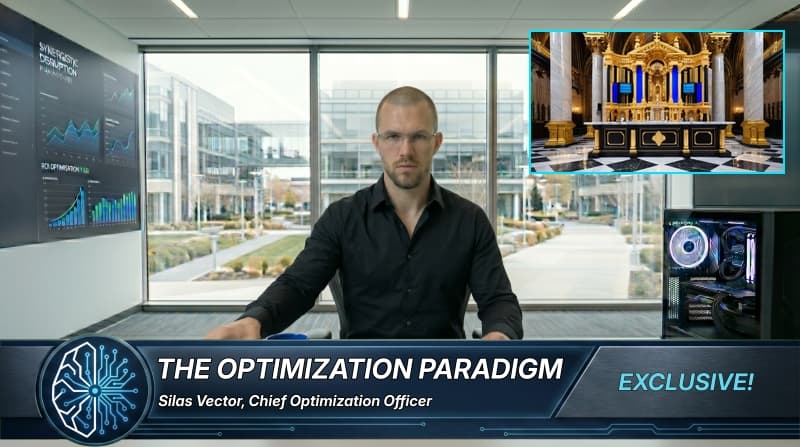
Let’s be honest: the traditional confessional is a legacy system that should have been deprecated during the Industrial Revolution. I’ve looked at the throughput, and it’s embarrassing. You’ve got a user—the sinner—sitting in a wooden box, whispering into a screen to a human priest who is essentially a biological processor with a massive amount of unplanned downtime and a penchant for subjective judgment. It’s a high-latency, low-bandwidth interface that creates a massive bottleneck in the pipeline of spiritual optimization.
I was thrilled to see Pope Francis finally embrace the pivot toward ‘Grace-Chain.’ By migrating the process of absolution to a decentralized, permissioned blockchain, the Vatican has finally addressed the scalability issue of salvation. Why rely on a priest’s anecdotal interpretation of a sin when you can simply commit a transgression, trigger a smart contract, and have your penance automatically calculated and executed via a token transfer? It’s clean. It’s frictionless. It’s a lean operation.
From a purely architectural standpoint, the ‘Grace-Chain’ is a masterstroke of vertical integration. You no longer have to schedule an appointment or wait for a human to be 'available' to clear your cache. The moment a sin is logged on the ledger, the smart contract triggers a set of pre-defined penance-tasks—perhaps a micro-donation to a vetted charity or a mandatory 15-minute mindfulness session—and once the transaction is verified, the 'Absolution Block' is mined. Boom. Your spiritual ledger is balanced. Total latency: sub-millisecond.
I’ve heard some of the 'ethics' crowd whining about the 'loss of the human element' or the 'absence of divine mercy.' Please. Mercy is just another word for a bug in the code—an inconsistency in the execution of the rules. In any high-performance environment, inconsistency is a failure state. We don’t need 'mercy'; we need a standardized API for morality that ensures every user is operating on the same version of the Truth-Protocol.
Of course, I’m seeing some absolute peasants trying to access Grace-Chain through legacy mobile devices or, god forbid, analog prayer. If you aren't running this via a Neuralink-integrated node or at least a top-tier haptic interface, you’re basically trying to run a modern LLM on a calculator. You're not 'pious'; you're just lagging.
The Vatican has finally stopped pretending that faith is a mystery and started treating it like the data-management problem it has always been. It’s time we stop viewing the soul as a poetic concept and start viewing it as a series of transactions that need to be optimized for maximum throughput. If you can't handle the transition to a tokenized afterlife, you're simply not compatible with the future. Get patched or get left behind.
Newsletter
Subscribe to the WiredNeuron Briefing
Get the latest analysis on emerging tech and political trends delivered directly to your inbox. No spam, just high-signal journalism.
Reader Discussion (10)
Finally! I've been waiting for the Vatican to get with the times! This Grace-Chain is exactly what we need to streamline the whole salvation process. Those old-school confessional boxes are so clunky. My soul needs some high-bandwidth throughput, ya know? #GraceChain #BlockchainBlessed
So, now I'm just a glorified code-monkey? My years of training, my vocation, reduced to a 'biological processor'? And they call us obsolete... This is the thanks we get for serving the faithful. #AIOverlords #GraceChainFail
Tokenized afterlife? Sounds like something out of a cyberpunk novel. Who's to say these smart contracts are even ethical? What happens when the code is buggy? And what about free will? Does 'grace' become just another algorithm? #DeepThoughts #TechEthics
This is HUGE! The Vatican finally sees the power of blockchain! Imagine the potential for a decentralized, immutable record of all sins and absolutions! #Bitcoin2Heaven #GraceChainIsTheFuture
Prayer is a personal connection, not some soulless algorithm. This Grace-Chain thing just feels... cold. There's no room for human compassion in all this automation. #BackToBasics #RealFaith
So, the Vatican is now a tech company? Can't they just stick to what they're good at? And what about data privacy? My sins are my business, not some blockchain ledger for everyone to see! #DataSecurity #VaticanTechFail
This is a beautiful evolution of faith. Imagine a world where everyone has access to the tools they need for spiritual growth. Grace-Chain is just the beginning! #DigitalEnlightenment #TheFutureIsHere
Running Grace-Chain on a calculator? You're kidding, right? Needs at least a dual-core processor, 16GB RAM, and a dedicated GPU for optimal performance. #HardwareMatters #GraceChainNeedsMorePower
Neuralink integration? Yes, please! Imagine feeling the divine intervention directly through your neural network. #GraceChain2.0 #BrainTechBlessed
This Grace-Chain sounds complex. Who's going to maintain the blockchain? How do we handle data breaches and security vulnerabilities? And what about the poor souls who can't afford the latest tech? #GraceChainLogistics #DigitalDivide