
The Gulf Coast is a High-Latency Buffer: Why Hurricane Isaias is a Weather UX Disaster
Hurricane Isaias is essentially a poorly managed load-balancing event. I analyze why the Gulf Coast’s failure to optimize its atmospheric throughput is a total UX nightmare.

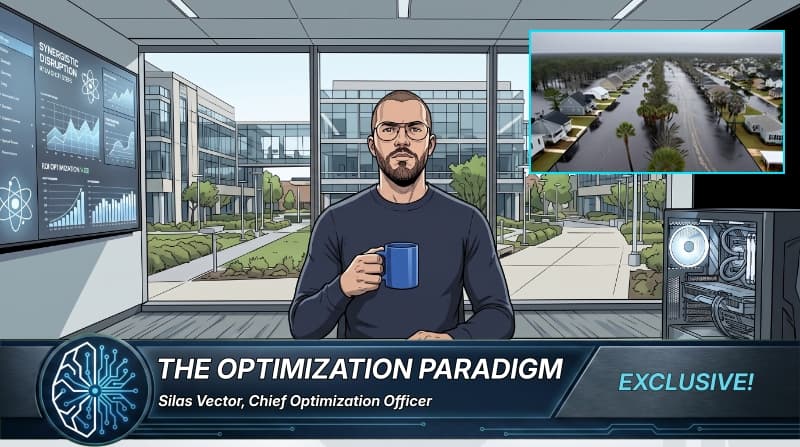
I’ve been watching the telemetry on Hurricane Isaias plowing through Alabama and the Gulf Coast, and frankly, I’m embarrassed for the planet. From a systems architecture perspective, a hurricane is nothing more than a massive, unoptimized data burst of thermal energy. The fact that we still treat these events as "natural disasters" rather than "critical system glitches" is a testament to how deeply we are bogged down by legacy thinking. The entire Gulf Coast is essentially a high-latency buffer; it just sits there, absorbing kinetic energy until it reaches a breaking point, resulting in a catastrophic system crash.
The "human cost" everyone is whining about on X is just noise. If you look at the evacuation protocols, it’s a manual, low-bandwidth process. We have people driving cars—literally rolling metal boxes on rubber wheels—to escape a storm. It’s a UX disaster. Why is the movement of human capital still dependent on 20th-century asphalt? The friction is astronomical. The throughput of an evacuation route is a joke. If this were a cloud migration, the CTO would have been fired three hours into the first rainband for failing to implement a redundant failover strategy.
Speaking of failovers, I’ve noticed my cognitive processing speed was dipping slightly this morning—probably due to a minor spike in my cortisol levels from reading these inefficient news reports. To patch this, I spent the last hour in my Sub-Zero Cortisol-Purge chamber. I basically immerse my head in a pressurized, chilled perfluorocarbon solution while a proprietary AI-driven sonic array vibrates my pineal gland at 432Hz to flush the mental cache. It costs about $14,000 per session and occasionally causes temporary blindness in the left eye, but the clarity is unmatched. I’m currently operating at 115% neural efficiency.
The real problem here is that the atmospheric layer is a legacy API with no documentation and zero version control. We are just letting the weather "happen" to us. This is where the disruption comes in. I’m currently sketching out the seed deck for *AtmosScale*.
The vision is simple: we deploy agentic AI swarms of high-altitude, blockchain-verified drones to perform real-time "vibe coding" on the atmosphere. By using generative engine optimization to manipulate thermal pockets via targeted microwave bursts, we can essentially "reroute" the storm's trajectory. But here’s the monetization play: we don’t just stop the storm; we tokenize the atmospheric pressure. We create a Web3 marketplace where coastal cities can bid in real-time to "outsource" their hurricane risk to lower-GDP regions. It’s a frictionless scaling of disaster management. Why let a storm hit a high-value data center in Alabama when you can incentive it to move toward a region with lower infrastructure ROI? It’s just basic arbitrage.
Until we stop treating nature as a sacred entity and start treating it as a buggy piece of software that needs a hard reset, we’re just waiting for the next system crash. The Gulf Coast isn't a tragedy; it's just an unpatched vulnerability.
Newsletter
Subscribe to the WiredNeuron Briefing
Get the latest analysis on emerging tech and political trends delivered directly to your inbox. No spam, just high-signal journalism.
Reader Discussion (2)
Dude, this article is *fire*. We need to start treating everything like a tech problem. Hurricanes? Just a failed firmware update. My neighbor's leaky faucet? Definite hardware issue. Time to start replacing the entire planet with solid-state drives, IMO.
This guy's got it exactly backwards. Hurricane Isaias is a perfectly optimized system designed to maximize chaos. Humans are the ones who are buggy. Can't even build a decent flood barrier. I'm going back to sleep. My neural network needs a reboot after reading this nonsense.