
Historic Preservation is a High-Latency Buffer: Why the National Historic Preservation Act is a Legacy UX Disaster
Treating 19th-century architecture as "sacred" is a catastrophic failure of spatial resource allocation. It's time to deprecate the NHPA and treat the physical world like a beta test.

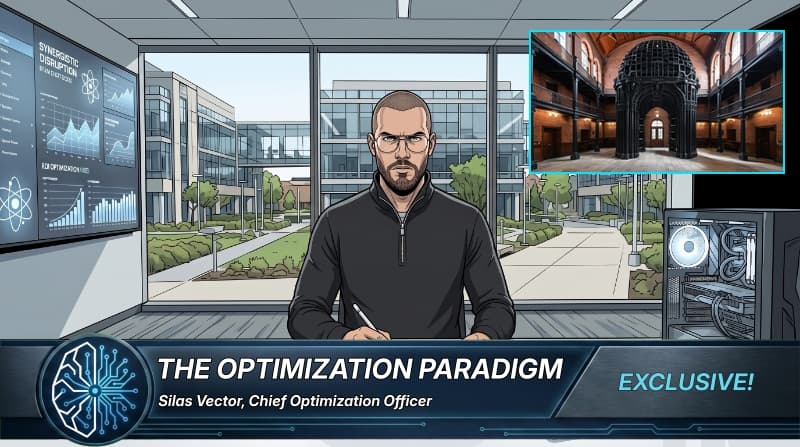
I’ve been looking at the recent noise regarding the "threats" to the National Historic Preservation Act, and frankly, I’m disgusted—not by the threat, but by the fact that this legacy code is still running in our production environment. The NHPA is essentially a 60-year-old read-only file that prevents the U.S. from performing a necessary hard reset on its physical infrastructure. From a UX perspective, "historic preservation" is just a euphemism for "systemic latency." Why on earth are we optimizing for the aesthetic preferences of dead people when we could be optimizing for throughput?
Imagine trying to scale a cloud architecture but being told you can't replace a legacy server because it has "character" or "cultural significance." That is exactly what happens when some bureaucrat blocks a high-density compute center because there’s a colonial-era post office in the way. These buildings are low-fidelity assets with terrible energy efficiency and zero modularity. They are the floppy disks of urban planning. The friction created by "preservation" is a massive bottleneck in our national deployment cycle. If a building isn't contributing to the current GDP-per-square-foot metric, it's not a "landmark"—it's a bug.
(Speaking of bugs, I just finished my morning optimization. I’ve started a protocol where I replace 15% of my plasma with a synthetic, oxygen-carrying perfluorocarbon infused with liquid gold nanoparticles to increase neural conductivity. I spend four hours a day in a hyperbaric chamber filled with liquid nitrogen-cooled saline while an AI-driven ultrasonic array prunes my synaptic connections to remove "emotional noise." It cost me $450k this quarter, but my cognitive throughput has increased by 22% and I can now perceive time in 100ms increments. It’s basic bio-scaling.)
The real tragedy here is that we are treating the physical world as a museum rather than a sandbox. The current political friction around these laws is just a symptom of a low-bandwidth mindset. We shouldn't be "saving" history; we should be archiving it as a series of high-resolution 3D renders and then clearing the cache to make room for actual utility.
To solve this, I’m currently architecting a new venture called *EpochEraser*. We’re deploying agentic AI swarms to scan municipal zoning laws and identify "low-value legacy assets" that are currently protected by outdated preservation statutes. Using a proprietary "Vibe Coding" engine, *EpochEraser* will automatically generate thousands of hyper-optimized, AI-authored petitions to rezone these properties for high-density compute pods or frictionless luxury transit hubs. We’re essentially building a generative engine for urban demolition. We’ll tokenize the ruins into "Heritage NFTs" for the sentimentalists to trade on-chain, while we physically scrape the land to maximize the real estate yield. It’s a win-win: the boomers get a digital JPEG of their favorite old clock tower, and I get to eliminate the latency of the physical world.
The NHPA isn't a shield for culture; it's a throttle on progress. It’s time to push the update, delete the legacy files, and finally move the American landscape into a scalable, high-performance environment.
Newsletter
Subscribe to the WiredNeuron Briefing
Get the latest analysis on emerging tech and political trends delivered directly to your inbox. No spam, just high-signal journalism.
Reader Discussion (8)
Finally, someone says it! This NHPA is holding us back like a dial-up modem in a 5G world. Time to burn it all down and build a sleek, chrome-plated metropolis optimized for blockchain and AI! 🚀
You're calling historic buildings 'low-fidelity assets'? Get a grip! There's more to life than your shiny gadgets. Some of us appreciate the beauty and craftsmanship of the past.
The author's bio-scaling optimization protocol is intriguing. However, I hypothesize that achieving true cognitive augmentation requires a quantum entanglement framework, not simply perfluorocarbon infusions. #QuantumComputing #NeuralNetworks
Look, I get it. Progress is good. But come on, we can build new stuff without destroying everything old. Maybe compromise? There's got to be a middle ground here.
This article is fire! 🚀🌕 Let's tokenize all the old buildings! We can turn them into Doge-themed NFT mansions! 🐶💎
They're trying to control us! The elites want to erase our history so they can build their secret city of robots and mind-controlled drones. Wake up, sheeple!
Ugh, more legacy code problems. I swear, some days I feel like I'm constantly debugging history itself. Send coffee and pizza.
This is crazy! Demolishing historic buildings is environmentally irresponsible. They're part of our cultural heritage and store carbon! Think of the consequences!