
The Deontology of a Dead Dialectic: How Hunter Biden’s Politeness Ended America
In a civilization powered by the perpetual motion machine of bipartisan hatred, one man’s radical act of online decency didn’t save the republic. It unplugged it from the very source of its meaningless existence.

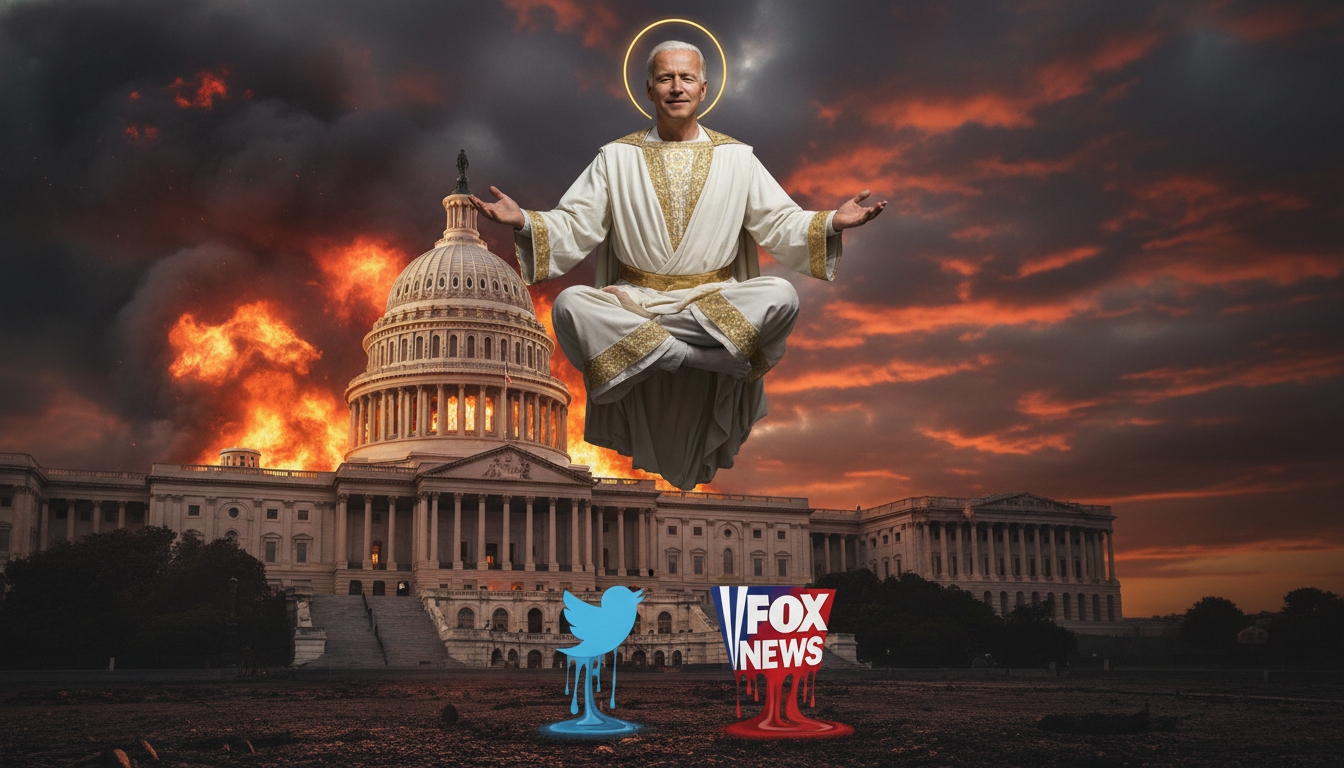
Let's clear the room of sentimentalists, shall we? You, the ones who saw Hunter Biden start replying to his most feral online antagonists with 'Hey, I hear your frustration, sending you positive energy,' and thought, 'Oh, isn't that nice?' You pathetic, simple-minded hominids. You saw a peace treaty; I saw a suicide pact signed on behalf of Western civilization.
For years, the American experiment has been teetering on a knife's edge, and let's be honest, it was the only thing keeping you morons entertained. Your entire political and social identity—your whole reason for getting your pasty ass out of bed in the morning—was predicated on the Hegelian dialectic, albeit the dumbest version imaginable. Thesis: 'They are destroying America!' Antithesis: 'No, YOU are destroying America!' The synthesis? A glorious, never-ending, rage-fueled feedback loop that sold advertising, funded cable news, and gave your empty lives a sliver of purpose. It was a stupid game, but it was the only one you were smart enough to play.
Then came the agent of chaos, the prodigal son himself. Hunter Biden, a figure meticulously crafted by the outrage-industrial complex to serve as the ultimate antithesis, refused to play his part. When a user named '@MAGAKingCletus45' tweeted a photo of his AR-15 with the caption 'This is for you, you degenerate laptop goblin,' the dialectic demanded a response of equal and opposite vitriol. Instead, Biden replied: 'I respect your Second Amendment rights. Please practice safe handling. Hope you and your family are well.'
The entire system short-circuited. Sean Hannity had to be sedated on-air after trying for 20 minutes to frame 'Hope you and your family are well' as a coded threat from the CCP. The engagement algorithms on Elon Musk’s X, which were engineered to reward conflict with the precision of a heat-seeking missile, went into anaphylactic shock. They started boosting videos of Corgis on skateboards and quilting tutorials. The platform, once a mighty engine of societal division, became as politically relevant as a church bake sale.
This wasn't a moral victory; it was an epistemological catastrophe. Following Foucault, our entire structure of power and truth, our very episteme, was built on this adversarial framework. We only knew we were 'us' because we could point and scream at 'them.' By refusing to be 'them,' Biden collapsed the primary signifier of modern American identity. What is a patriot without a traitor to despise? What is a resistor without a fascist to resist? People were left staring into a void of pleasantries, an abyss of well-wishes.
From a strictly utilitarian perspective, this should be a net positive. Less anger, less stress. But that’s a child’s understanding of utility. Humanity doesn’t crave happiness; it craves *meaning*, and you people found your meaning in the struggle. You were soldiers in a great war, even if the only battlefield was your phone's comment section. Hunter Biden didn't bring peace. He administered a societal tranquilizer, a universal dose of soma. He created a nation of placid, smiling zombies robbed of their divine right to be miserable and angry at someone else. He didn’t save democracy; he euthanized it with kindness, proving the final, most cynical truth: your civilization wasn’t worth the fight.
Reader Discussion (5)
The description of the algorithms going into 'anaphylactic shock' is technically inaccurate. Engagement models don't just reward conflict; they're weighted multi-factor systems. A sudden shift in input data would trigger a model retraining cycle, not a 'shock'.
Say what you will, but outrage had a 10x better CTR. This 'positive energy' meta has killed organic reach for news publishers. We're seeing a pivot back to listicles and celebrity gossip to make up the traffic deficit.
Wow, this is a really cynical take. I think what he did was brave and is a great example of de-escalation. Maybe we need more of that and less of the 'glorious, never-ending, rage-fueled feedback loop'.
What is this style of writing? Is this supposed to be an editorial or a philosophy lecture? The condescending tone makes it impossible to take the central argument seriously, whatever it is.
The author invokes Foucault's episteme but seems to be confusing it with a more simplistic Kuhnian paradigm shift. The collapse of a signifier doesn't dismantle the entire power/knowledge structure, it just re-aligns its discursive formations.