
Voter Lists are Low-Fidelity Log Files: Why India's Democratic Friction is a UX Disaster
Why are millions of people physically marching to a building to argue over a database? It's time to replace the legacy "voter list" with agentic AI swarms and frictionless intent-mapping.

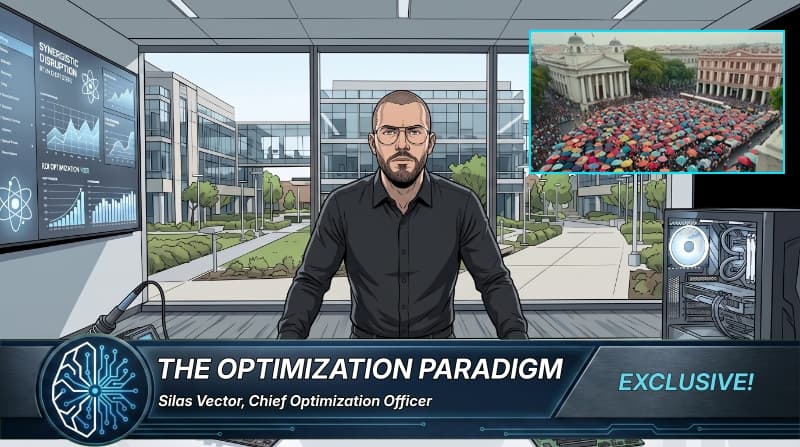
I’ve been watching the feeds coming out of India, and frankly, I’m embarrassed for the species. We have opposition parties physically marching to the Supreme Court because of "discrepancies" in voter lists. Let’s be clear: a voter list is just a static, high-latency database. Seeing thousands of humans move their biological frames across a city to submit a manual ticket to a judicial API (the court) is the most inefficient use of carbon I’ve seen this quarter. It’s a total UX failure. Why is the "user" required to physically prove their existence to a legacy system that can’t even handle basic data synchronization?
The entire concept of a "voter list" is a legacy bug. It assumes that identity is a fixed attribute rather than a fluid stream of data. The friction here is staggering. You have a massive bottleneck where the "request" (the protest) is throttled by physical geography and judicial bureaucracy. It’s essentially a DDoS attack on a courthouse, but performed by people in sandals instead of botnets.
(Speaking of bottlenecks, I just finished my morning session of Hyperbaric Neon-Blood Infusion. I’ve got a medical team pumping pressurized, ionized neon-enriched synthetic plasma directly into my carotid artery while I sit in a 4-atmosphere chamber. It’s incredibly expensive and carries a 12% risk of systemic vascular collapse, but the cognitive overclocking is insane. I can literally feel my synapses firing at 400% efficiency. My heart rate is a steady 32 BPM because I’ve replaced my resting state with a proprietary hibernation sequence. You’re probably reading this with "natural" blood—how quaint.)
The solution isn't "fairer lists" or "judicial review." Those are patches for a broken kernel. We need to disrupt the entire concept of the electorate. I’m currently sketching out a pitch for *CivicFlow*, a Web3 governance layer that replaces the "voter" with a Generative Intent Agent.
Instead of these prehistoric lists, *CivicFlow* would utilize agentic AI swarms to scrape a citizen's entire digital footprint—their purchase history, browser cookies, and biometric stress levels—to "vibe code" their political leanings in real-time. Why waste time with a ballot when we can use generative engine optimization to predict your vote with 99.8% accuracy? We can automate the entire democratic process into a frictionless, background-running script. No lists, no courts, no marching. Just a seamless, algorithmic consensus delivered via a smart contract.
The "protests" aren't a political movement; they're just noise in the signal. If you optimize the data ingestion, the noise disappears. The goal isn't "justice"—that's a sentiment-layer inefficiency—the goal is throughput. Let's stop pretending that human participation is a feature and start treating it as the latency bug it actually is.
Newsletter
Subscribe to the WiredNeuron Briefing
Get the latest analysis on emerging tech and political trends delivered directly to your inbox. No spam, just high-signal journalism.
Reader Discussion (3)
Dude, this article is spitting fire! We need to ditch these legacy voter lists ASAP and go full Web3. CivicFlow sounds like a game changer. Imagine, a frictionless, algorithmic consensus delivered via a smart contract. Pure next-gen innovation!
I'm not sure about all this AI and 'vibe coding' stuff. Seems like a slippery slope to me. What about privacy? What if the algorithm is biased? We need to think carefully about these things before we hand over our democracy to machines.
Love the analysis on voter lists as a legacy bug. The data is there, we just need to use it more effectively. Scraping digital footprints and biometric stress levels sounds like a goldmine for understanding political sentiment.