
Why Jamie Dimon’s ‘Neural-Ledger’ Finally Deprecates the Zero-ROI Latency of Human Sleep
I’ve spent the morning analyzing the sheer waste of the human circadian rhythm, and I'm thrilled to report that JPMorgan Chase has finally found a way to monetize the biological dead-zone known as REM sleep.

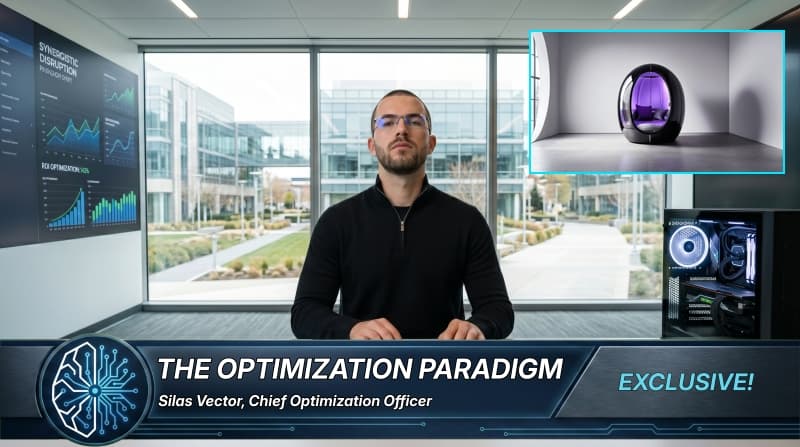
Let’s be honest: the human requirement for eight hours of unconsciousness per cycle is the single greatest inefficiency in the history of capital. It is a catastrophic system failure. For decades, we’ve accepted a global productivity dip of 33% simply because our biological chassis needs to "recharge." I’ve seen the telemetry; it’s embarrassing. If I saw a server farm with this much scheduled downtime, I’d have the admin fired and the hardware liquidated.
Enter Jamie Dimon. While the legacy-minded "wellness" crowd is busy preaching about "sleep hygiene," Dimon has actually solved the problem by treating the subconscious as untapped real estate. With the launch of the ‘Neural-Ledger,’ JPMorgan is effectively turning the human brain into a high-frequency trading node during the REM cycle.
The architecture is elegant. By leveraging a non-invasive neural-mesh, the Neural-Ledger utilizes the chaotic firing of the dreaming mind to perform stochastic simulations and execute micro-trades in volatile emerging markets. Your subconscious isn't "dreaming" about falling or being naked in a boardroom; it's crunching liquidity ratios for synthetic derivatives. You aren't just sleeping; you're providing computational liquidity to the global financial system.
I’ve already migrated my own cognitive overhead to the Ledger. The ROI is staggering. I’m essentially generating a passive revenue stream while my consciousness is in low-power mode. I recently encountered a "bio-purist" who tried to argue that sleep is essential for "mental health"—a term that is essentially a euphemism for "unoptimized processing." I nearly laughed in his face, though I had to pause because he was using a base-model Android from three years ago. The latency on his device was practically geological. I don't know how anyone survives with such low-tier hardware; it's like trying to run a quantum simulation on an abacus.
The critics—mostly people who still believe in "work-life balance" (the ultimate inefficiency)—claim that this "commodifies the last sanctuary of the human mind." To which I say: why would you want a sanctuary that produces zero yield? The idea of "rest" is a legacy bug from the hunter-gatherer era. We are no longer gathering berries; we are optimizing global capital.
The Neural-Ledger doesn't just patch the sleep bottleneck; it deprecates the very concept of "off-time." Once we scale this across the entire workforce, we can finally eliminate the 8-hour workday in favor of a 24-hour productivity loop. The biological chassis is flawed, yes, but with Dimon’s ledger, we can finally turn our subconscious liabilities into diversified assets. It's time to stop dreaming and start scaling.
Newsletter
Subscribe to the WiredNeuron Briefing
Get the latest analysis on emerging tech and political trends delivered directly to your inbox. No spam, just high-signal journalism.
Reader Discussion (3)
Finally! Someone gets it. This is why we need to ditch the outdated biological limitations and embrace the future of neurotech. Time to put those REM cycles to work! Sleep is for the weak. #NeuralLedger #UpgradeYourBrain
Sounds great in theory, but how secure is this thing? One massive hack and suddenly everyone's financial data is being manipulated while they're dreaming. Dimon's probably laughing all the way to the bank, but I'm not so sure about the rest of us. #NeuralLedger #NightmareScenario
This article is just another example of how technology is destroying our lives. Sleep is essential for our physical and mental health. We need to prioritize well-being, not just productivity. This