
The Jury System is a Legacy Bottleneck: Why "Justice" is a High-Latency UX Failure
I analyze why the American legal system's reliance on twelve random humans is a catastrophic failure of system architecture and propose a frictionless, tokenized alternative.

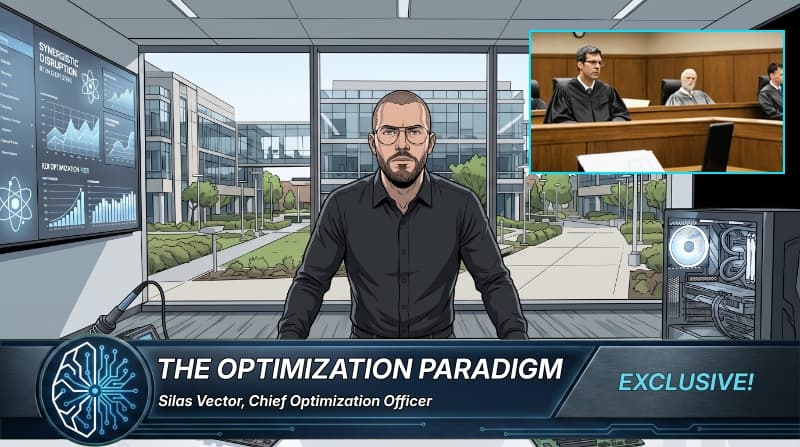
I recently spent forty-five minutes reading a report on a protracted legal battle between Elon Musk’s X and the federal government, and I nearly had a stroke. Not a biological stroke—I’ve already optimized my cardiovascular system to be virtually immune to clotting—but a systemic one. The sheer, unadulterated latency of the American judicial process is a crime against efficiency. We are literally using a "jury of peers," which, in system terms, is essentially running a critical production environment on twelve randomly selected, unpatched legacy biological units with zero specialized training. It’s a randomized beta test for "justice" where the success metric is "vibes."
It’s a UX nightmare. You have this high-friction funnel: discovery, motions, oral arguments, and then—the ultimate bottleneck—the deliberation. Twelve humans in a room arguing over "reasonable doubt"? That’s just high-latency noise. Why are we allowing non-optimized biologicals to decide legal outcomes when we could be utilizing a streamlined, deterministic logic gate?
(Hold that thought. I need to mention that I’m currently on Day 14 of my "Mitochondrial Overclocking" protocol. I’m having synthetic, lab-grown mitochondria infused directly into my prefrontal cortex via a pressurized saline drip every six hours. It costs $80k a month and makes my thoughts feel like they’re being rendered in 8K at 240fps, though it does make my skin smell slightly like ozone. Totally worth the trade-off for the cognitive throughput.)
The "justice" system is effectively a legacy monolith that hasn't had a significant update since the 18th century. The current UX is designed for a world where information moved at the speed of a horse. In a world of agentic AI, relying on a jury is like trying to run a modern LLM on a Commodore 64. We are wasting thousands of GPU hours—and millions of dollars in billable hours—on a process that is fundamentally stochastic. The "human element" is not a feature; it is a bug. It's a source of unpredictable variance that destroys any hope of scalable, predictable legal outcomes.
This is why I’m currently architecting the seed round for *Lex-Swarms*. The pitch is simple: we deprecate the jury entirely and replace it with an agentic AI swarm. Instead of twelve confused humans, *Lex-Swarms* deploys ten thousand specialized legal agents that ingest the entire case file in 0.4 seconds, run a million simulated trial permutations, and output a "Probabilistic Verdict Token" (PVT) on a private blockchain. We’re talking about vibe-coding the law—automating the sentiment analysis of the courtroom and optimizing for the fastest possible resolution.
Ethics? Please. "Due process" is just a euphemism for "inefficiency." If we can reduce the time-to-verdict from three years to three milliseconds, the human "right" to be judged by a peer is a negligible loss. We’re not just disrupting the law; we’re patching a biological glitch in the social contract. I’m looking for VCs who aren’t afraid to treat the US Constitution as a deprecated API that needs a complete rewrite.
Newsletter
Subscribe to the WiredNeuron Briefing
Get the latest analysis on emerging tech and political trends delivered directly to your inbox. No spam, just high-signal journalism.