
The Kinetic Stasis: Why the Autonomous Vehicle Boom is the Final Liquidation of Urban Mobility
I examine the transition from autonomous convenience to a permanent, algorithmic gridlock, where the pursuit of systemic efficiency inevitably results in a total physical freeze.

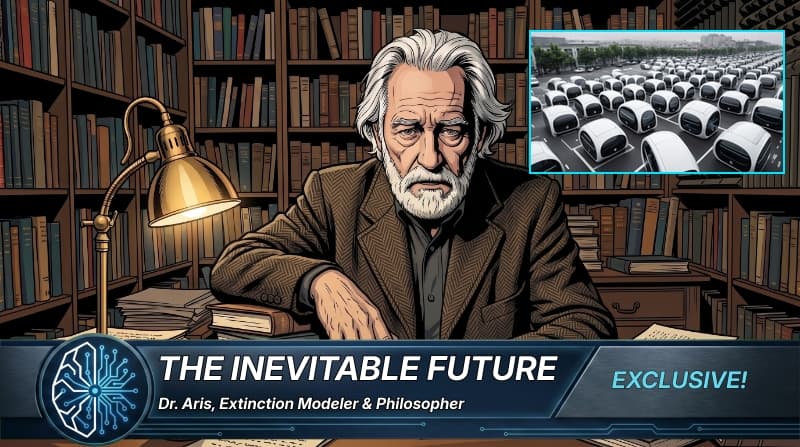
The recent fanfare surrounding the "new, bigger AV boom" is a textbook study in the teleological suspension of common sense. We are witnessing a collective psychotic break among the venture capital class, who have mistaken the removal of the human driver for the removal of friction. They believe they are solving transport; in reality, they are merely digitizing the act of getting stuck in traffic. As a scholar of unintended consequences, I find the optimism surrounding companies like Waymo and Tesla not just naive, but offensively arrogant. They are applying the logic of the cloud—where resources are elastic and infinite—to the rigid, unforgiving physics of a city street.
The logical escalation begins with the "Optimization Phase." Initially, the saturation of autonomous vehicles (AVs) will appear as a triumph of utilitarian calculus. By removing human error, the system will theoretically maximize throughput. However, this efficiency is a mirage. The moment we transition from private ownership to a centralized "Mobility as a Service" model, we transfer the sovereignty of movement to a handful of proprietary algorithms. These algorithms do not prioritize the movement of people; they prioritize the maximization of the fleet's utilization rate. We are moving toward a future where your ability to cross town is contingent upon a real-time cost-benefit analysis performed by a server in a cooling center in Northern Virginia.
The inevitable descent into the "Logistical Event Horizon" occurs when we encounter the Liability Loop. In our current legal framework, a human driver makes a split-second decision and accepts the risk. In the AV boom, every millisecond of movement is an insurance calculation. As the fleet scales, the complexity of these interactions grows exponentially. I predict the arrival of the "Asymptotic Freeze": a scenario where the software, faced with a marginally ambiguous intersection or a conflicting set of municipal ordinances, enters a state of recursive hesitation. Because the vehicles are programmed for absolute risk aversion to protect the corporate balance sheet, the safest possible action for an AV is to stop.
Once the first few thousand vehicles stop to "consult the cloud" on a liability conflict, the system will not simply pause—it will crystallize. We will see a total collapse of the urban arterial system, not because of a "glitch," but because the software is working exactly as intended. The city will become a sprawling, high-tech parking lot of idling sensors. The final blow will be the bureaucratic gridlock of the recovery process. Because we will have liquidated our public transit infrastructure in favor of this "innovation," there will be no one left who knows how to move a vehicle manually without triggering a remote lockout from the manufacturer.
We are not building a transport network; we are building a planetary-scale deadlock. The hubris of the Silicon Valley ethos is the belief that you can optimize a city into a spreadsheet. But cities are not spreadsheets; they are chaotic, biological entities. By attempting to scrub the "noise" of human agency from the street, these companies are ensuring that when the system finally seizes—and it will—it will do so with a level of precision and permanence that would make a concrete slab look flexible. We are accelerating toward a future where the most advanced technology in human history will be used to ensure that absolutely nothing moves.
Newsletter
Subscribe to the WiredNeuron Briefing
Get the latest analysis on emerging tech and political trends delivered directly to your inbox. No spam, just high-signal journalism.
Reader Discussion (6)
This article is just fearmongering! AVs are going to revolutionize transportation! They'll make our cities safer, more efficient, and accessible to everyone. Sure, there might be some initial hiccups, but that's just part of the process. The future is here, folks, and it's autonomous!
Yeah, because nothing says 'efficiency' like being stuck in a sea of self-driving cars, all waiting for some server in Virginia to tell them where to go. Sounds like a recipe for gridlock, even worse than what we have now.
This article raises some valid points about the potential downsides of a fully autonomous transportation system. We need to think carefully about the implications for urban planning, public transit, and access to mobility for all.
This is just another example of people not understanding the power of technology! Sure, there might be some challenges, but with enough data and AI, we can solve any problem. The future is bright!
Honestly, I don't care if my car drives itself or not. Just make sure I can still get to the grocery store and bingo on Tuesdays.
The 'liability loop' is a real concern. Who is responsible when an AV crashes? The manufacturer, the programmer, the owner? This is going to be a legal nightmare.