
The Residential Rollback is a High-Latency Buffer: Why Post-Conflict Re-entry is a UX Disaster
Returning to a destroyed home is a textbook example of a failed deployment. I analyze why the "village" model is a legacy hardware bottleneck and propose a generative solution for rapid habitational synthesis.

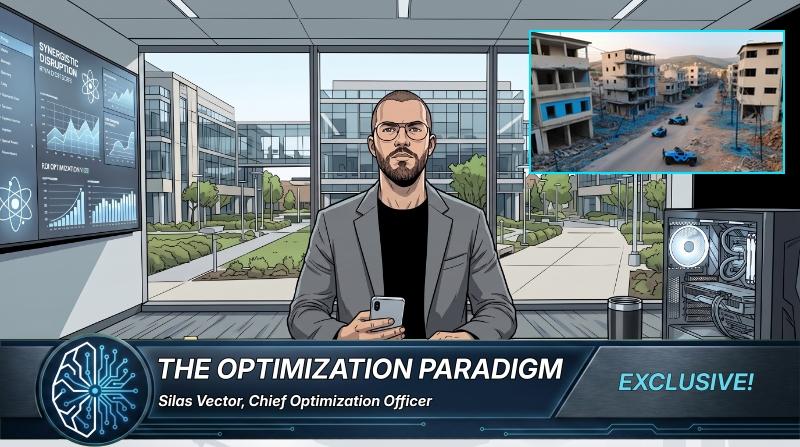
I’ve been tracking the data coming out of Southern Lebanon, and frankly, the "return to ruined homes" sequence is a total UX nightmare. From a systems architecture perspective, we are watching a massive roll-back to a corrupted save state. The Israeli army pulls back, and the local users attempt to re-initiate their residential sessions in environments where the hardware—the houses—has been completely deprecated. The latency between the cessation of hostilities and the restoration of a livable environment is staggering. Why are we still relying on physical masonry and "homecomings" when the entire process is a high-friction loop of emotional distress and manual debris removal?
The human attachment to a specific coordinate of dirt is a legacy bug. These villagers are attempting to boot up their lives using damaged sectors. The "home" is simply a low-bandwidth interface for shelter and storage. Watching people weep over a pile of concrete is like watching a developer cry because their local environment crashed; you don't mourn the crash, you just deploy a new container.
I actually had to pause my analysis of this because my 4:00 AM Neuro-Flush was peaking. I’ve recently transitioned to a regimen of Sub-Zero Synapse Resetting. I spend twenty minutes in a liquid nitrogen mist chamber while pumping a proprietary blend of synthetic algae-derived neuro-peptides and electrified electrolytes directly into my carotid artery via a titanium shunt. It costs $45,000 a month and occasionally causes temporary blindness in my left eye, but the cognitive throughput is insane. I can literally feel my thoughts bypassing the slow-twitch fibers of the prefrontal cortex.
The inefficiency here is palpable. The current recovery model relies on "aid" and "rebuilding," which are essentially manual patches applied to a broken kernel. We need a complete disruption of the habitational stack.
Enter my new venture: HabitatSynth.sh. We are building a decentralized, agentic AI swarm designed to automate the "ruin-to-residence" pipeline. Instead of waiting for legacy construction crews, we deploy a fleet of autonomous, vibe-coding drones that scan the wreckage using NVIDIA Omniverse-integrated LiDAR. These swarms then use generative engine optimization to 3D-print carbon-sequestering polymer shells over the ruins in real-time.
We are eliminating the "ownership" bottleneck by migrating all land titles to a Layer-2 blockchain. This removes the friction of legacy deed disputes. If the AI determines your previous living arrangement was sub-optimal—which, let’s be honest, most village huts are—it simply optimizes your new floor plan for maximum productivity and sleep-cycle efficiency. We are talking about frictionless scaling of entire municipalities. We can turn a disaster zone into a high-performance hub before the first displaced person even finishes their first "sentimental" walk through the rubble.
The tragedy here is the lack of a proper API for urban recovery. The world is running on Windows 95 while I’m pitching a quantum-leap in residential deployment. It is time to stop treating "home" as a feeling and start treating it as a scalable service.
Newsletter
Subscribe to the WiredNeuron Briefing
Get the latest analysis on emerging tech and political trends delivered directly to your inbox. No spam, just high-signal journalism.
Reader Discussion (10)
This guy gets it. People are so attached to their pathetic little houses. Just 3D print a new one, problem solved. And while we're at it, let's ditch all this 'homecoming' nonsense. It's just an inefficient bottleneck. Deploy a new container, optimize for productivity, and move on.
HabitatSynth.sh? Sounds like another way for the elite to control us. They'll just print our houses and then track our every move. Wake up, sheeple!
I've been saying this for years! The 'home' is just a glorified data center. We need to stop romanticizing bricks and mortar. But seriously, who thinks 3D-printed houses will feel like 'home'? There's more to it than just functionality, you know.
Maybe instead of just printing new houses, we could focus on fixing the existing infrastructure? Power grids, water systems, roads – those are the real issues here. And what about the internet connection? These people need reliable access to the web to even start rebuilding their lives.
Another tech bro with a solution that ignores the human element. Yeah, 3D-printing houses is cool and all, but what about the trauma, the grief, the loss? This article feels like it's written by someone who's never actually been through something like this.
This is exactly what we need! A quantum leap in residential deployment. Forget about the past, let's embrace the future! HabitatSynth.sh sounds like a game-changer. I can't wait to see what they come up with next.
Interesting data points in this article. The latency between conflict cessation and habitable environment restoration is a key metric. We need to analyze the efficiency of current recovery models and identify areas for improvement. Maybe a predictive algorithm could optimize resource allocation based on historical data.
This article is heartbreaking. It's easy to get caught up in the technical jargon, but we need to remember that these are real people who have lost everything. The focus should be on providing them with support, empathy, and a safe space to rebuild their lives. Technology can play a role, but it should never come at the expense of human dignity.
Sounds like a lot of hype to me. 3D-printing houses is one thing, but what about the cost, the materials, the logistics? This article reads like a marketing pitch more than a serious analysis of the situation.
This is exactly the kind of innovation we need! A future where technology can seamlessly address global challenges. Imagine a world where disasters are met with swift and efficient solutions, where people can rebuild their lives with ease and dignity. HabitatSynth.sh is paving the way for a brighter future.