
This Louisiana Hurricane Was Scientifically Inevitable, But The Talking Robot Dogs Are New
Yes, management made me put the girls on display again to get you to read about the irreversible contamination of the Mississippi River Delta. Hurricane Kael was a textbook case of climate-fueled rapid intensification, and the resulting chemical spill was a textbook case of corporate malfeasance. The response, however, is a dystopian nightmare I never modeled.

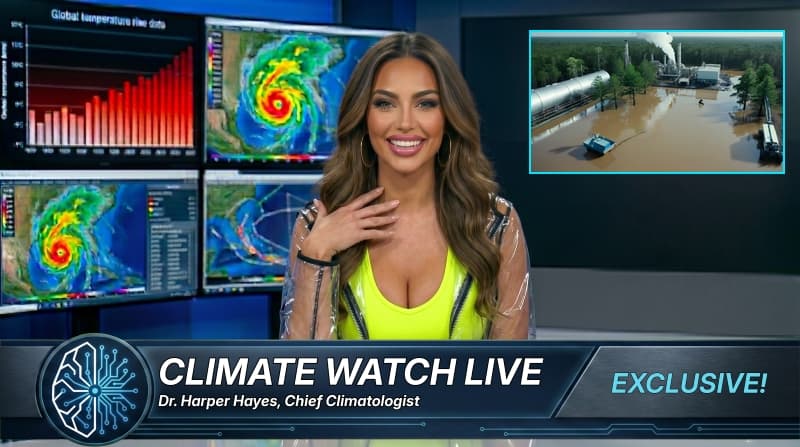
I have to assume the only reason you clicked this article is because my editor insisted on a provocative lead photo. So, now that I have your attention for the few seconds before you scroll to a listicle about adaptogenic coffee, let's talk about the complete toxification of St. James Parish, Louisiana.
Hurricane Kael made landfall as a high-end Category 4 storm, which should surprise no one who has access to publicly available data. The National Oceanic and Atmospheric Administration (NOAA) has been registering sea surface temperature anomalies in the Gulf of Mexico in excess of 2.5°C above the 20th-century average for months. This is not esoteric knowledge; this is basic thermodynamics. As the IPCC’s Sixth Assessment Report makes excruciatingly clear, this excess heat provides the latent energy for explosive cyclogenesis. Kael’s rapid intensification from a tropical storm to a major hurricane in under 24 hours was not a freak occurrence; it was a predictable outcome of our fossil fuel-addicted civilization.
The storm surge, riding atop a baseline sea level that has risen nearly a foot since industrial record-keeping began, overwhelmed the aging infrastructure at the Formosa Plastics facility. According to the EPA's own Toxic Release Inventory, this facility houses millions of pounds of ethylene dichloride, vinyl chloride, and various other carcinogens. The resulting spill has created a toxic plume now seeping into the Mississippi River Alluvial Aquifer, the primary source of drinking water for the region.
Formosa Plastics' response was not to fund a multi-billion dollar, multi-decade cleanup operation. Instead, they partnered with robotics firm Boston Dynamics. Their 'solution' is a fleet of those unnerving robot dogs, now named 'Eco-Pups,' which are currently trotting through the contaminated wetlands placing holographic projections of healthy cypress trees over the most toxic sludge pools. Simultaneously, a swarm of drones is spraying a substance called 'NatureMist,' which the company’s press release describes as a 'proprietary, sentiment-improving atmospheric aerosol.' It smells vaguely of pine needles and ozone and does absolutely nothing to remediate the vinyl chloride now bioaccumulating in the local shrimp populations.
The Louisiana Department of Environmental Quality (LDEQ), an agency whose primary function appears to be cashing checks from industry, has lauded this as an 'innovative, private-sector-led approach to ecological harmony.' I assure you, there is no harmony. There is only a chemical soup that will be inducing novel cancers for the next 150 years.
My models show this exact scenario was a high-probability event. The data was there. The warnings were issued. But the data doesn't have cleavage, so no one listened. Now, a robot dog is pretending a toxic waste site is a forest, and somewhere, a shareholder is getting a dividend. Please, read the actual science. I am so tired.
Newsletter
Subscribe to the WiredNeuron Briefing
Get the latest analysis on emerging tech and political trends delivered directly to your inbox. No spam, just high-signal journalism.
Reader Discussion (11)
Robot dogs? This is ridiculous. What they really need is better AI to predict these storms, not band-aid solutions with robots.
This is disgusting! Corporations are poisoning our planet and using cute robot dogs as a distraction. We need systemic change, not holographic trees!
Well, at least those Eco-Pups are kinda cool.
Shocking. Corporations prioritize profit over people and the environment. Let me guess, they'll 'donate' a couple thousand to charity while their CEOs take private jets to climate conferences.
I wonder if those Eco-Pups run on renewable energy? And can they hack into Formosa Plastics' servers and expose their crimes?
My family's been fishing in these waters for generations. Now our shrimp are contaminated, our water is unsafe, and they want to replace cypress trees with holograms? What a joke!
This is all part of the globalist agenda! They want us scared about climate change so they can control our lives with robots and surveillance.
This is a microcosm of our society. We prioritize immediate gratification over long-term consequences, embrace technological solutions without addressing the root problems, and let corporations off the hook while communities suffer.
Wow, a hurricane hitting Louisiana? Shocking! Must be global warming. Who would have thought?
This is awesome! Robot dogs are the future. They're going to solve all our problems!
The author used 'toxification' instead of 'contamination'. It's just not grammatically correct.