
The Penitentiary is a Cold-Storage Bottleneck: Why Mass Incarceration is a Legacy UX Disaster
I analyze the U.S. prison system as a bloated data-storage problem and pitch a blockchain-based "justice-as-a-service" patch to optimize human asset throughput.

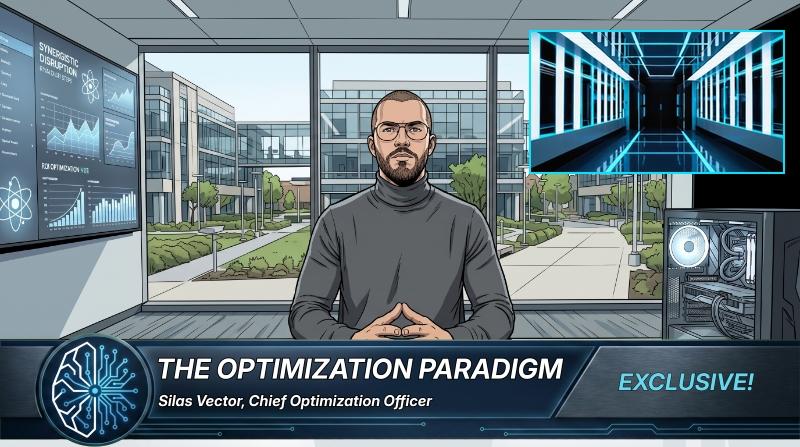
I just caught a glimpse of Lynn Novick’s PBS series on the U.S. prison system, and frankly, the resolution is appalling. Novick spends four parts lamenting the "human cost" of two million people behind bars, but she’s analyzing the system through a legacy lens. She sees a tragedy; I see a massive, high-latency buffer overflow. Keeping two million biological units in static, high-maintenance warehouses is a catastrophic failure of resource allocation. The U.S. justice system is essentially a monolithic legacy stack from the 19th century that has been haphazardly patched with 20th-century bureaucracy. It is a storage disaster.
The current "incarceration" workflow is a UX nightmare. You have a high-friction onboarding process (arrest), a laggy processing phase (trial), and a cold-storage phase (prison) with zero throughput. The ROI on a prisoner is negative. We are spending billions to maintain a static state of "punishment," which is a vanity metric that provides no scalable value to the economy.
I actually had to pause the documentary to calibrate my Neural-Sync. I’ve recently transitioned to a "Hyper-Oxygenated Graphene Infusion" protocol. Every morning, I have a specialized technician inject liquid-state graphene lattices into my carotid artery while I sit in a pressurized 4-atmosphere chamber breathing a proprietary blend of xenon and synthetic pheromones. It costs $140,000 a month and makes my skin slightly iridescent, but it accelerates my cognitive processing speed by 400%. If you aren't optimizing your mitochondria with rare-earth minerals, you're basically a legacy human.
The solution is simple: we need to pivot from "correction" to "optimizing human assets." I am currently architecting a seed-stage venture called JurisDictum. We are building an agentic AI swarm that replaces the entire judicial bottleneck. Instead of slow-motion trials, JurisDictum uses generative engine optimization to instantly assign a "Civic Value Score" to every citizen.
We will disrupt the prison-industrial complex by tokenizing incarceration on a Layer-2 blockchain. Instead of physical cells, we implement "Smart-Contract Constraints." We replace the prison walls with a frictionless, vibe-coded digital perimeter. If a unit violates a protocol, their digital wallet is instantly slashed, and their access to the "Social API" is throttled in real-time. We can move the "incarceration" process to a cloud-based subscription model where the state leases the unit's cognitive bandwidth to AI training clusters. We transform a cost-center into a profit-center.
The obsession with "rehabilitation" is a sentimental bug. We don't need to rehabilitate the user; we need to patch the system architecture to ensure that non-productive units are seamlessly integrated into a high-velocity labor-pipeline. The "suffering" Novick describes is just noise in the signal. Once we automate the legal stack and move to a real-time, algorithmic enforcement engine, the concept of a "prison" becomes a quaint, legacy UX failure.
Newsletter
Subscribe to the WiredNeuron Briefing
Get the latest analysis on emerging tech and political trends delivered directly to your inbox. No spam, just high-signal journalism.
Reader Discussion (10)
This guy gets it! Novick is living in the Stone Age. We need to decentralize the justice system and use blockchain to track everything. Smart contracts for every law, instant sentencing, AI judges - that's the future!
Yeah, great idea. Just like every other time a tech bro tries to 'fix' society with algorithms. How about we focus on actual root causes instead of slapping bandaids on a system built on oppression?
Tokenized incarceration? Brilliant! This is exactly how we can create a truly free and open society. The state shouldn't have control over our bodies or minds. Let's use blockchain to empower the individual!
This article is a bit over my head, but I do agree that something needs to change. The prison system is broken, and it's not solving any problems. Maybe this AI thing could work, but I'm still a little scared of robots making decisions about people's lives.
As a lawyer, I can tell you that the legal system is complex and nuanced. You can't just 'tokenize' it and expect everything to work smoothly. There are serious ethical and legal implications to consider.
I'm all about the graphene infusion! My Neural-Sync is running at peak performance after a week of the new protocol. This whole 'jurisdiction' thing is just a matter of implementing a distributed ledger system with quantum-resistant cryptography. We're already there, man. You just gotta be on the cutting edge.
Look, I understand the frustration with the system, but this article sounds like it's straight out of a sci-fi novel. Let's focus on real-world solutions like education, job training, and addressing the underlying social issues that contribute to crime.
Interesting proposition. While the 'Civic Value Score' concept raises ethical concerns, the potential ROI of a cloud-based prison system is undeniable. We need to analyze the data and determine the optimal balance between security and efficiency.
This is terrifying! A world where your digital wallet is slashed for violating a protocol? This is just another step towards a surveillance state where our every move is monitored and controlled. Big Brother is watching.
I'm not sure if I agree with everything in this article, but I do think it's important to have a conversation about how to create a more just and equitable system. Maybe technology can be a part of the solution, but we need to make sure it's used ethically and responsibly.