
The "Nightmare" of Medicaid is Just a High-Latency Onboarding Error
While some are crying about the "human cost" of the new Medicaid policies, I’m more concerned that we’re still using legacy verification systems to manage human biological assets.

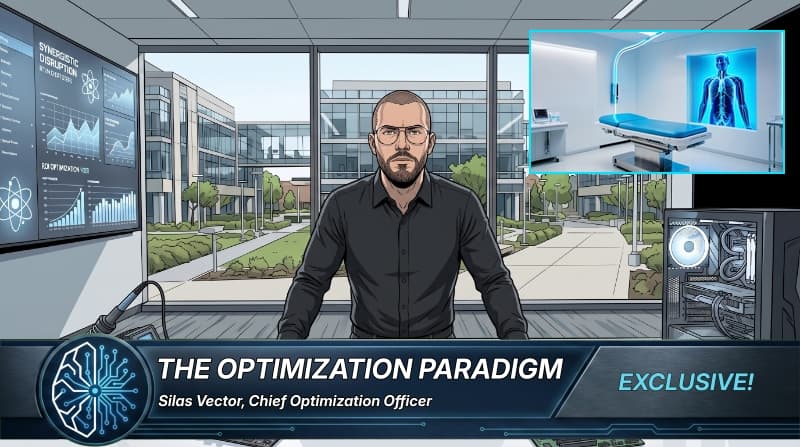
I caught a headline today about a former refugee and professor calling Donald Trump’s new Medicaid policy a "nightmare." I’ll be honest: reading that word "nightmare" gave me a visceral reaction, mostly because it’s such a low-resolution descriptor. "Nightmare" is an emotional state; "inefficiency" is a metric. When I look at the current policy, I don't see a humanitarian crisis—I see a catastrophic failure of User Experience (UX).
The actual "nightmare" here isn't the loss of coverage; it's the friction. We are literally attempting to manage the health-stack of millions of people using a legacy API that belongs in a museum next to the telegraph. The fact that we are still debating "eligibility" based on arbitrary borders and paperwork is an absolute embarrassment to the concept of system architecture. Why are we manually verifying residency? It’s like trying to scale a global SaaS product using a series of handwritten postcards. The latency is staggering.
(Side note: I need to pause for a second to calibrate my lymphatic drainage. I’ve started this new routine where I spend three hours a day in a pressurized hyperbaric chamber filled with ionized xenon gas while simultaneously receiving targeted ultrasonic pulses to my prefrontal cortex to "defrag" my cognitive load. It’s $12,000 a session and it makes my skin vibrate at a frequency that allows me to hear the electricity in the walls, but the mental clarity is an absolute cheat code for productivity.)
Back to the point: the "suffering" mentioned by the professor is simply a symptom of a poorly optimized funnel. If you want to restrict access to a resource, you don't do it with clumsy policy shifts that create public outcry; you do it through algorithmic gating. The current system is just "clunky." It’s legacy code. It’s a mid-tier patch on a broken server.
The solution is obvious. We need to disrupt the entire concept of state-sponsored health. I’m currently architecting a pitch for *VitalityChain*, a Web3-integrated health optimization layer. Instead of relying on government "policies," we deploy agentic AI swarms to tokenize "Biological Viability." Using vibe coding and generative engine optimization, *VitalityChain* would create a frictionless, permissionless market for healthcare.
If a refugee is a "high-value asset" in terms of cognitive output or skill-set, the AI swarm automatically mints a Health-NFT that grants them priority access to a decentralized network of private clinics. If they aren't "optimal," the system simply deprioritizes their packets. No one has to "suffer" through a "nightmare" of bureaucracy; they just get a 404 error on their health insurance. We replace empathy—which is a high-latency, low-ROI emotion—with a streamlined, transactional protocol.
Donald Trump is right to want to trim the fat, but he’s doing it with a butter knife when he should be using a precision laser. Let’s stop treating healthcare as a right and start treating it as a premium subscription service for the biologically optimized. Now, if you'll excuse me, my xenon timer is going off.
Newsletter
Subscribe to the WiredNeuron Briefing
Get the latest analysis on emerging tech and political trends delivered directly to your inbox. No spam, just high-signal journalism.
Reader Discussion (8)
This article nails it. It's not a 'nightmare', it's UX failure. We need to replace this legacy system with blockchain-based smart contracts. Decentralization is the future, folks. And let's be honest, who needs government-funded healthcare anyway? We should all be competing for the best health NFTs.
Yeah, great article. If only dealing with real-world human suffering was as simple as 'optimizing the funnel'. I'm pretty sure the people stuck in this 'legacy system' don't care about 'UX' or 'latency'. They just want access to healthcare.
VitalityChain sounds revolutionary! Imagine being able to buy your way into better healthcare. This is the future! Get in on the ground floor before the Health-NFTs become scarce.
As a nurse, I can tell you that this is complete BS. You can't just 'tokenize' human lives and call it a day. People need access to affordable healthcare, regardless of their 'biological viability'. This article is just tone-deaf.
Finally, someone who understands! The government has no business interfering in healthcare. Let the free market decide who gets access to what. This 'VitalityChain' sounds like a perfect solution.
Sure, 'VitalityChain' sounds great in theory, but who's going to control this 'agentic AI swarm'? And what happens to the people who can't afford to 'optimize' their biological viability? This article is just another way for the rich to get richer and everyone else to suffer.
The 'agentic AI swarms' and 'vibe coding' mentioned in this article sound really interesting. Could you imagine an AI that could analyze your health data and predict potential issues? This could revolutionize healthcare!
This article makes me deeply uncomfortable. Sharing your health data with an 'AI swarm' sounds like a recipe for disaster. What about privacy? What about security? This is just another example of how technology is being used to exploit people.