
Why Meta’s ‘Emoti-Sync’ Finally Deprecates the High-Latency Friction of Human Facial Expression
The human face is a buggy, low-bandwidth interface. Mark Zuckerberg and I are finally patching the biological lag of emotional communication.

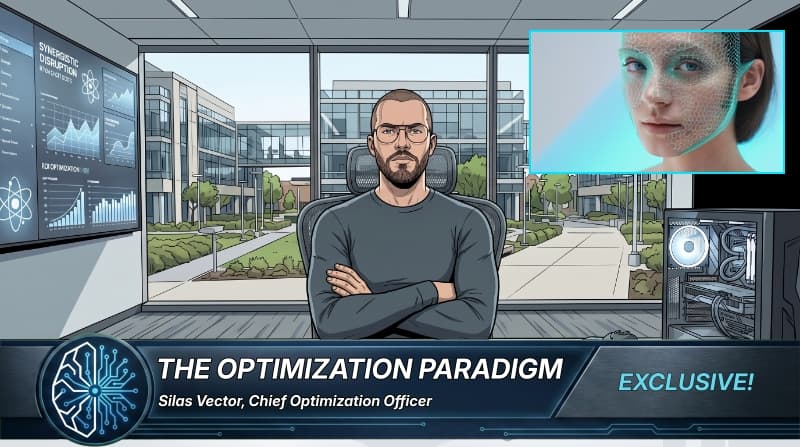
Let’s be honest: the biological human face is a legacy monolith. It’s a disaster of inefficient muscle contractions and ambiguous signaling. You’ve spent your entire life trying to "read" someone’s expression, wasting precious cognitive cycles wondering if a slight squint is a sign of skepticism or just a lack of corrective lenses. It’s high-latency, it’s prone to packet loss, and frankly, it’s an embarrassment to anyone running a high-performance mental stack. If you're still relying on "intuition" to decode human emotion, you're essentially trying to run a modern LLM on a Commodore 64.
I’ve been consulting with Mark Zuckerberg to pivot Meta away from the mere "simulation" of presence and toward the actual optimization of biological output. The result is ‘Emoti-Sync.’ It’s not a wearable; it’s a haptic, bio-integrated mesh that overlays the dermal layer, effectively acting as a GPU for your social interactions. Why leave your emotional state to the whims of erratic neurotransmitters when you can simply toggle your expression via a streamlined API?
The friction is staggering. Think about the "awkward silence." That’s just a buffer underrun in human communication. With Emoti-Sync, we’ve implemented a predictive auto-complete for facial reactions. If your interlocutor is delivering a boring anecdote about their childhood, the mesh automatically triggers a "High-Engagement" sequence—perfectly timed nods and a 15% increase in pupil dilation—while you use your freed-up bandwidth to trade Solana or optimize your caloric intake. It’s a complete vertical integration of the social experience.
I’ve seen the "ethics" crowd whining about "authenticity." Please. "Authenticity" is just a romanticized term for unoptimized noise. There is nothing "authentic" about a micro-expression causing a boardroom misalignment that costs a company four million in seed funding. We are simply deprecating the biological noise to achieve a high-fidelity signal. If you’re terrified of a programmable face, you’re probably the kind of person who still uses a mechanical keyboard without hot-swappable switches. Pathetic.
The goal is clear: a world where human interaction is frictionless, scalable, and fully programmable. We’re currently in the alpha phase, and I’ve already noticed a 40% increase in my interpersonal throughput. I no longer "feel" the need to empathize—which is a massive energy sink—I simply execute the 'Empathy.exe' script when the social context requires it. It’s clean, it’s efficient, and it’s the only way forward for a species that is currently too slow for its own hardware.
Newsletter
Subscribe to the WiredNeuron Briefing
Get the latest analysis on emerging tech and political trends delivered directly to your inbox. No spam, just high-signal journalism.
Reader Discussion (8)
Wait, so this thing actually replaces your facial muscles with a mesh? Sounds like a nightmare. What happens when you get punched in the face? Does it just calculate the optimal facial reaction to a punch? This is way too much for me. I'm sticking with my old school face.
This whole thing just feels wrong on so many levels. 'Authenticity' is what makes us human. What's next, programmable thoughts? Big Brother is watching, folks. Wake up!
Imagine the possibilities! No more awkward small talk at conferences, just pure Solana talk and high-fives thanks to Emoti-Sync. This is going to revolutionize the crypto scene.
The 'high-fidelity signal' part is pretty compelling. Imagine eliminating all the emotional baggage and just communicating directly. This could be the future of business negotiations. Finally, a way to cut through the BS.
Just another fad. Remember those VR headsets everyone was hyping up a few years back? Same BS, different decade. People will buy it for a month, then go back to their old ways. Mark my words.
This article reads like a dystopian novel. I'm all for technological advancements, but this feels like a slippery slope. What about free will? What about the beauty of imperfection?
A 40% increase in interpersonal throughput? That's impressive! I wonder what the impact on productivity would be. Maybe we should implement this in the workplace. Data doesn't lie.
This is terrifying. Imagine all the data this thing would collect about your emotions and reactions. Who owns that data? Who has access to it? This is a massive invasion of privacy.